
Effective Plaque Removal at Home: Step-by-Step Guide
Brushing harder won't save your smile if you're missing the spots that actually matter. Most of us have felt that familiar frustration. You brush for the full two minutes, yet your gums still bleed or your back molars feel permanently fuzzy. It's a common struggle because traditional, straight toothbrushes often fail to reach the hidden zones where bacteria thrive. Achieving effective plaque removal at home isn't about the force you use. It's about the precision of your technique and the innovation behind your tools.
You deserve a daily routine that provides total confidence rather than lingering guesswork. In this guide, you'll master the specific techniques and tools needed to eliminate stubborn plaque from those difficult, hard-to-reach areas. We're breaking down a clear, repeatable brushing routine that prioritizes your gumline and those tricky back molars.
You'll discover which toothbrush features actually impact your health and how to transform your habits for healthier gums and a brighter smile. It's time to stop guessing and start protecting your whole-body health through better oral care. Let's move beyond basic brushing and start focusing on real prevention.
Key Takeaways
- Identify the three "hidden zones" where bacteria hide and why traditional straight brushes often fail to reach them.
- Master the specific techniques required for effective plaque removal at home by targeting the gumline and hard-to-reach back molars.
- Discover why sonic technology and soft bristles are the superior choice for disrupting bacterial biofilms without irritating sensitive gums.
- Implement a structured two-minute routine that divides your mouth into quadrants for total, consistent coverage.
- Commit to a 90-day brush head replacement schedule to maintain precision and keep your routine hygienic.
Understanding Dental Plaque and the Oral-Systemic Connection
Plaque is a relentless, sticky film of bacteria that never stops forming on your teeth. It is a living biofilm that clings to your enamel and hides along the gumline. Understanding Dental Plaque is the first step toward a healthier mouth. When you skip a spot, this soft film begins to mineralize into tartar, also known as dental calculus. Once tartar forms, your toothbrush cannot touch it. Only a professional dental cleaning can scrape it away. This makes effective plaque removal at home your most important daily defense against long-term damage. Prevention is not a twice-yearly event; it is a choice you make every morning and night.
The Role of Biofilm in Gum Inflammation
Bacteria in plaque are active organisms. They consume the sugars from your diet and release acidic byproducts that irritate your gum tissue. This irritation leads to periodontal inflammation, also known as gum inflammation, where the tissues supporting your teeth become red and swollen. You might notice your gums feeling tender or bleeding occasionally during brushing. These are not just minor annoyances. They are clear signals from your body that bacteria are winning. Consistent, preventative care is your first line of defense. By disrupting the biofilm every twelve hours, you prevent the chronic irritation that leads to gum recession and bone loss. It is about maintaining a clean environment before problems have a chance to take root.
Why Your Mouth is a Gateway to Overall Health
Your oral health does not stay in your mouth. Research suggests that the bacteria and inflammation associated with gum disease may be linked to systemic health issues. Studies have found an association between poor oral hygiene and conditions like heart disease and diabetes. While scientists are still investigating the exact relationship, the connection is strong enough to treat your mouth as a gateway to whole-body well-being. Using advanced tools like the Y-angled sonic toothbrush allows you to reach the back molars and gumline with clinical precision. Brushing is not just a chore; it is a vital part of your holistic health routine. When you prioritize effective plaque removal at home, you are taking a proactive step toward a healthier life. Your mouth is the starting point for your body's overall wellness.
Identifying the 'Hidden Zones': Where Plaque Accumulates Most
Most of us brush the teeth we see in the mirror. It's a natural instinct, but it’s also where the least amount of plaque actually hides. True effective plaque removal at home requires a shift in focus toward the "hidden zones" where bacteria thrive undisturbed. These areas include the gumline, the tight spaces between your teeth, and the often ignored surfaces of your back molars. Visible surfaces are rarely where the real problems start. Decay and inflammation usually begin in the shadows where standard tools fail to reach.
Traditional straight toothbrushes are designed for flat surfaces. Your mouth, however, is a complex series of curves and tight corners. When you use a straight brush, the handle often hits your front teeth or cheek before the bristles can reach the curvature of the dental arch. This creates a "blind spot" behind the last molars where decay frequently begins. If you aren't reaching these zones, you aren't truly cleaning your mouth. You're simply polishing the surfaces that are already the easiest to keep clean.
The Difficulty of Back Molar Access
Your jaw hinge presents a significant physical barrier. When you open wide, the space between your molars and your cheek actually narrows, making it nearly impossible to fit a standard, bulky brush head into the very back. This "reach" problem is why many people find their back teeth never feel quite clean even after a long brushing session. An angled head bypasses these obstructions by following the natural contour of your jaw. It allows the bristles to wrap around the back of the last molar, disrupting the biofilm that straight brushes simply skip.
The Vulnerable Gumline
The gingival margin, or gumline, is perhaps the most critical area for your long-term health. Plaque doesn't just sit on the tooth; it migrates into the small space between the tooth and the gum tissue. This leads to a "pocketing" effect where bacteria hide just beneath the surface, triggering inflammation and bleeding. To manage this, you need to understand why use an angled toothbrush for better access to these delicate margins.
While brushing at a 45-degree angle is essential, you also need to know how to floss correctly to clear the interdental spaces that no brush can reach. Combining these habits ensures that effective plaque removal at home covers every millimeter of your mouth. If you’re struggling with those hard-to-reach spots, switching to a precision angled sonic toothbrush can provide the reach you’ve been missing.
Selecting the Best Tools for Effective Plaque Removal
Most people assume that the harder they scrub, the cleaner their teeth become. This is a common misconception that often leads to damaged enamel and receding gums. Achieving effective plaque removal at home isn't about the force you apply; it's about the mechanical disruption of the bacterial biofilm. To do this safely, you must prioritize tools with soft bristles. Hard or medium bristles are too abrasive for daily use and can create microscopic scratches on your teeth where bacteria love to hide. Precision in design and optimal vibration frequency are far more critical than forceful scrubbing.
Modern oral care has evolved beyond the simple plastic handle. We now have access to precision-engineered tools that treat gum health as a priority. Choosing the right device means looking for innovation that simplifies your routine while protecting your sensitive tissues. When your tools are designed for the human mouth's actual shape, you don't have to fight against them to get results.
Sonic Technology vs. Manual Brushing
Manual brushing relies entirely on your physical movement and dexterity. It's easy to miss spots or use inconsistent pressure. Sonic technology changes the equation by using high-frequency vibrations to disrupt plaque. These vibrations create "fluid dynamics," a process where the motion of water and toothpaste reaches beyond the physical tips of the bristles. This allows for a deeper clean in the tight spaces between teeth that a manual brush simply can't touch.
For health-conscious users, the type of technology matters. Certain electric toothbrush designs may emit electromagnetic fields (EMF) close to the brain. Choosing an EMF-free sonic toothbrush provides a safe, high-tech option that aligns with a non-toxic lifestyle. It offers the power of sonic disruption without the unnecessary exposure to radiation, making it a smart choice for a holistic health routine.
The Advantage of an Angled Brush Head
Dentists have long recommended the "45-degree rule" for optimal cleaning. This technique involves angling the bristles toward the gumline to clear away the plaque that hides just under the edge of the tissue. Achieving this with a traditional straight toothbrush is awkward and requires constant wrist adjustment. Most people eventually give up and revert to a flat, less effective angle.
A pre-angled brush head makes this ideal position intuitive and effortless. By using a tool like the Y-angled sonic toothbrush, you can maintain the perfect angle even in the back of your mouth. This precision reduces the need for "aggressive" brushing. When your tool is designed to fit the curvature of your dental arch, effective plaque removal at home becomes a natural part of your morning, not a physical challenge. Precision always beats power when it comes to long-term gum health.
A Step-by-Step Routine for Total Plaque Removal at Home
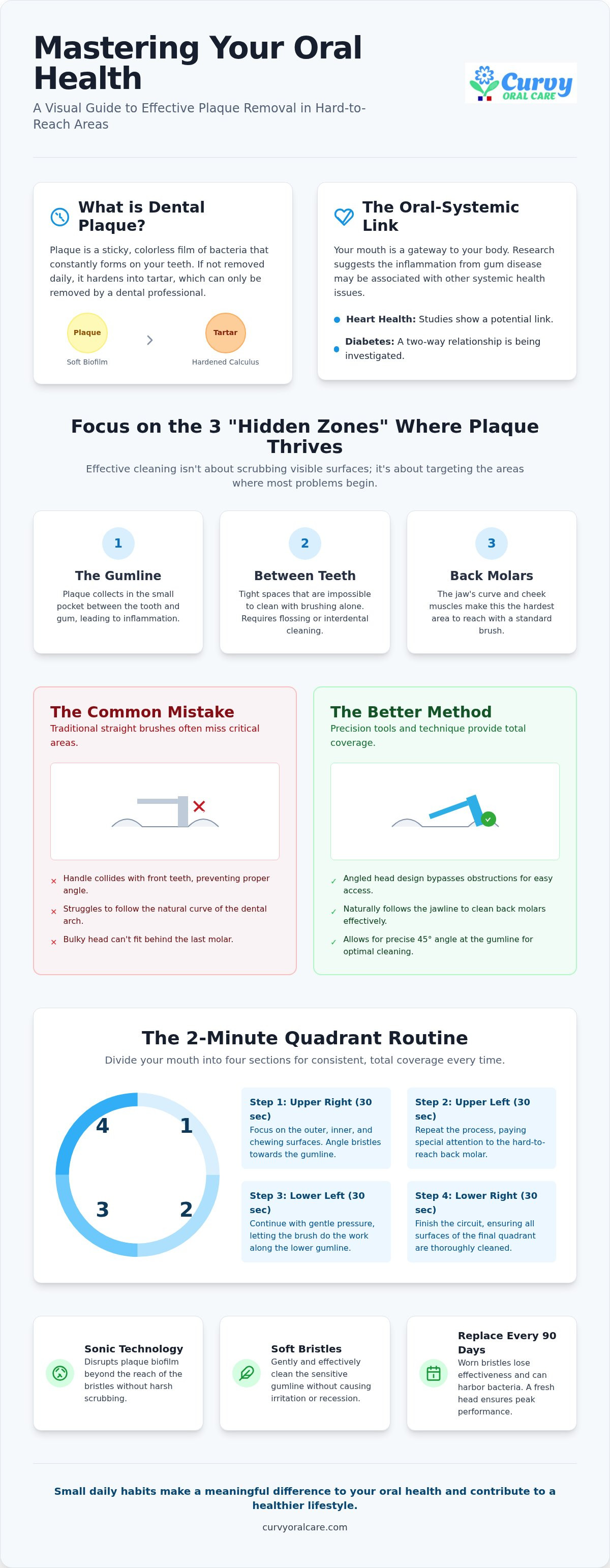
Brushing your teeth isn't a race; it's a methodical process of decontaminating your mouth. To achieve effective plaque removal at home, you must commit to a full two minutes of focused cleaning. Most people stop after less than a minute, leaving behind massive colonies of bacteria in the corners of their mouth. By dividing your mouth into four quadrants, including the upper right, upper left, lower right, and lower left, you ensure that no tooth is neglected. Dedicate thirty seconds to each quadrant to maintain a consistent, high standard of hygiene every single day.
A comprehensive routine doesn't stop at the visible surfaces. You must prioritize the gumline and the hidden back surfaces where plaque mineralization begins. Combining this structured brushing with daily interdental cleaning creates a defensive barrier that protects your gums from chronic inflammation. Precision is the difference between a healthy smile and a series of expensive dental visits. It is the small, daily choices that prevent long-term issues.
The 45-Degree Brushing Technique
Begin by positioning your bristles correctly. Instead of pressing the brush flat against your teeth, angle the bristles toward the gumline at a 45-degree angle. This allows the bristles to reach slightly under the gum tissue where bacteria hide. If you feel the bristles against your gums, you're doing it right. This position is essential for disrupting the biofilm that causes irritation.
Next, focus on your motion. Use small, gentle circular movements to break up the plaque. Aggressive scrubbing can cause gum recession and wear down your enamel. If you are using a sonic brush, let the high-frequency vibrations do the work for you. Your job is simply to guide the tool along the dental arch with light pressure. Let the technology handle the mechanical disruption.
Every tooth surface requires specific attention. You must clean the outer surfaces, the inner surfaces near your tongue, and the chewing surfaces of every tooth. Skipping the inside surfaces is a common mistake that leads to tartar buildup behind the front teeth. Consistency across all surfaces ensures that bacteria have nowhere to hide and multiply.
Mastering the Back Molars
Navigating the tightest spaces in the mouth requires specialized access. The area behind your last molars is the most difficult to reach with a standard brush. Use the Y Angled Sonic Toothbrush to easily access these blind spots. The angled head allows you to wrap around the back of the tooth without hitting your jaw hinge or cheek. This reach is vital for preventing decay in the very back of the mouth.
Vertical surfaces also need a specific approach to be truly clean. For the inside of your front teeth, tilt the brush vertically. Use several gentle up-and-down strokes to clear the plaque that often accumulates in these narrow areas. This technique ensures the bristles make full contact with the entire length of the tooth. It addresses the curvature that horizontal brushing often misses.
Finalize your routine by addressing your tongue. Bacteria thrive on the rough surface of your tongue and can quickly migrate back to your clean teeth. A gentle sweep from back to front removes these lingering colonies and keeps your breath fresh. For the best results, upgrade your routine with a precision angled sonic toothbrush that reaches every corner of your mouth effortlessly.
Maintaining Your Routine for Long-Term Gum Health
Consistency is the final piece of the puzzle. You've learned the techniques and selected the right tools, but your results depend on the long-term integrity of your routine. Achieving effective plaque removal at home is not a one-time achievement; it is a daily commitment to precision. If you let your habits slip or your tools degrade, bacteria will quickly reclaim the "hidden zones" you’ve worked so hard to protect. Maintaining your oral health requires a proactive mindset that looks beyond the bathroom mirror.
Your mouth is a dynamic environment that reacts to everything from your stress levels to your hydration. By treating your oral care as a vital part of your whole-body wellness, you create a foundation for health that lasts a lifetime. This means paying attention to the details that most people ignore, such as the condition of their equipment and the balance of their internal chemistry.
The Importance of Fresh Bristles
Dental professionals recommend replacing your brush head every 3 months for a specific mechanical reason. Over ninety days of use, bristles lose their structural integrity and begin to fray. Once they lose their stiffness, they can no longer effectively disrupt the sticky bacterial biofilm. Instead of cleaning, they simply slide over the plaque, leaving the most dangerous deposits behind. Frayed bristles also harbor bacteria in microscopic cracks, which can reintroduce contaminants to your mouth during every session.
Don't wait for your brush to look worn out before you act. By the time you see visible damage, the bristles have already lost their efficiency. Many users find that a subscription service is the best way to automate this maintenance. It removes the guesswork and ensures you always have a precision tool ready for use. Remember, a fresh brush head is essential for the effective plaque removal at home we aim for.
Beyond Brushing: A Holistic Approach
Brushing is your primary defense, but it shouldn't be your only one. Your diet and hydration levels directly impact your oral pH balance. Drinking water throughout the day helps maintain a healthy flow of saliva, which is your body's natural way of neutralizing plaque acids and washing away food debris. A diet low in processed sugars further limits the fuel available to harmful bacteria, making your effective plaque removal at home much easier to manage.
Finally, remember that home care is a partnership with your dental professional. Regular checkups are necessary to monitor your progress and catch potential issues before they escalate into systemic problems. Use these visits to refine your technique and get professional feedback on your gum health. Small, consistent habits today build the foundation for a lifetime of health. By staying disciplined with your routine and your tool maintenance, you’re choosing a future of confidence and well-being.
Take Control of Your Oral Health Journey
Mastering effective plaque removal at home is the most impactful step you can take for your long-term well-being. By shifting your focus from aggressive scrubbing to precision angles, you protect your enamel while eliminating bacteria in the hidden zones that traditional brushes often skip. Your mouth is the gateway to your systemic health. Reaching those back molars and the delicate gumline is not just about a brighter smile; it is about proactive prevention for your entire body.
You no longer have to struggle with awkward angles or outdated tools. This technology was designed by oral health experts to make the 45-degree technique intuitive and effortless. With a patented Y-angled head for precision and EMF-free technology for safe daily use, you can clean with total confidence every day. Upgrade your routine with the Y-Angled Sonic Toothbrush for total plaque removal and experience the satisfaction of a truly clean mouth. Your future self will thank you for the small, consistent habits you start today.
Health & Medical Disclaimer: This content is for educational purposes only and does not constitute medical advice, diagnosis, or treatment. Always seek the advice of your dentist or other qualified health provider with any questions you have regarding a dental or medical condition. Do not ignore professional advice or delay seeking it because of something you have read here. If you experience persistent bleeding gums, swelling, pain, or significant changes in your oral health, consult a dental professional immediately.
Frequently Asked Questions
How can I tell if I've removed all the plaque at home?
Your tongue is your most reliable tool for a quick assessment. Run it over every surface of your teeth; they should feel as smooth as polished glass. If any area feels "fuzzy" or rough, plaque is still present. For a visual check, you can use plaque disclosing tablets. These contain a harmless dye that stains remaining biofilm, showing you exactly where your technique needs improvement.
Is an electric toothbrush really better for plaque removal than a manual one?
Sonic technology is significantly more efficient at disrupting bacterial biofilm than manual brushing. While a manual brush relies entirely on your hand speed and dexterity, sonic vibrations create thousands of strokes per minute. This motion generates fluid dynamics that reach beyond the bristle tips. Using a high-quality device is a cornerstone of effective plaque removal at home, as it compensates for human error.
Why do my gums bleed even when I brush regularly?
Bleeding is typically a sign of localized inflammation caused by plaque left behind along the gumline. Even if you brush twice a day, you might be missing the gingival margin where bacteria hide. If your brush doesn't reach a 45-degree angle, the biofilm remains undisturbed and irritates the tissue. Consistent cleaning of these "hidden zones" will typically reduce inflammation and stop the bleeding within weeks.
What is the best technique for cleaning the very back molars?
Accessing the back molars requires a combination of the right tool and proper jaw positioning. Try closing your mouth slightly while brushing to relax your cheek muscles, which provides more room for the brush head. Using a patented Y-angled head allows you to reach behind the last molar without hitting your jaw hinge. This geometry ensures the bristles wrap around the back surface, clearing away stubborn plaque.
Does fluoride-free toothpaste still help with plaque removal?
Yes, the mechanical action of brushing is the primary driver for removing plaque. Toothpaste acts as a lubricant and a mild abrasive to help break up the sticky biofilm. While fluoride is used to strengthen enamel, fluoride-free options still contribute to effective plaque removal at home by assisting the bristles in scrubbing away bacteria. The most important factor remains your brushing technique and reaching every single tooth surface.
How often should I really be replacing my toothbrush head for maximum effectiveness?
You should replace your brush head every three months to maintain peak performance. Over time, bristles become frayed and lose the stiffness required to disrupt plaque effectively. Worn bristles also develop microscopic tears that can harbor bacteria. If you have recently been ill, it is a smart habit to swap for a fresh head immediately to avoid reintroducing germs. A subscription model can help automate this maintenance.
Can plaque be removed once it has turned into tartar?
No, once plaque mineralizes into tartar, or calculus, it cannot be removed with a toothbrush at home. Tartar bonds strongly to the tooth enamel and requires professional scaling by a dentist or hygienist using specialized tools. This is why daily prevention is so critical. By disrupting the soft plaque biofilm every twelve hours, you prevent it from hardening into the stubborn deposits that lead to gum disease.
What are the early warning signs of gum disease I should watch for?
Early warning signs, often called gingivitis, include gums that are puffy, dusky red, or bleed easily during brushing and flossing. You might also notice persistent bad breath or a metallic taste in your mouth. These symptoms indicate that bacteria are triggering an inflammatory response. Catching these signs early allows you to reverse the damage through improved daily habits and professional care before the condition progresses into serious periodontal disease.

Article by
Aline Peixe Nebot
Aline Peixe Nebot is a Veterinarian and passionate advocate for better oral health, committed to raising awareness of oral health as a matter of public health. She actively promotes the importance of simple, effective oral care routines and works to educate the public about the often-overlooked link between oral health and overall systemic health. Her mission is to make better oral care knowledge accessible to everyone and encourage healthier habits for life.
Disclaimer
Disclaimer: The information provided in this article is intended for general educational and informational purposes only. It is not intended to replace professional medical, dental, or healthcare advice, diagnosis, or treatment.
Some content may be AI-assisted and is provided to support health education and awareness. While we strive to share accurate and up-to-date information, health recommendations and scientific evidence can evolve, and the information presented may not apply to every individual.
The connection between oral health and overall systemic health is an important and developing area of research. Associations discussed in this article should not necessarily be interpreted as proof of cause and effect.
Always consult a qualified dentist, physician, or other healthcare professional regarding your individual health, symptoms, medications, or treatment decisions. Do not delay or discontinue professional care based on information presented in this article.
This content is for education and awareness—not diagnosis or treatment.