

Why Use an Angled Toothbrush? The Science of Reaching Every Surface
What if the tool you use every morning is fundamentally designed for a mouth that doesn't exist? Most people assume their teeth are a flat surface, but your mouth is a complex landscape of curves and tight corners. If you've struggled with bleeding gums or persistent plaque despite brushing twice a day, you might wonder why use an angled toothbrush when straight handles have been the norm for so long. It's frustrating to put in the effort and still receive a disappointing report from your dentist.
The answer lies in the geometry of reach. A straight brush often skips over the very areas where bacteria thrive, particularly around your back molars and along the delicate gumline. We'll explore the science of better access and show you how a simple shift in design can transform your oral hygiene. You'll discover how reaching every surface doesn't just lead to a cleaner mouth feel; it supports your long-term well-being by disrupting plaque before it can trigger inflammation.
Key Takeaways
- Straight brushes are a legacy of manufacturing ease rather than biological design. Learn why use an angled toothbrush to navigate the natural 3D curves of your dental arch with precision.
- Reaching the ideal 45-degree angle at the gumline is challenging with a standard handle. An angled head naturally aligns bristles to clear away plaque from the spaces where it accumulates most.
- Your mouth is the gateway to your body. Research suggests an association between gum health and systemic well-being, making precision cleaning an essential part of your holistic health routine.
- Mastering specific techniques like the "molar maneuver" ensures your back teeth receive the same care as your smile. These often-neglected areas are where most dental issues begin.
- Modern oral care combines patented geometry with EMF-free sonic technology. This approach provides a high-tech clean that prioritizes both efficiency and a non-toxic lifestyle.
The Geometry of a Healthy Mouth: Why Straight Brushes Fall Short
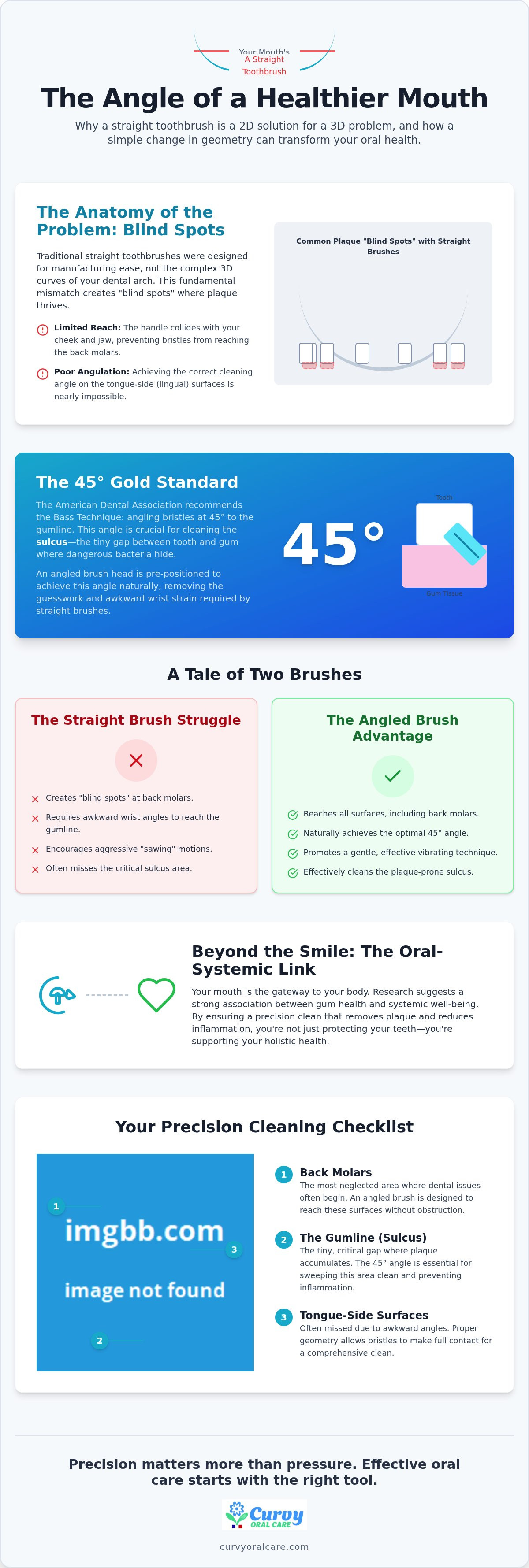
The human mouth is a masterpiece of complex curves, yet for centuries, we've cleaned it with a tool that resembles a simple ruler. A straight toothbrush is a 2D solution for a 3D problem. It ignores the biological reality that your teeth are arranged in a dental arch, a shape that requires a tool capable of wrapping around corners. An angled toothbrush is specifically engineered to mirror these natural contours. It moves away from the "straight-stick" design, which is a legacy of manufacturing ease rather than biological optimization. Factories found it cheaper to produce straight handles, but your mouth isn't built for factory convenience.
The Problem with "Blind Spots" in Oral Care
Traditional brushes face a physical barrier: your own anatomy. When you try to reach the very back of your mouth, your cheek and jawbone limit the movement of a straight handle. This creates a mechanical conflict where the handle hits your teeth or skin before the bristles can reach the target. Because of this, most plaque is left behind on the very last molars and the lingual, or tongue-side, surfaces of the teeth. Blind spots are areas where traditional brushes cannot maintain bristle-to-tooth contact due to physical obstruction. These zones become breeding grounds for bacteria, leading to inflammation and eventual gum disease if they aren't addressed with better tools.
Anatomy vs. Industry: A Brief History
Looking at the history of toothbrush design, it's clear that early iterations prioritized basic friction over precision. Early brushes were flat and rigid, designed for a time when we understood far less about the microscopic mechanics of plaque. We now know that the mouth is a series of intricate curves, not a flat surface. Ergonomic evolution is finally catching up to dental science, shifting the focus from "brushing more" to "brushing better."
Understanding why use an angled toothbrush involves recognizing that precision matters more than pressure. Modern designs, like the Y-angled sonic toothbrush, prioritize access to the gumline and the distal surfaces of the back molars. By changing the geometry of the tool, we eliminate the physical struggle of reaching the corners of the mouth. This simple shift in design ensures that your daily routine is as efficient as it is effective.
The 45-Degree Advantage: Biomechanics of Effective Brushing
Brushing your teeth is a mechanical process, but most people perform it with a tool that fights against their own anatomy. The gold standard for oral hygiene is the Bass Technique. This method requires you to tilt the bristles at a specific 45-degree angle toward the gumline to disrupt plaque where it's most dangerous. One primary reason why use an angled toothbrush is that it removes the physical struggle of maintaining this precise position. While a straight handle forces your wrist into awkward, strained angles, a pre-angled head does the work for you. It ensures the bristles sit exactly where they need to be to protect your long-term health.
The American Dental Association brushing recommendations highlight the importance of cleaning the sulcus. This tiny space between your tooth and the gum tissue is a primary hiding spot for bacteria. When you use a straight brush, you often miss this gap because the handle hits your teeth or lips before the bristles can tilt correctly. This leads to hidden plaque accumulation and eventual inflammation. An angled design provides the clearance needed to sweep the sulcus clean without the need for gymnastic wrist movements.
Facilitating the Bass Technique
Effective brushing relies on gentle vibration rather than aggressive scrubbing. When people use straight brushes, they often over-brush or use a "sawing" motion to compensate for poor access. This aggressive habit can lead to accidental gum recession and enamel wear. Because an angled brush naturally aligns with the gumline, you can focus on small, circular vibrations that break up biofilm efficiently. This targeted approach cleans deeper while being significantly kinder to your soft tissues.
Leverage and Pressure Control
The physics of an angled neck changes how you apply force to your teeth. A straight handle often causes users to push too hard on the front teeth while barely reaching the back. An angled neck acts as a lever, distributing pressure more evenly across the entire dental arch. It provides better tactile feedback, allowing you to feel exactly where the bristles are making contact. This increased control means you don't need to use excessive force to achieve a professional-level clean. Switching to a patented angled design removes the mechanical guesswork from your morning routine, ensuring every surface gets the attention it deserves.
Beyond the Smile: How Precision Cleaning Supports Whole-Body Health
Your mouth acts as the primary gateway to your body. It isn't an isolated system; it's a dynamic environment where oral health directly influences your general well-being. With oral diseases affecting approximately 3.5 billion people globally, the need for effective prevention has never been more urgent. When you consider why use an angled toothbrush, it's helpful to look past the cosmetic benefits. Precision cleaning is a fundamental component of preventative medicine. By accessing the "blind spots" where bacteria hide, you're doing more than preventing a cavity. You're protecting the rest of your body from the silent spread of oral bacteria.
The Inflammation Connection
Plaque accumulation along the gumline triggers an immune response known as gingivitis, or gum inflammation. This localized inflammation can have far-reaching effects on your health. In the United States, 47.2% of adults aged 30 and older have some form of periodontal disease, which is an inflammatory condition affecting the tissues that support the teeth. Research suggests an association between periodontal disease and various systemic conditions. For instance, studies have found an association between the bacteria in dental plaque and an increased risk of cardiovascular events. While research is still investigating the relationship between these factors, the consensus is that a healthy mouth supports a healthy body.
Removing plaque from the sulcus, which is the tiny space between the tooth and gum, is critical. If left undisturbed, bacteria can enter the bloodstream through inflamed tissue. An angled brush makes this removal process consistent and effective. It allows you to clean areas where traditional straight brushes fail, effectively disrupting the inflammatory cascade before it spreads. This is why precision matters. It's about maintaining a barrier that keeps your internal systems functioning at their peak.
A Proactive Approach to Longevity
View your daily oral care as a pillar of your holistic health routine. It's one of the simplest preventive actions you can take for long-term wellness. Better tools lead to more consistent habits. When a toothbrush works with your anatomy, you're more likely to use it effectively every day. This isn't just about avoiding a filling at your next dental checkup; it's about investing in your future self and your overall quality of life. Small daily habits make a meaningful difference to your long-term health.
Choosing a tool like the Y-angled sonic toothbrush ensures your hygiene routine is optimized for total-body health. It combines mechanical precision with a modern understanding of biology. By prioritizing gum health today, you're taking a proactive step toward a healthier lifestyle. Your mouth is the first line of defense. Make sure it has the right equipment to do its job effectively. Why use an angled toothbrush? Because your health depends on reaching every surface, every time.
Master Your Routine: Techniques for Hard-to-Reach Areas
Switching to a superior tool is the first step, but mastering the navigation of your dental landscape is where the real transformation happens. Most people spend the majority of their two-minute routine on the front surfaces because they're easy to see. To get the best results, flip your priority. Start with the most difficult zones first. When you understand why use an angled toothbrush, you realize it's designed to do the heavy lifting in the corners of your mouth where a straight brush simply can't perform. Focus your energy on the back molars and the tongue-side surfaces before finishing with the visible "smile" zone.
The Molar Maneuver
The very back of your wisdom tooth area is a primary site for plaque-induced inflammation. To clean this zone effectively, follow these three steps:
- Step 1: Open your mouth only slightly. Opening too wide actually tightens your cheek muscles, blocking the brush from reaching the back. Keeping a relaxed, halfway-open position gives you the clearance you need.
- Step 2: Use the natural tilt of the brush head to wrap around the distal, or rear, surface of the last molar. The angle allows the bristles to hug the back of the tooth without the handle hitting your front teeth.
- Step 3: Use small, circular vibrations. Avoid long, horizontal strokes. These tiny movements disrupt the biofilm without irritating the delicate tissue at the very back of the jaw.
Don't forget the lingual surfaces of your lower front teeth. This is where saliva pools and minerals can quickly harden plaque into tartar. Position the brush vertically and use the angled tip to reach down to the gumline on the inside of these teeth. It's a high-traffic area for bacteria that requires daily, focused attention.
Cleaning the Gumline Without Irritation
Precision cleaning is about contact, not pressure. Let the bristles do the work. If you're pressing hard enough to splay the bristles, you're actually reducing their effectiveness and risking gum recession. Use a gentle "flick" motion to sweep plaque away from the gum pocket toward the biting surface of the tooth. This ensures that bacteria are removed from the mouth rather than being pushed deeper into the sulcus.
Using a Y-angled sonic toothbrush makes this process nearly effortless. The sonic vibrations handle the disruption of plaque, while the patented angle ensures you maintain the perfect 45-degree contact without straining your wrist. If you're ready to eliminate the guesswork and reach every hidden corner of your mouth, upgrade to a precision angled sonic brush today.
The Curvy Difference: Patented Angles and EMF-Free Innovation
While the dental industry has remained stagnant for decades, Curvy Oral Care has focused on a necessary evolution. We've moved beyond the manufacturing convenience of straight handles to prioritize human biology. When you ask why use an angled toothbrush, the answer is found in our patented geometry. This design specifically targets the blind spots we identified earlier, ensuring that the back molars and the gumline are never neglected. It's a proactive approach to oral health that turns a chore into a high-tech wellness ritual. We offer manual, sonic, and kids’ versions to ensure every member of the family can maintain a preventative routine that actually works.
Why EMF-Free Matters for Your Mouth
Innovation shouldn't come at the cost of your holistic well-being. Many modern electric brushes emit high levels of electromagnetic fields (EMF) right next to your brain and jaw. We believe in a non-toxic lifestyle, which is why our sonic technology is strictly EMF-free. This commitment to low-radiation oral care provides safe vibrations that disrupt plaque without unnecessary exposure. It's about precision and peace of mind. For a deeper look at our philosophy, read The EMF-Free Sonic Toothbrush: A Complete Guide to Non-Toxic Oral Care. We've combined the power of sonic cleaning with a non-toxic design to support your whole-body health goals.
Building Better Habits with Curvy
The best tool in the world only works if it's used correctly and consistently. Our design makes the right technique feel effortless. You don't have to fight your anatomy to reach a 45-degree angle because the brush is already there. To keep your routine effective, we offer a convenient subscription model. This ensures your brush heads are always fresh and effective, as frayed bristles can't remove plaque efficiently. Remember that the American Dental Association recommends replacing your brush every three to four months. Our subscription handles the timing for you so you never have to settle for a sub-optimal clean.
Your oral health is a pillar of your overall longevity. By choosing a tool that respects the complex curves of your mouth, you're taking a definitive step toward better reports from the dentist and a healthier life. Don't let legacy designs dictate your health outcomes. It's time to experience the relief and satisfaction of a truly effective daily routine. Upgrade your routine with the Curvy angled toothbrush and see the difference that patented precision makes for your smile.
Transform Your Daily Routine with Precision Geometry
Brushing shouldn't be a struggle against your own anatomy. You've seen how the mouth's natural curves require a tool designed for 3D reach rather than 2D simplicity. By prioritizing the gumline and those difficult back molars, you're doing more than just cleaning teeth; you're supporting your body's systemic well-being. Small daily habits make a meaningful difference, and using a tool that aligns with dental science ensures those habits are effective. Understanding why use an angled toothbrush is the first step toward eliminating the blind spots where plaque and inflammation thrive.
It's time to replace legacy designs with a solution that works with you. Our patented 45-degree design and EMF-free sonic technology provide a professional clean that health-conscious families trust. Don't wait for your next dental checkup to make a change. Take a proactive step today and experience the reach of the Y-Angled Sonic Toothbrush. Your mouth is the gateway to your health, and with the right habits, you can protect it for a lifetime. Better oral care is one of the simplest investments you can make in your long-term quality of life.
Frequently Asked Questions
Is an angled toothbrush better than a straight one?
Yes, an angled design is superior for reaching the complex 3D landscape of the mouth. Straight handles are a legacy of manufacturing ease. They often fail to maintain contact with the tooth surface in tight corners. An angled brush mirrors the natural dental arch, allowing you to reach hidden plaque. This is a primary reason why use an angled toothbrush for a more comprehensive clean. It eliminates the mechanical struggle of navigating around your cheeks.
How do I use an angled toothbrush properly?
Use the brush to follow the natural curves of your teeth without applying excessive pressure. Position the bristles at a 45-degree angle toward the gumline. Allow the patented angle to do the work of reaching the back molars. Use small, circular vibrations rather than long horizontal strokes. This technique ensures that you disrupt the biofilm in the sulcus, which is the tiny space between the tooth and gum, without irritating the soft tissue.
Can an angled toothbrush help with receding gums?
An angled toothbrush can be a powerful tool for preventing the conditions that lead to gum recession. Recession often occurs from aggressive scrubbing or plaque-induced inflammation. Because the angled head naturally aligns with the gumline, you don't need to push as hard to achieve a deep clean. This better leverage reduces the risk of accidental trauma to the tissue. By effectively removing plaque from hard-to-reach areas, you prevent the chronic inflammation that causes gums to pull away.
Why is it so hard to reach my back molars with a regular brush?
Physical barriers like your cheek muscles and jawbone obstruct straight handles. When you open your mouth, the space at the back narrows significantly. A straight stick often hits your teeth or lips before the bristles can wrap around the rear surface of the last molar. This creates blind spots where bacteria thrive. An angled neck provides the necessary clearance to navigate these tight corners, ensuring every surface of your wisdom tooth area receives proper care every morning.
Do dentists recommend angled toothbrushes?
Many dental professionals recommend angled tools because they facilitate the correct brushing technique. Dentists prioritize the removal of plaque from the gumline, which requires a 45-degree angle. Since most people find it difficult to maintain this angle with a straight brush, an angled design acts as a helpful guide. It bridges the gap between professional advice and daily reality. Using a tool that simplifies the Bass Technique makes it easier to follow clinical guidelines for effective oral hygiene.
Are angled toothbrushes good for people with braces?
Yes, the precision of an angled head is ideal for navigating around brackets and wires. Braces create numerous hiding spots for food particles and plaque. A straight brush often skips over the areas tucked behind the hardware. The unique geometry of an angled brush allows you to tilt the bristles into these gaps more effectively. This is why use an angled toothbrush if you're undergoing orthodontic treatment; it ensures that your gum health remains a priority while your teeth move.
How often should I replace my angled brush head?
You should replace your brush head every three to four months to maintain optimal cleaning power. Frayed or matted bristles lose their ability to reach into the sulcus and disrupt plaque. The American Dental Association suggests replacement at this interval, or sooner if you've been sick. Curvy Oral Care offers a flexible subscription model for EMF-free brush heads to ensure you always have a fresh head ready. Consistent replacement is essential for preventing bacteria buildup and ensuring your routine stays effective.
What is the "Bass Technique" and why does the angle matter for it?
The Bass Technique is the clinical standard for brushing that focuses on the gumline. It involves placing bristles at a 45-degree angle to the tooth and using gentle, vibratory motions. This specific angle is required to reach the bacteria hiding in the gum pocket. A straight brush requires significant wrist strain to achieve this position in the back of the mouth. An angled brush head naturally sets the bristles in the correct orientation, making this professional technique accessible for everyone.

Article by
Aline Peixe Nebot
Aline Peixe Nebot is a Veterinarian and passionate advocate for better oral health, committed to raising awareness of oral health as a matter of public health. She actively promotes the importance of simple, effective oral care routines and works to educate the public about the often-overlooked link between oral health and overall systemic health. Her mission is to make better oral care knowledge accessible to everyone and encourage healthier habits for life.
Disclaimer
Disclaimer: The information provided in this article is intended for general educational and informational purposes only. It is not intended to replace professional medical, dental, or healthcare advice, diagnosis, or treatment.
Some content may be AI-assisted and is provided to support health education and awareness. While we strive to share accurate and up-to-date information, health recommendations and scientific evidence can evolve, and the information presented may not apply to every individual.
The connection between oral health and overall systemic health is an important and developing area of research. Associations discussed in this article should not necessarily be interpreted as proof of cause and effect.
Always consult a qualified dentist, physician, or other healthcare professional regarding your individual health, symptoms, medications, or treatment decisions. Do not delay or discontinue professional care based on information presented in this article.
This content is for education and awareness—not diagnosis or treatment.