
Toothbrush Options for Cleaning Hard-to-Reach Areas
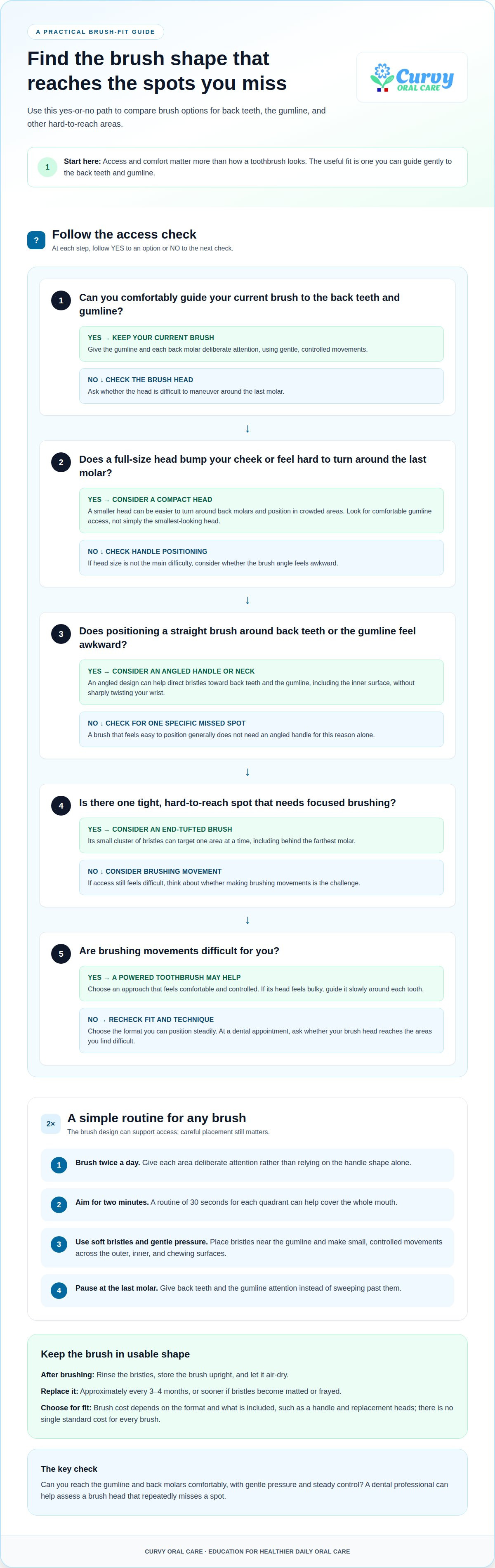
The best toothbrush for hard-to-reach areas is one you can guide comfortably to the back teeth and gumline. A dentist-recommended toothbrush for hard-to-reach areas may have a compact head, an angled handle or neck, or a powered head. Brush twice a day with gentle pressure and soft bristles.
It’s easy to focus on the front surfaces you can see, but plaque can collect around the gumline and behind back molars. Keeping gums healthy is part of caring for your mouth. Research continues to explore links between oral and general health, but an association alone doesn’t prove that one causes the other.
This guide compares compact heads, angled handles, end-tufted brushes, and powered toothbrushes. Learn how each can help with access and what to consider when choosing a practical fit for your routine.
Key Takeaways
- Consider an angled handle or neck if positioning a straight brush around back teeth and the gumline feels awkward.
- A compact brush head can improve maneuverability, while a small end-tufted brush can target a specific hard-to-reach spot.
- A powered toothbrush may help when brushing movements are difficult; choose a brushing approach that feels comfortable and controlled.
- Head size affects how easily you can reach different areas, so focus on access and comfort rather than choosing by appearance alone.
- Use gentle pressure and pay attention to the gumline and back molars as part of a consistent daily routine.
1. Angled handles and necks for back teeth
Dentists may recommend an angled, compact, or single-tuft toothbrush when a particular area is difficult to reach. An angled neck can help direct bristles toward the back teeth and gumline, while a compact head or single-tuft brush offers more focused access. The best fit depends on where your brush misses and how comfortably you can guide it.
Back molars are easy to overlook because they sit behind the teeth you see first. For each back tooth, place the bristles near the gumline, then make gentle, controlled movements across the outer, inner, and chewing surfaces. An angled neck can help you approach the inner surface without sharply twisting your wrist. Pause briefly at the last molar instead of sweeping past it.
Handle shape matters, too. A straight, narrow handle may feel familiar, but a larger grip can be easier to hold if small handles are difficult to control. Foam or rubber grips can also be added to a standard manual toothbrush. Choose a grip that lets you guide the head steadily; a firm hold shouldn’t mean pressing harder against your teeth or gums.
Use the brush head as a positioning guide. Turn the handle until the bristles meet the gumline at a comfortable angle, then move along the tooth rather than scrubbing forcefully back and forth. The American Dental Association recommends soft-bristled toothbrushes and gentle pressure to help reduce the risk of gum injury. Soft bristles can also follow tooth contours into awkward spots.
Keep your toothbrush clean between uses. Rinse the bristles after brushing, store the brush upright, and let it air-dry. Replace it approximately every three to four months, or sooner if the bristles become matted or frayed. Worn bristles lose their shape, making them harder to guide precisely along the gumline or around a back molar.
Brush twice a day, and give each area deliberate attention rather than relying on handle shape alone. A two-minute routine, divided into 30 seconds for each quadrant, can help you cover the whole mouth. An angled design supports access, but careful placement still matters. If a straight brush repeatedly misses one spot, an angled handle or neck may make your daily technique easier to control.
For caregivers brushing an infant’s teeth, a child-sized toothbrush with soft bristles and a small head is recommended twice a day. Primary teeth may begin to erupt as early as 6 months of age, when they become at risk of tooth decay, so brushing can become part of care once teeth appear. A toothbrush head around 1 inch long can help reach all areas of the mouth. Soft bristles can also reach tricky spots by adapting to the contours of the teeth, making gentle placement useful around small teeth and along the gumline.
Children should brush teeth twice a day, and brushing songs designed for children can last two minutes to help them brush for the recommended duration. A song can give a child a steady cue to keep brushing rather than stopping after only a brief pass. Caregivers can guide the brush head around each tooth and toward the back of the mouth, using gentle movements. A small head and soft bristles may make it easier to guide the brush through areas that are difficult for a child to reach independently.
2. Small toothbrush heads for hard-to-reach areas
A smaller toothbrush head can turn more easily around back molars and reach crowded areas. Dentists commonly recommend soft-bristled brushes, and a compact head can make it easier to position the bristles. When choosing a dentist-recommended toothbrush for hard-to-reach areas, prioritize comfortable access to the gumline, not a head that simply looks smaller.
Size gives a useful reference point, but mouth shape and comfort matter too. An adult toothbrush head is roughly half an inch wide and one inch tall. Children need smaller heads: infants and toddlers use heads roughly 15 mm long, young children 15 to 19 mm, and older children 22 mm. A child-sized head helps caregivers guide the brush around small teeth.
At your next dental appointment, ask whether the brush head reaches the areas you find difficult. If a full-size head bumps your cheek while you brush the last molar, for example, a more compact option may be easier to maneuver. The right fit should let you place the bristles near the gumline without forcing the handle or stretching your mouth uncomfortably.
To clean with a compact head, start at the last molar and work across one surface at a time. Angle the bristles toward the gumline, then use small, controlled movements on the outer, inner, and chewing surfaces. Move the head along the tooth rather than scrubbing hard. This helps remove plaque from the gumline while limiting unnecessary pressure on gums and enamel.
A head that is too large can make it harder to reach behind the back teeth or position bristles precisely. Brushing too hard can irritate gums, and repeated force may wear enamel. If an electric toothbrush feels bulky, guide its head slowly around each tooth instead of moving it quickly across several teeth. A compact manual brush is another option when precise placement feels easier by hand.
Toothbrush cost depends on the format and what comes with it, such as a manual or electric handle and replacement heads. There is no single standard cost for every dentist-recommended brush; choose based on access, comfort, and the features you’ll use. A dental appointment can help clarify which head size suits your mouth and brushing technique.
If a powered option is also on your list, consider this sonic toothbrush, toothpaste, and travel case combination as another format to explore. Whichever brush you choose, check that its head can reach your back molars and gumline without straining your grip.
3. End-tufted toothbrushes
An extra-soft end-tufted toothbrush with a contra-angle can reach behind the farthest molar. Its small cluster of bristles lets you focus on one tight area at a time, rather than sweeping across several teeth.
For dental implants, bridges, and crowns, a soft, compact brush or end-tufted brush can help clean around hard-to-reach edges. Use gentle, controlled strokes along the gumline and around each restoration, without forcing bristles beneath its edges.
Specialized brushes can help clean around braces or crowded teeth. An end-tufted brush can target plaque near brackets and along the gumline, while a toothbrush with an orthodontic cut can clean more broadly around braces.
Think of an end-tufted brush as a precision tool, not a replacement for your regular toothbrush. Use it after brushing when a specific spot, such as the back of the last molar or a bracket edge, needs careful attention. Its small head also makes it easier to see and guide the bristles accurately.
For a simple technique, place the tuft against the tooth near the gumline. Make small, gentle circles or short strokes, then reposition it to clean the next edge. Around braces, angle the bristles toward the gumline above and below each bracket. Around a crown, follow the gumline where the restoration meets the tooth.
Slow movements matter more than pressure. Pressing hard can irritate gums and bend the bristles away from the surface you’re trying to clean. If the tuft feels uncomfortable or catches on a restoration, ease up and adjust its angle. Persistent soreness or bleeding warrants attention at a dental appointment.
Use the brush consistently, but don’t expect one tuft to clean every surface quickly. A timer can help you maintain a complete two-minute brushing routine with your regular brush; the end-tufted brush adds focused cleaning where needed. This distinction helps you remove plaque from narrow spots without skipping the wider tooth surfaces.
After use, rinse the bristles and let the brush air-dry upright. Replace it when the tuft becomes splayed or worn, since damaged bristles are harder to position precisely. Used with a steady technique, this small brush can complement daily cleaning around back molars, braces, implants, bridges, and crowns.
4. Powered toothbrushes
A powered toothbrush with a timer and soft bristles can support careful cleaning behind molars and around braces. The powered head does much of the brushing movement while you guide it tooth by tooth. For better access, choose a head you can position comfortably around the last molars and bracket edges.
Powered brushes can be useful when hand movements feel difficult. Arthritis, limited dexterity, or helping someone else brush can make repeated manual strokes tiring. Hold the handle lightly, place the bristles against one tooth, and move slowly along its surfaces. Powered movement assists cleaning, but deliberate placement still helps reach the gumline and back teeth.
A built-in timer helps you brush for two minutes. Some models also signal every 30 seconds, prompting you to move to another quadrant. Use each interval to cover the outer, inner, and chewing surfaces in that part of your mouth. Around braces, guide the head above and below brackets rather than gliding quickly across them.
A pressure sensor can alert you when you’re brushing too hard. This is useful because extra force doesn’t improve access and can irritate gum tissue. Keep the brush head against your teeth with gentle pressure. If your gums feel uncomfortable, reduce pressure and adjust your angle instead of pushing harder.
Soft bristles are a practical choice for routine brushing. The American Dental Association recommends soft-bristled toothbrushes and gentle pressure to help reduce the risk of gum injury. Don’t choose medium or hard bristles simply because they feel firmer. Brushing should clean along the gumline without scraping or forceful scrubbing.
Children who find brushing movements difficult may find a powered toothbrush easier to manage with caregiver support. Look for soft bristles; a pressure sensor can give feedback about force. An adult helping should guide the head around back molars and along the gumline, rather than letting the brush skip those areas.
Safety testing is another useful comparison point: ANSI/ADA Standard No. 120 is used for testing powered toothbrush safety. This standard doesn’t replace good technique. Choose a brush that feels comfortable to hold, then use its timer and any pressure alert to build a steady routine. A powered brush can make cleaning easier, but it still needs to reach each tooth.
5. Toothbrush head size for hard-to-reach areas
A compact brush head is often easier to maneuver around back molars and crowded spaces. For an adult, a head roughly one inch long and half an inch wide offers a useful size reference. The right shape is one you can guide onto each tooth surface without straining your cheek or wrist.
Head size affects access, not brushing skill. A large head may cover more surface at once, but it can be harder to position behind the last molar. A smaller head gives you more control in that tight area, but still requires deliberate placement along the gumline and across the chewing surface.
Try a simple reach test with your brush: open comfortably, place the head behind a back molar, then turn it toward the inner surface. If the handle presses against your cheek or the bristles can’t reach the tooth, a smaller head may fit better. Repeat the test on both sides, since access can feel different.
Head dimensions also change with age. Infants and toddlers need brush heads roughly 15 mm long; young children need 15 to 19 mm heads. Older children need heads around 22 mm long. These smaller sizes help caregivers reach the teeth without crowding a child’s mouth during brushing.
Shape and bristle softness matter alongside size. A small head with soft bristles can reach tight contours without requiring hard pressure. Hard bristles don’t improve access and can be harsh on gums. Use gentle movements, keeping the bristles against one tooth surface before repositioning for the next.
For electric brushes, consider whether the head can be positioned comfortably around a back molar. Powered movement doesn’t remove the need to guide the brush across inner, outer, and chewing surfaces. Move slowly, pause at difficult spots, and avoid letting a broad head skip the gumline or spaces between teeth.
Choose based on the area you struggle to clean, not the head’s appearance. A compact head can improve maneuverability, but a single brush head cannot clean between teeth by itself. Keep interdental cleaning in your routine, and discuss persistent difficulty reaching a particular surface at your dental appointment.
If a powered brush is the format you prefer, explore this sonic toothbrush combination as an option for your routine. The clear takeaway: choose a head you can place precisely, then guide it gently across every tooth surface.
Curvy Oral Care: Replacement Brush Heads
Curvy Oral Care offers angled toothbrushes, sonic toothbrushes, and replacement brush heads for daily brushing. If your current brush feels awkward around back molars or along the gumline, an angled brush may make it more comfortable to guide the bristles into those areas. Replace worn brush heads using the twist-and-pull method; new heads may feel light, so handle them gently. A brush-head subscription delivers a two-pack automatically every six months, with a ten percent discount and free shipping. The subscription also includes a lifelong sonic toothbrush warranty. These products support your routine but don’t replace personalized dental advice or professional care. Explore Curvy Oral Care’s toothbrushes and replacement heads to find an option for your routine. The website is intended for users aged eighteen and older.
Make your next brushing routine more intentional
During your next brushing session, notice where control feels awkward. Is it the last molar, the inner surface, or a crowded spot? That observation gives you a practical starting point when choosing a dentist-recommended toothbrush for hard-to-reach areas. Comfort matters: a brush you can guide steadily makes it easier to give each tooth and the gumline careful attention.
Build the habit around gentle, consistent cleaning rather than trying to compensate with extra pressure. If you notice persistent bleeding, swelling, or pain, arrange a dental evaluation; a toothbrush choice can’t replace personalized care. Small adjustments to your daily routine can support healthier gums and make oral care feel more manageable.
Ready to explore a powered brushing option for your routine? Explore the sonic toothbrush combination, and keep taking practical steps toward a cleaner, more comfortable routine.
Frequently Asked Questions
Different Types of Toothbrushes: Which One Is Right for You?
Choose a toothbrush based on the spot you struggle to reach and what feels easy to control. A compact head can suit a crowded mouth, an angled design can help with back teeth, and an end-tufted brush can target one small area. A powered brush may be useful if hand movements feel tiring. Curvy Oral Care’s website is intended for users aged 18 or older.
Is the size of the toothbrush head important?
Yes. A head that’s difficult to maneuver can make it harder to clean along the gumline or reach behind a back molar. Consider how the brush feels around your own teeth, not just its listed dimensions. For a child with oral sensitivities or a strong gag reflex, a smaller head may feel more comfortable and improve access. Replace a worn head when its bristles become frayed or matted.
What Type of Toothbrush Is Best?
The best choice is one you can use gently and position across all tooth surfaces. Soft bristles suit routine brushing; use medium or hard bristles only if your dentist specifically advises them. The American Dental Association’s Seal of Acceptance indicates that a manual brush has been evaluated for safety and effectiveness in removing plaque and reducing gingivitis. Personal needs, such as braces or limited dexterity, can affect which design feels easiest to use.
What is the benefit of an angled neck on a toothbrush?
An angled neck changes how the brush head approaches a tooth, which can make awkward surfaces easier to reach without sharply twisting your wrist. For example, you can adjust the handle while directing the head toward the inner side of a back molar. The angle doesn’t replace careful brushing: reposition the bristles as you move, and avoid pressing the neck or head against your gums.
Are electric or manual toothbrushes better for reaching back teeth and gumlines?
Either type can reach these areas if you can position its bristles carefully. An electric brush may suit someone with arthritis or limited dexterity because its powered head does much of the brushing movement. A manual brush offers direct control over each stroke. In either case, move systematically around the mouth and pay attention to the gumline, not just the broad, visible surfaces.
Health & Medical Disclaimer: This content is for educational purposes only and isn’t a substitute for professional dental or medical advice, diagnosis, or treatment. Consult a qualified professional about personal health concerns. Seek dental advice for persistent bleeding, swelling, pain, or other significant changes in oral health.

Article by
Aline Peixe Nebot
Aline Peixe Nebot is a Veterinarian and passionate advocate for better oral health, committed to raising awareness of oral health as a matter of public health. She actively promotes the importance of simple, effective oral care routines and works to educate the public about the often-overlooked link between oral health and overall systemic health. Her mission is to make better oral care knowledge accessible to everyone and encourage healthier habits for life.
Disclaimer
Disclaimer: The information provided in this article is intended for general educational and informational purposes only. It is not intended to replace professional medical, dental, or healthcare advice, diagnosis, or treatment.
Some content may be AI-assisted and is provided to support health education and awareness. While we strive to share accurate and up-to-date information, health recommendations and scientific evidence can evolve, and the information presented may not apply to every individual.
The connection between oral health and overall systemic health is an important and developing area of research. Associations discussed in this article should not necessarily be interpreted as proof of cause and effect.
Always consult a qualified dentist, physician, or other healthcare professional regarding your individual health, symptoms, medications, or treatment decisions. Do not delay or discontinue professional care based on information presented in this article.
This content is for education and awareness—not diagnosis or treatment.