

The Science of Safe Sonic Vibration: Is Your Toothbrush Protecting or Risking Your Health?
What if the device you trust to protect your health is actually introducing unnecessary biological stress to your body twice a day? It’s a question many health-conscious people are starting to ask as they feel the intense rattle of high-frequency tools against their sensitive teeth and gums.
You’ve likely upgraded to a power brush because you want the most effective plaque removal possible, yet it’s completely reasonable to feel concerned about the impact of electromagnetic fields (EMF) and aggressive vibration mechanics so close to your brain. You shouldn't have to choose between a clean mouth and a calm nervous system. Finding a truly safe sonic vibration toothbrush means looking beyond simple cleaning power to understand how these devices interact with your biology.
This guide dives into the critical intersection of high-frequency cleaning and systemic safety. We’ll break down the latest research on EMF exposure, explain the mechanics of gum-safe vibrations, and show you how to achieve a superior clean that respects your body’s delicate balance. You'll discover how a more precise, science-backed approach to oral care can protect your gums from recession while giving you total peace of mind.
Key Takeaways
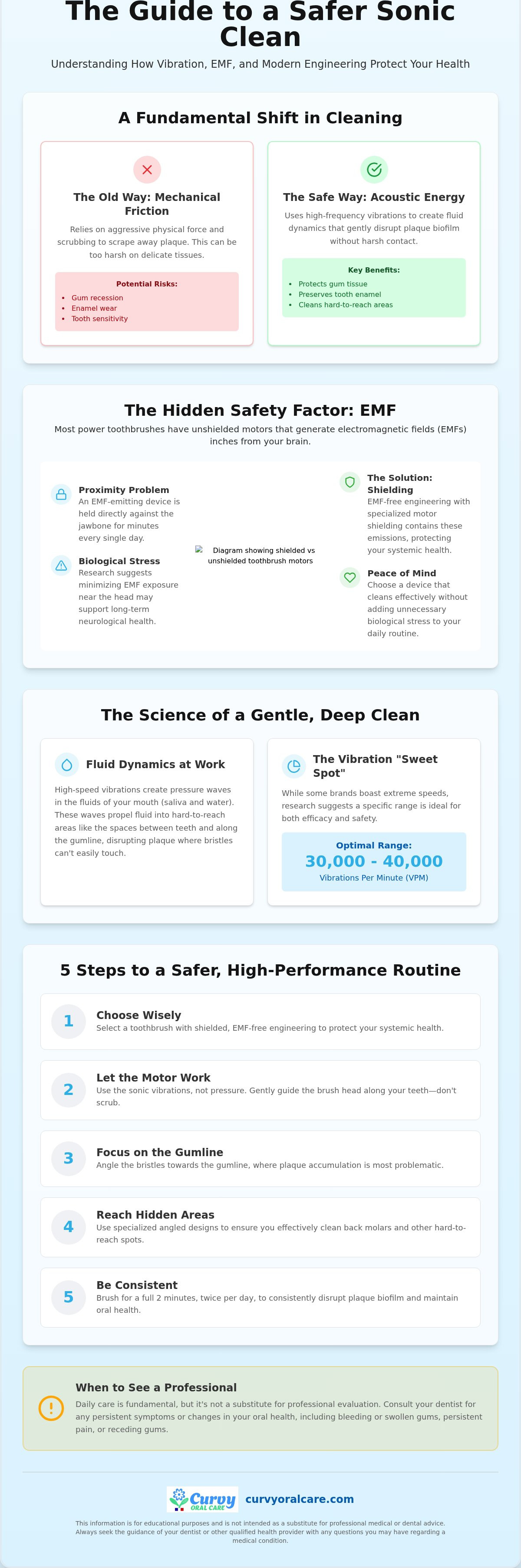
- Understand why shielded, EMF-free engineering is a vital upgrade for protecting your systemic health during your daily routine.
- Learn how a safe sonic vibration toothbrush uses acoustic energy to disrupt plaque biofilm without the need for damaging manual pressure.
- Discover why letting the sonic motor do the work-rather than scrubbing-is the most effective way to prevent gum recession and enamel wear.
- See how specialized angled designs ensure you reach the hidden spaces along the gumline and back molars where plaque tends to accumulate.
- Gain a clear, 5-step strategy to transition into a high-performance oral care routine that prioritizes both cleaning efficacy and biological safety.
What Defines a Safe Sonic Vibration Toothbrush?
A safe sonic vibration toothbrush represents a significant evolution from the manual scrubbing habits of the past. Traditional cleaning often relies on physical friction to scrape away plaque, which can lead to receding gums and worn enamel if you are too aggressive. In contrast, sonic technology uses high-frequency vibrations to create acoustic energy. This energy disrupts the sticky film of bacteria, known as plaque biofilm, without needing the abrasive force that characterizes an older Electric toothbrush or standard manual models. By using pulses rather than physical scrubbing, these devices protect the structural integrity of your teeth while providing a deeper clean.
True safety in dental technology is a delicate balance. It requires high cleaning efficacy to prevent gum disease (periodontal disease) while ensuring the preservation of your mineralized tissue. Beyond just your teeth, a modern approach to safety considers biological factors like electromagnetic fields (EMF) and sensory comfort. While many power brushes focus solely on motor speed, a truly safe model, such as the Curvy Y-Angled Sonic Toothbrush, integrates EMF-free engineering to support your systemic health during every use. This ensures that your oral care routine doesn't introduce unnecessary biological stress to your body.
The Mechanics of Acoustic Energy
The magic of sonic cleaning lies in fluid dynamics. When a brush vibrates at high speeds, it creates pressure waves in the fluids of your mouth. These waves push water and saliva into the hard-to-reach spaces between your teeth and along the gumline. However, faster isn't always safer for everyone. While some brands push for extreme speeds, research suggests that the "sweet spot" for effective plaque disruption without irritating sensitive enamel falls between 30,000 and 40,000 vibrations per minute (VPM). This range provides enough power to clean deeply while remaining gentle on the soft tissues of your mouth.
Sonic vs. Ultrasonic: Frequency Boundaries
It is helpful to distinguish between standard sonic frequencies and medical-grade ultrasonic waves. Sonic brushes operate within the audible range of human hearing, whereas ultrasonic devices use much higher frequencies that are silent and typically reserved for clinical settings. Standard sonic frequencies are optimized for daily home use because they provide a tangible cleaning sensation and mechanical movement that effectively sweeps away debris. Sonic safety is defined by the precise synergy of frequency and amplitude, ensuring that the brush head moves with enough range to clean but enough control to protect your oral health.
EMF Radiation: The Hidden Safety Factor in Dental Tech
Most people think about battery life or motor power when buying a toothbrush. They rarely consider the electromagnetic fields (EMF) generated by the unshielded motors sitting inches from their brain. These fields are low-level radiation produced by electronic components. While many devices emit EMF, the proximity problem is unique here. You hold this motor against your jawbone for four minutes every day. This creates a direct path for energy to interact with sensitive tissues during your most consistent daily habit.
Research at institutions like The University of Texas at Austin has investigated the levels of electric and magnetic radiation emitted by common household electronics. Some standard models produce significant readings that bio-conscious users might prefer to avoid. Reducing this "dirty electricity" exposure is a simple way to prioritize systemic wellness. It ensures your cleaning routine doesn't come with a side of unnecessary radiation. Shielding these motors is a necessary evolution in a stagnant industry that has ignored biological safety for decades.
The Biological Case for EMF-Free Brushing
Research suggests that minimizing EMF exposure near the head may support long-term neurological health. While the science is still evolving, many individuals report sensitivity to high-frequency electronic devices. Traditional rechargeable handles often lack the shielding needed to contain these emissions. If you are looking for a safe sonic vibration toothbrush, choosing one with specialized engineering is a proactive step. This choice reflects a deeper understanding of how daily habits influence your overall well-being and long-term quality of life.
Neurological Comfort and Electronic Safety
Systemic health starts with the tools you put in your mouth. Some users find that the intense electronic hum of unshielded motors causes sensory discomfort or a "buzzy" feeling in the jaw. This isn't just about plaque; it's about how the technology feels in your body. Curvy Oral Care uses 100% EMF-free engineering to eliminate these concerns. We believe your morning routine should be as clean biologically as it is mechanically. By choosing a non-toxic, shielded electronic routine, you can focus on your oral health without the distraction of electronic triggers.
A shielded routine offers peace of mind for those focused on a holistic lifestyle. By removing radiation from your morning and evening habits, you ensure your technology works for you, not against you. You can experience this difference yourself with an EMF-free sonic model designed for total body safety. It is a modern solution for a health-conscious generation that values both high performance and biological integrity.
Vibration Frequency vs. Mechanical Pressure
Many people still believe the "Scrubbing Myth"-the idea that the harder you press, the cleaner your teeth will be. This habit is the leading cause of gum recession and enamel wear. When you apply excessive manual pressure, you aren't just removing plaque; you're physically scraping away the protective layers of your teeth. A safe sonic vibration toothbrush changes this dynamic entirely. Instead of relying on physical force, it uses high-frequency pulses to vibrate plaque biofilm off the tooth surface. This mechanical efficiency allows the bristles to do the work without you needing to lean into the handle.
This gentle approach is particularly beneficial for those with dental work. If you have crowns, veneers, or braces, aggressive scrubbing can potentially compromise the bonds or irritate the surrounding tissue. Sonic vibrations provide a deep clean that is safe for restorative materials. For some users, however, intense vibrations can be a sensory trigger. While rare, some individuals report headaches or discomfort from poorly tuned sonic motors. A well-engineered brush balances frequency to ensure it disrupts plaque without causing neurological or sensory overwhelm.
Protecting the Gumline from Over-Brushing
The delicate gingival margin, or the edge where your gums meet your teeth, is highly susceptible to damage from aggressive manual habits. Sonic technology acts as a "no-touch" cleaner by using fluid dynamics to reach into the spaces between teeth. This means the brush can clean areas the bristles don't even physically touch. To maximize this safety, soft bristles are essential. When you pair high-speed vibrations with hard bristles, you risk creating micro-abrasions on the gums. Choosing soft, high-quality bristles ensures the energy is used for cleaning rather than irritation.
Ergonomic Safety and the 45-Degree Angle
Most traditional toothbrushes feature straight handles that force your hand into awkward positions. These angles often lead to "pressure spikes" where you inadvertently push too hard on certain areas, like the front teeth or the canine corners. This is where ergonomic design becomes a mechanical safety feature. A brush head that is naturally angled, like the Curvy Y-Angled Sonic Toothbrush, aligns with the Bass Method automatically. This method involves holding the bristles at a 45-degree angle toward the gumline for the most effective and safest clean.
By using a bio-optimized design, you reduce the risk of mechanical error. You don't have to fight against the shape of the brush to reach your back molars or the inside of your lower teeth. This intuitive alignment protects your gums from the accidental trauma caused by trying to navigate a straight brush in a curved mouth. It turns a complex task into a simple, safe, and effective daily routine.
5 Steps to a Safer Sonic Brushing Routine
Transitioning to a safe sonic vibration toothbrush is a major win for your systemic health, but your technique determines the final result. Owning the right technology is only half the battle; you must use it in a way that respects your biological boundaries. Follow these five steps to ensure your routine is as protective as it is effective.
- Step 1: Switch to an EMF-free model. Eliminate unnecessary radiation exposure near your head by choosing a handle with specialized shielding.
- Step 2: Apply zero manual pressure. You've spent years scrubbing, but it's time to stop. Let the sonic motor's acoustic energy disrupt the plaque for you.
- Step 3: Position at a 45-degree angle. Tilt the bristles toward the gumline to reach the gingival margin, where bacteria often hide.
- Step 4: Glide, don't scrub. Move the brush slowly across each tooth surface, allowing the vibrations to do the heavy lifting.
- Step 5: Replace the brush head every 90 days. Frayed bristles lose their precision and can become abrasive, potentially scratching your enamel.
Mastering the "Glide" Technique
Speed is often the enemy of a deep clean. If you move the brush head too quickly across your teeth, you don't give the sonic pulses enough time to create the fluid dynamics needed to flush out debris. Use the QuadPacer method to stay on track. Spend 30 seconds on each of the four quadrants of your mouth, ensuring you give equal attention to the front, back, and chewing surfaces. This deliberate pace is especially important for the back molars and the lingual surfaces (the back of the teeth), where plaque accumulation is most common. Don't rush; the goal is thorough biofilm disruption, not just a quick sweep.
Maintenance for Long-Term Safety
Your brush head is a precision tool that wears down with every use. After about three months, the bristles begin to lose their rounded tips and start to fray. These jagged edges can act like sandpaper on your gums, leading to irritation and micro-tears. Furthermore, old bristles can become a breeding ground for bacteria if not replaced regularly. A brush head subscription is an excellent safety tool because it removes the guesswork, ensuring you always have fresh, soft bristles to maximize the benefits of your safe sonic vibration toothbrush. Maintaining this consistency is the simplest way to support long-term gum health. You can start your journey toward a more mindful routine with the Curvy Y-Angled Sonic Toothbrush, which combines ergonomic safety with advanced EMF-free engineering.
The Curvy Advantage: Engineering Safety from the Inside Out
The Curvy Y-Angled Sonic Toothbrush isn't a minor tweak to an old design; it's a fundamental reimagining of oral care safety. While the industry has been stagnant for decades, we've focused on the intersection of high-performance cleaning and biological integrity. Choosing a safe sonic vibration toothbrush means looking beyond the motor's speed to see how the entire device respects your body. Our patented EMF-free technology ensures your oral care routine supports your systemic health by removing the electromagnetic stress often found in unshielded electronic handles.
Precision plaque removal shouldn't feel sterile or cold. We've moved away from the traditional medical brand feel to create a vibrant, consumer-centric experience that prioritizes your well-being. By focusing on gum health as the foundation of your daily routine, we empower you to take control of your oral-systemic connection. It's about more than just a bright smile; it's about a healthier lifestyle built on science-backed habits.
Why the Angle Matters for Safety
Most brushes fail in the "danger zones"-those difficult spots behind the back molars and along the inner gumline where plaque hides. When a brush handle is straight, you have to twist your wrist and apply aggressive pressure to reach these areas. This mechanical struggle is a primary cause of accidental gum trauma and recession. The Curvy Y-angled head provides a mechanical advantage by naturally aligning the bristles at the 45-degree tilt required by the Bass Method. This design eliminates the need for physical force, allowing the sonic vibrations to disrupt plaque biofilm safely and effectively in every corner of your mouth.
A Holistic Approach to Modern Hygiene
We prioritize comfort and precision over the "more modes" marketing gimmicks that often clutter the dental tech market. A safe sonic vibration toothbrush doesn't need ten settings; it needs a bio-compatible frequency and a shape that works with your anatomy. Small daily habits, when performed with tools engineered for safety, contribute significantly to your whole-body wellness. By reducing mechanical error and electronic triggers, we make it easy to maintain a professional-level clean at home. Experience the safest clean with the Curvy Y-Angled Sonic Toothbrush and discover how modern engineering can protect your health from the inside out.
Health & Medical Disclaimer: The information provided in this article is for educational and awareness purposes only and is not intended as medical advice, diagnosis, or treatment. Always seek the advice of your dentist, physician, or other qualified healthcare provider with any questions you may have regarding a medical condition or oral health concerns. Never disregard professional medical advice or delay in seeking it because of something you have read here. If you are experiencing persistent bleeding gums, swelling, pain, or significant changes in your oral health, please consult a dental professional immediately. Curvy Oral Care products are designed to support oral hygiene and are not a substitute for professional dental care.
Elevate Your Routine for Long-Term Systemic Wellness
Transitioning to a safe sonic vibration toothbrush is more than a dental upgrade; it's a commitment to your entire body's health. You've learned that effective cleaning doesn't require aggressive pressure or exposure to unshielded electromagnetic fields. By prioritizing tools that respect your biology, you protect your delicate gumline while ensuring a deep, clinical clean every single morning and night.
Our patented EMF-free technology removes systemic stress from your routine, while the Y-angled head ensures you reach those hidden plaque danger zones with absolute precision. Coupled with a subscription model that guarantees fresh, safe bristles exactly when you need them, you can finally stop scrubbing and start gliding. It's time to let modern engineering do the hard work for you.
Upgrade to the safest EMF-free angled sonic experience today. Your mouth is the gateway to your overall health, and taking care of it shouldn't feel like a compromise. You have the knowledge and the tools to build a brighter, healthier future one brush at a time.
Frequently Asked Questions
Is a sonic vibration toothbrush safe for people with sensitive teeth?
Yes, a safe sonic vibration toothbrush is often a better choice for sensitivity than manual brushing. Because the motor does the heavy lifting, you don't need to apply the physical pressure that often triggers pain. Using soft bristles allows the acoustic energy to disrupt plaque while remaining gentle on your enamel. If you experience discomfort, focus on a slow glide technique rather than any scrubbing motion to protect your teeth.
Can sonic vibrations trigger headaches or sensory issues?
While most people use these devices without issue, some individuals are sensitive to high-frequency vibrations. This "buzzy" sensation can sometimes lead to headaches if the motor is unshielded or poorly tuned. Choosing a model with advanced engineering helps minimize these electronic triggers. If you have a history of sensory sensitivity, a shielded, EMF-free handle provides a much smoother and more comfortable experience for your nervous system every day.
What does EMF-free mean in a toothbrush and why does it matter?
EMF-free means the electronic motor and battery are specifically shielded to prevent electromagnetic fields from reaching your body. This is crucial because you hold the device directly against your jawbone for several minutes daily. Reducing this "dirty electricity" exposure supports your systemic wellness by eliminating unnecessary radiation near your brain. It ensures your morning routine remains biologically clean while providing the high-performance plaque removal you expect from modern technology.
Is it safe to use a sonic toothbrush on dental implants or braces?
Sonic technology is highly effective and safe for cleaning around dental hardware. The high-speed pulses create fluid dynamics that flush out bacteria from tiny gaps around brackets or implant posts that bristles can't always reach. Research suggests that these vibrations don't compromise the bonds of your dental work. Just remember to use a soft brush head and avoid pressing the hard plastic handle against your braces while the motor is running.
Can a sonic toothbrush cause gum recession if used incorrectly?
Yes, any toothbrush can contribute to gum recession if you use it with too much force or hard bristles. The goal of a sonic device is to replace manual scrubbing with vibration. If you continue to scrub while the motor is on, you are applying double the abrasive force to your gums. To protect your gingival margin, let the bristles rest lightly against the teeth and move them slowly without pushing.
How do I know if my sonic toothbrush is producing high levels of EMF?
Without a specialized meter, it's difficult to measure exact radiation levels at home. However, unshielded toothbrushes often have a more intense electronic hum and a vibrating sensation that feels sharper in the hand and jaw. Most traditional market leaders don't disclose their EMF output. For total peace of mind, it's best to choose a brand that explicitly prioritizes EMF-free engineering and provides transparent information about their biological safety standards.
Are sonic toothbrushes safe for children’s developing teeth?
Sonic brushes are safe for children once they have the coordination to hold the handle properly, usually around age three. Using a safe sonic vibration toothbrush designed for kids helps them clean more effectively without needing perfect manual technique. It's vital to use a small, soft brush head and supervise them to ensure they aren't pressing too hard. This builds healthy, proactive habits that protect their developing gums and enamel early on.
Why is an angled sonic toothbrush safer than a straight one?
An angled head is a mechanical safety feature that protects you from over-brushing. Straight handles often make it difficult to reach the back molars or the inside of the teeth at the correct 45-degree angle. This struggle leads many people to apply extra pressure to compensate for the awkward reach. An angled design naturally aligns with your anatomy, allowing you to reach every danger zone without the wrist movements that cause accidental gum trauma.
Health & Medical Disclaimer: The information provided in this article is for educational and awareness purposes only and is not intended as medical advice, diagnosis, or treatment. Always seek the advice of your dentist, physician, or other qualified healthcare provider with any questions you may have regarding a medical condition or oral health concerns. Never disregard professional medical advice or delay in seeking it because of something you have read here. If you are experiencing persistent bleeding gums, swelling, pain, or significant changes in your oral health, please consult a dental professional immediately. Curvy Oral Care products are designed to support oral hygiene and are not a substitute for professional dental care.

Article by
Aline Peixe Nebot
Aline Peixe Nebot is a Veterinarian and passionate advocate for better oral health, committed to raising awareness of oral health as a matter of public health. She actively promotes the importance of simple, effective oral care routines and works to educate the public about the often-overlooked link between oral health and overall systemic health. Her mission is to make better oral care knowledge accessible to everyone and encourage healthier habits for life.
Disclaimer
Disclaimer: The information provided in this article is intended for general educational and informational purposes only. It is not intended to replace professional medical, dental, or healthcare advice, diagnosis, or treatment.
Some content may be AI-assisted and is provided to support health education and awareness. While we strive to share accurate and up-to-date information, health recommendations and scientific evidence can evolve, and the information presented may not apply to every individual.
The connection between oral health and overall systemic health is an important and developing area of research. Associations discussed in this article should not necessarily be interpreted as proof of cause and effect.
Always consult a qualified dentist, physician, or other healthcare professional regarding your individual health, symptoms, medications, or treatment decisions. Do not delay or discontinue professional care based on information presented in this article.
This content is for education and awareness—not diagnosis or treatment.