

The Ergonomic Sonic Toothbrush Guide: Precision, Safety, and Gum Health in 2026
The secret to a healthier smile isn't how hard you brush, but how effectively you can reach the areas that matter most. Most people assume ergonomics is just about a comfortable handle, yet true innovation lies in the geometry of the brush head itself. Finding the right ergonomic sonic toothbrush can be the difference between a surface-level clean and reaching the deep crevices where plaque hides with precision. You've likely felt the frustration of trying to navigate a bulky, straight-headed brush toward back molars, only to end up with irritated or bleeding gums.
It's a common struggle that often leads to hidden plaque buildup and unnecessary inflammation. This guide will show you how patented angled designs and EMF-free technology are redefining oral hygiene for 2026. You'll discover how to achieve superior plaque removal and better gum health while simplifying your daily routine. We'll explore the science of the oral-systemic connection, the importance of protecting your gumline, and why the right tools make a world of difference for your long-term wellness.
Key Takeaways
- Understand why true ergonomic design focuses on the brush head's geometry to reach difficult areas, rather than just the comfort of the handle.
- Discover how an ergonomic sonic toothbrush with a 45-degree angled head simplifies cleaning along the gumline and reaching those stubborn back molars.
- Explore the benefits of EMF-free technology, which provides a modern, science-backed solution for those looking to minimize electromagnetic exposure during their daily routine.
- Identify how to match bristle stiffness and head size to your unique mouth anatomy to prevent gum irritation and ensure a more thorough clean.
- Learn how a regular replacement schedule via a subscription service maintains the mechanical efficiency needed for consistent plaque removal and long-term gum health.
Defining Ergonomics in Modern Oral Care
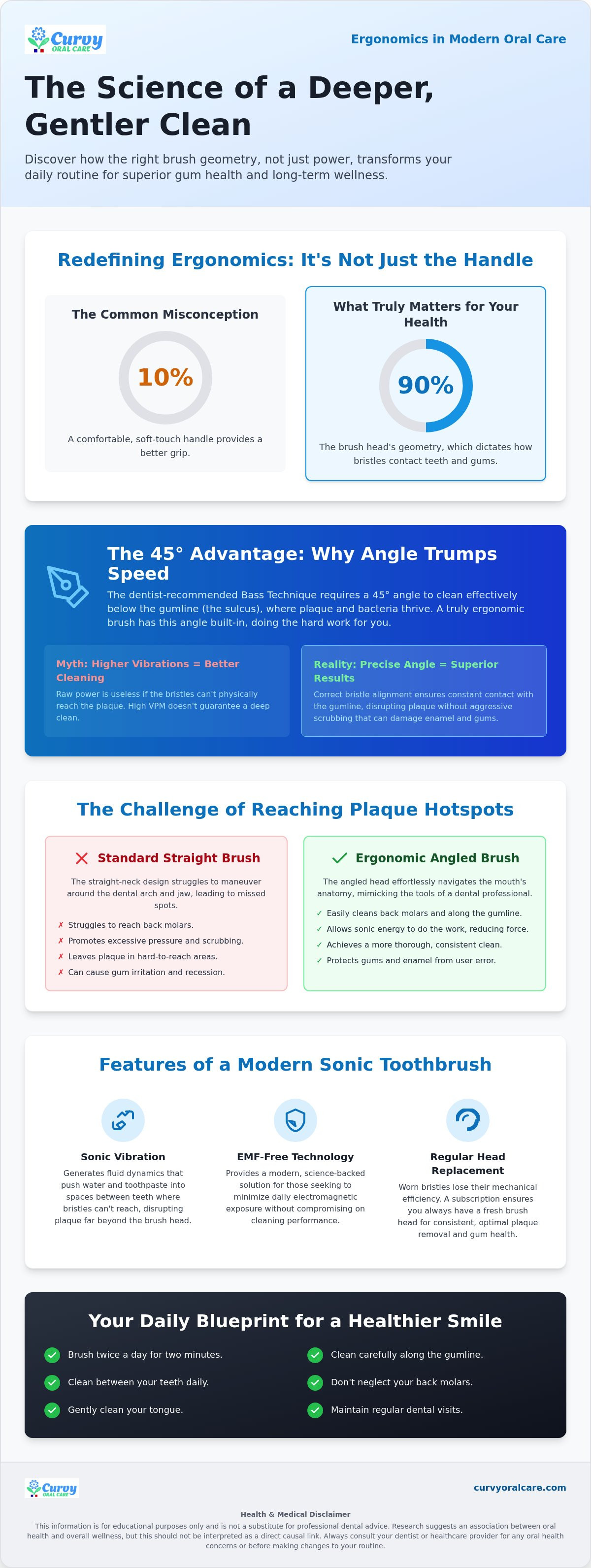
Ergonomics is often misunderstood as a marketing buzzword for a "comfy handle." In reality, dental ergonomics is the precise science of designing tools that fit the complex anatomy of the human mouth. While a soft-touch grip feels nice, it only accounts for about 10% of the ergonomic equation. The remaining 90% is about how the brush head interacts with your teeth and gums. An ergonomic sonic toothbrush is a tool that optimizes both user grip and bristle-to-gum contact.
Dentists have long taught the Bass technique, which requires holding bristles at a 45-degree angle to the gumline to disrupt plaque effectively. Standard brushes often make this angle difficult to maintain, especially when you're tired or rushed. A truly ergonomic design does the heavy lifting for you. It ensures the bristles land exactly where they need to be without requiring awkward wrist contortions or excessive pressure.
The Problem with Standard Straight-Neck Brushes
Traditional toothbrushes usually feature a straight neck, which creates a physical reach problem. Your jaw and cheeks naturally limit how a straight handle can maneuver around your back molars. When you struggle to reach these areas, you're more likely to use poor form or skip those spots entirely. This leads to plaque accumulation in the very places where gum disease, also known as periodontal disease, often starts. Beyond the mouth, forcing a straight brush into tight corners puts unnecessary mechanical stress on your wrist and hand muscles. It's an inefficient way to manage a daily necessity.
Sonic Vibration vs. Manual Motion
Modern Electric toothbrush technology has evolved to solve many of these manual limitations. Sonic pulses create high-speed vibrations that do more than just scrub surfaces. They generate fluid dynamics, which means they move water and toothpaste into the tiny spaces between your teeth that bristles can't physically touch. This process compensates for limited manual dexterity, making it easier for everyone to achieve a professional-level clean at home.
However, high frequency must be balanced with gentle care. The goal isn't just raw power; it's precision. Using a Y-angled sonic toothbrush allows the device to do the work while you simply guide it along the gumline. This combination of sonic energy and ergonomic angling ensures that your daily routine is both effective and supportive of long-term gum health. It transforms a chore into a sophisticated wellness habit.
The 45-Degree Advantage: Why Head Angle Trumps Vibration Speed
Many brands brag about hitting 60,000 vibrations per minute (VPM). High speed sounds impressive, but it's a myth that power alone equals a cleaner mouth. If the bristles don't physically reach the plaque, the vibration speed is irrelevant. Clinical success depends on the 45-degree angle, known as the Bass technique. This specific tilt allows bristles to slip just under the gumline to disrupt bacteria. An ergonomic sonic toothbrush designed with a built-in angle ensures you hit this target every time. It uses mechanical leverage to clean effectively without the need for aggressive scrubbing.
Safety is as vital as efficiency. While manufacturers must follow FDA safety regulations to ensure devices are safe for oral tissues, the real danger often comes from user error. People often overcompensate for poor brush reach by pressing harder. This scrubbing behavior can lead to permanent enamel wear and gum damage. An angled head provides the leverage needed to let the sonic energy do the work, reducing the physical force required for a deep clean.
Reaching the Hard-to-Reach Places
The back molars are notorious plaque hotspots. Your jawbone and cheek muscles create a narrow corridor that makes straight brushes feel bulky and intrusive. This often triggers a gag reflex, causing people to rush or avoid the area entirely. An angled neck mimics the specialized tools used by dental hygienists. It slips easily into the back of the mouth, allowing for a thorough clean of the posterior teeth, which are the teeth at the back, without discomfort.
Precision Bristle Alignment
Your teeth aren't arranged in a straight line; they follow a natural curve called the dental arch. A straight brush head often gaps or skips as it moves around this curve. Precision alignment means the bristles stay in constant contact with the sulcus. This is the small pocket where the tooth meets the gum. By maintaining the correct angle, you protect yourself from gingival recession, or receding gums, often caused by improper, horizontal brushing. For a more intuitive experience, a Y-angled sonic toothbrush aligns naturally with these curves, making professional-level care part of your daily routine.
Beyond the Grip: EMF-Free Technology and Sonic Safety
Most users choose an ergonomic sonic toothbrush because they want the best clean possible. They understand that sonic vibrations create fluid dynamics to reach where bristles cannot. A Cochrane systematic review of 56 studies confirms that powered brushes remove more plaque and reduce gingivitis more effectively than manual brushing. As we move through 2026, the conversation is expanding beyond just plaque. We are now looking at how these electronic devices interact with our bodies over years of daily use.
Bathroom electronics generate Electromagnetic Fields (EMF). Since a toothbrush is held directly against the jaw, it sits near sensitive areas like the brain and thyroid. While standard devices are regulated, many proactive users are asking if "safe enough" is really sufficient for a tool used twice a day. Curvy Oral Care prioritizes EMF-free design to provide peace of mind alongside clinical performance. It's about ensuring your oral care routine supports your whole-body wellness without introducing unnecessary concerns.
What is an EMF-Free Sonic Toothbrush?
Standard sonic motors use high-speed magnetism that can create significant electromagnetic signatures. When you use an ergonomic sonic toothbrush, you're holding that motor just inches from your head. An EMF-free model uses specific engineering to minimize this output. This involves specialized circuit design and shielding that traps radiation before it leaves the handle. You can learn more about this in our deep dive, Is Your Electric Toothbrush Safe? The Truth About Low Radiation Sonic Tech. These modifications don't reduce the cleaning power; they simply make the technology cleaner for the user.
Long-Term Health Considerations
We live in an environment saturated with signals from phones, Wi-Fi, and smart appliances. This cumulative exposure is why safe limits in 2026 are shifting toward more conservative, lower-exposure guidelines. It's about the "total load" on the body. Choosing low-radiation devices is a smart, proactive step in a comprehensive preventative health strategy. By reducing unnecessary exposure during your morning and evening routines, you support your body's long-term wellness without sacrificing the foundation of your oral health.
How to Choose the Best Ergonomic Brush for Your Dental Profile
Selecting the right tool starts with understanding your unique mouth anatomy. A brush head that's too large can't maneuver effectively around the back of your jaw, while one that's too small might require more passes to clean every surface. Finding your ideal ergonomic sonic toothbrush means matching the device to your physical needs. For most adults, a compact head is the superior choice because it allows for greater precision in tight spaces. You should also look for a feature checklist that includes a two-minute timer and multiple cleaning modes to ensure you don't rush the process or use too much power on sensitive areas.
Portability shouldn't mean sacrificing performance. When searching for a sonic toothbrush for travel, many people settle for flimsy manual alternatives or bulky cases that take up too much room. A travel-friendly ergonomic brush should be lightweight and maintain a long battery life while still providing the same angled reach you use at home. This consistency ensures that your gum health doesn't take a vacation just because you're away from your bathroom counter.
Ergonomic Brushing for Sensitive Gums
Receding gums, or gums that have pulled away from the teeth, require a delicate touch. Aggressive brushing with hard bristles often makes this condition worse by wearing down enamel and irritating the tissue. Soft bristle technology is essential here because it cleans effectively without causing trauma. An ergonomic handle plays a vital role by reducing the amount of pressure you naturally apply. Because the Y Angled Sonic Toothbrush EMF Free aligns the bristles at the correct angle for you, there is no need to push hard against the teeth to feel like you're getting a deep clean.
Kids and Ergonomics: Training Better Habits
Children are still developing the motor skills needed for complex tasks like brushing. Their smaller hands require handles designed for a secure, comfortable grip that doesn't slip. Since their bodies are still growing, choosing EMF-free kids sonic toothbrushes is a proactive way to reduce unnecessary electromagnetic exposure during their formative years. An angled head is particularly helpful for kids because it helps them reach their back molars early on, preventing plaque from hiding in areas they usually miss. This sets a foundation for a lifetime of healthy habits and fewer visits for fillings.
Ready to upgrade your routine with a design that works with your anatomy? You can shop our patented angled sonic toothbrushes to find the perfect fit for your dental profile.
Maintaining Peak Performance with Automated Subscriptions
Owning a high-performance tool requires consistent maintenance to ensure it delivers the promised results. An ergonomic sonic toothbrush is a masterpiece of precision engineering, but that precision relies entirely on the integrity of the bristles. Over time, even the most durable materials begin to break down under the stress of thousands of vibrations per minute. This is why a toothbrush subscription service is far more than a simple convenience. It acts as a vital health tool that ensures your equipment always operates at peak efficiency, protecting your gum health without you having to track the calendar.
Dentists insist on the "3-month rule" for a reason. After ninety days of regular use, bristles lose their stiffness and structural memory. Automated delivery prevents the common habit of using frayed bristles long after they've lost their effectiveness. When you receive a fresh head at your door, it serves as a physical reminder to prioritize your wellness. This proactive approach ensures that your daily routine remains as effective on day 500 as it was on day one.
The Science of Bristle Wear
When bristles become splayed or frayed, they lose their ability to maintain the critical 45-degree angle we discussed earlier. Instead of sliding gently into the sulcus, which is the small pocket between the tooth and gum, worn bristles bend and skip over the surface. This mechanical failure often leads users to overcompensate by pressing harder. As we've learned, excessive pressure is a leading cause of enamel wear and gum recession. Beyond the loss of cleaning power, old brush heads naturally accumulate bacteria over time. Using an old head also creates uneven resistance, which puts unnecessary mechanical strain on the sonic motor and can reduce the lifespan of your device.
The Curvy Subscription Advantage
Sticking to a replacement schedule shouldn't be a chore. Our subscription model allows you to customize delivery frequency to match your personal brushing habits. This ensures you always have a fresh supply of Replacement Brush Heads without accumulating unnecessary waste. It is a sustainable way to maintain professional-level care while ensuring your device continues to reach those difficult back molars with ease. By removing the mental load of tracking wear and tear, you can focus on the simple habit of a better clean. Experience the Precision of an Angled Sonic Toothbrush and see how a fresh start every few months transforms your dental checkups.
Empower Your Smile with Precision Engineering
Achieving a healthier mouth doesn't require more effort; it requires better tools. We've explored how a truly ergonomic sonic toothbrush shifts the focus from raw vibration speed to the precise 45-degree angle necessary for effective plaque removal along the gumline. By reaching those difficult back molars and prioritizing 100% EMF-free technology, you're making a conscious choice for both your oral health and your whole-body wellness. Using a patented angled head ensures you're cleaning exactly where bacteria hide without the need for aggressive scrubbing.
Maintaining this standard of care is simple with flexible subscription plans that keep your bristles fresh and effective. It's time to move beyond the limitations of traditional straight-necked brushes and embrace a routine that fits your unique anatomy. You deserve a daily habit that feels as good as the results it delivers. Ready to transform your dental checkups? Experience the Precision of an Angled Sonic Toothbrush today and take the first step toward a lifetime of healthy gums and a brighter smile.
Frequently Asked Questions
What makes a toothbrush ergonomic compared to a standard one?
An ergonomic sonic toothbrush is defined by how well it adapts to your unique anatomy. While standard models often focus only on handle comfort, true ergonomics prioritizes the brush head's ability to maintain a 45-degree angle at the gumline. This design reduces the need for awkward wrist movements and ensures that bristles make consistent contact with every tooth surface. It transforms a manual struggle into a guided, efficient process for better long-term oral health.
Is an angled toothbrush better for plaque removal than a straight one?
Yes, research suggests that an angled design provides superior access to the back molars and the spaces between teeth. Straight brushes often hit the jaw or cheek, making it difficult to reach the very back of the mouth where plaque frequently accumulates. By mimicking the tools used by dental hygienists, an angled head provides better leverage. This allows you to clean difficult spots more effectively without applying the excessive pressure that can lead to gum irritation.
Do sonic toothbrushes emit harmful EMF radiation?
Most electronic devices produce electromagnetic fields (EMF), but the levels vary significantly between brands. Because a toothbrush is held against the jaw, it sits very close to sensitive areas like the brain and thyroid. While standard devices meet general safety requirements, many people prefer to minimize their cumulative exposure. EMF-free technology uses specialized shielding and circuit design to eliminate these fields, providing a modern solution for those who prioritize a holistic approach to wellness.
How often should I replace the head on my ergonomic sonic toothbrush?
You should replace your brush head every three months to maintain peak performance. Bristles naturally lose their structural integrity and begin to splay after ninety days of regular use. When this happens, they can no longer maintain the precise 45-degree angle required for effective plaque removal. Using frayed bristles can also lead to unnecessary gum irritation. A subscription service helps you stay on track by delivering fresh Replacement Brush Heads exactly when they are needed.
Can an ergonomic toothbrush help with receding gums?
An ergonomic design can be a helpful tool for managing receding gums by preventing the over-pressure that often causes tissue wear. By naturally aligning the bristles at the correct angle, the brush does the work for you. This eliminates the need for the aggressive horizontal scrubbing that can damage delicate gum tissue. If you notice persistent bleeding or significant changes in your gumline, it's essential to seek a professional evaluation from your dentist for a diagnosis.
Is a sonic toothbrush safe for children?
Sonic toothbrushes are generally safe for children and can help them develop better habits early on. Kids often struggle with the motor skills needed to reach their back teeth, so an angled head simplifies the process. Choosing an EMF-free kids sonic toothbrush provides an extra layer of safety for their growing bodies. It's always best to supervise young children while they brush to ensure they are using the proper technique and not applying too much pressure.
What is the difference between an angled head and a slanted bristle?
An angled head refers to the physical tilt of the toothbrush neck or head, while slanted bristles are simply the way the hairs are trimmed. A structural angle provides real mechanical leverage, allowing the brush to reach around the curve of your jaw. Slanted bristles alone cannot compensate for a straight handle's inability to access the back of the mouth. Combining a patented angled head with high-quality bristles offers the most comprehensive solution for effective cleaning.
Why does Curvy Oral Care focus on EMF-free technology?
Curvy Oral Care prioritizes EMF-free technology because oral health is a vital component of whole-body wellness. We believe in a proactive, prevention-based approach that considers the total load of electronic exposure on the body. By removing electromagnetic fields from our sonic toothbrushes, we offer a science-backed solution that doesn't force a compromise between high-tech cleaning and personal safety. It's about providing peace of mind during a routine you perform twice every single day.

Article by
Aline Peixe Nebot
Aline Peixe Nebot is a Veterinarian and passionate advocate for better oral health, committed to raising awareness of oral health as a matter of public health. She actively promotes the importance of simple, effective oral care routines and works to educate the public about the often-overlooked link between oral health and overall systemic health. Her mission is to make better oral care knowledge accessible to everyone and encourage healthier habits for life.
Disclaimer
Disclaimer: The information provided in this article is intended for general educational and informational purposes only. It is not intended to replace professional medical, dental, or healthcare advice, diagnosis, or treatment.
Some content may be AI-assisted and is provided to support health education and awareness. While we strive to share accurate and up-to-date information, health recommendations and scientific evidence can evolve, and the information presented may not apply to every individual.
The connection between oral health and overall systemic health is an important and developing area of research. Associations discussed in this article should not necessarily be interpreted as proof of cause and effect.
Always consult a qualified dentist, physician, or other healthcare professional regarding your individual health, symptoms, medications, or treatment decisions. Do not delay or discontinue professional care based on information presented in this article.
This content is for education and awareness—not diagnosis or treatment.