
Sonic toothbrush charger replacement stand for EU plug users
An EU plug doesn’t make a charger universal. A sonic toothbrush charger replacement stand must match the toothbrush’s charging connection and electrical requirements. The plug only determines whether it fits the wall socket. Compatibility depends on the exact toothbrush model, so a stand that works with one brush may not work with another.
A missing or broken charger can interrupt your routine, and a universal option may seem like the simplest fix. But matching the plug alone can lead to the wrong replacement. Start with the toothbrush model and its charging details.
This article explains how to identify compatible models, what to compare before choosing a replacement, and when a universal charger with an EU plug may suit your needs. You’ll learn how to distinguish socket fit from charger compatibility and choose a replacement that works with your toothbrush.
Key Takeaways
- Match a replacement stand to your toothbrush’s exact model and charging connection; an EU plug alone doesn’t establish compatibility.
- Compare original and third-party options by checking model fit and the charger’s stated electrical requirements.
- If charging fails, inspect the connection, stand placement, and charging contacts before deciding the toothbrush or charger needs replacing.
- Warranty coverage depends on the toothbrush and replacement charger terms, so identify which item is affected before seeking support.
- For a new brushing option, explore Curvy Oral Care’s sonic toothbrushes and choose a brush that fits your daily routine.
Compatible toothbrush models
A charging stand fits a toothbrush only when its charging design matches. The EU plug describes the wall connector, not the brush connection. Two handles from the same brand can use different bases, and similar-looking stands may have different charging contacts or alignment. Find the exact model identifier on the handle, packaging, or instruction booklet, then match it to the replacement stand’s compatibility information before plugging it in.
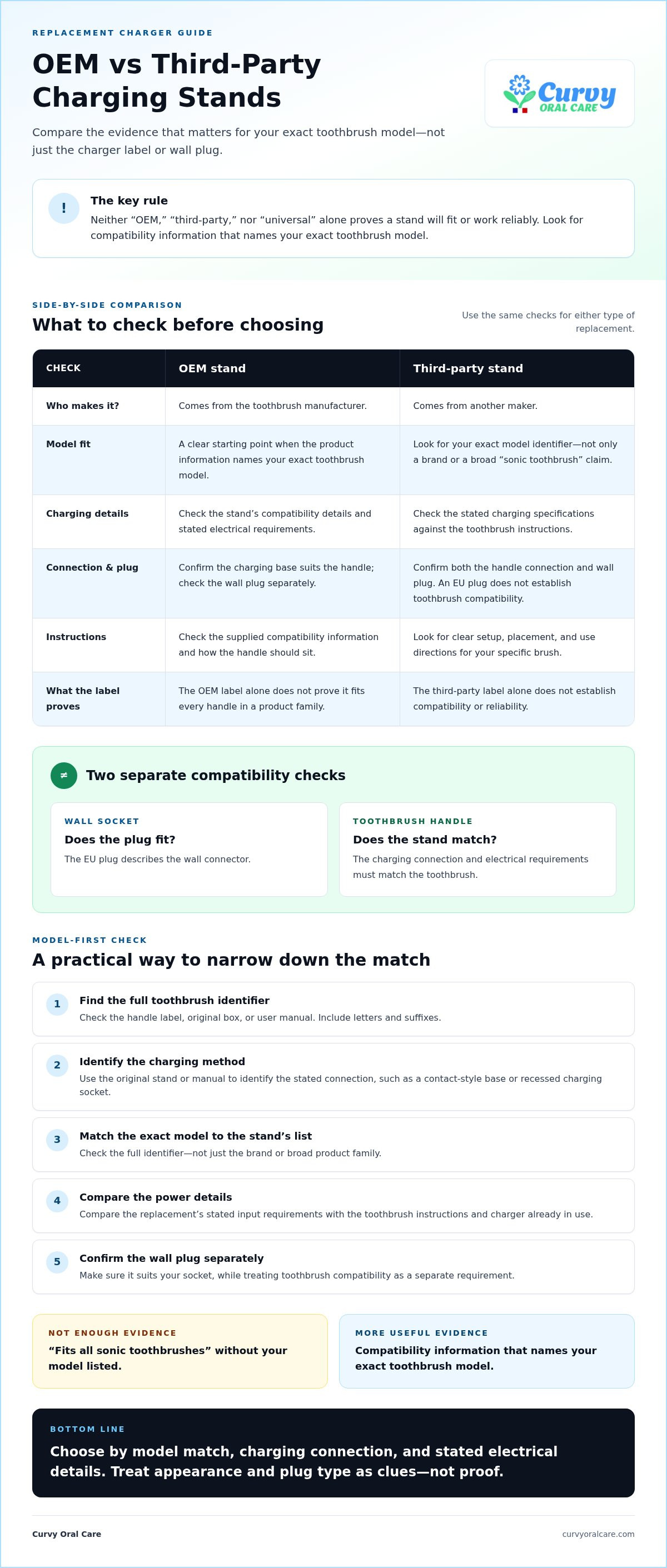
Use this sequence to narrow down a compatible replacement:
- Find the model name or number. Check the handle label, original box, or user manual. Record the full identifier, including letters and suffixes.
- Identify the charging method. Look at the original stand and manual for a contact-style base, a recessed charging socket, or another stated connection.
- Compare the stand’s model list. Match the full toothbrush identifier, not just the brand or broad product family.
- Check the power details. Compare the replacement’s stated input requirements with the toothbrush instructions and the charger already in use.
- Confirm the EU plug separately. Make sure the plug suits your wall socket, while treating toothbrush compatibility as a separate requirement.
If the label has worn away, use a clear photo of the handle and original base. Compare their shape, charging area, and printed identifiers with the replacement description. A product photo can help distinguish a stand from a cable or travel case, but appearance alone cannot confirm compatibility. A close visual match is a clue, not a model match.
Read “universal” claims carefully. The word may describe a plug or a charger intended for several listed models. It doesn’t automatically mean every sonic toothbrush will charge on that stand. Look for the exact model name or a compatibility list that includes it. A brand name without a model range isn’t enough to establish a match.
For example, a toothbrush labelled “Model AB-200” needs a stand that names AB-200 or clearly includes its model family. A stand described only as fitting “sonic toothbrushes” leaves the key compatibility question unanswered. Likewise, an EU plug on a charger doesn’t show whether its charging connection fits your particular handle. Keep the model number and connection type together when comparing options.
If your household has several handles, such as adult and children’s brushes, don’t assume one stand charges them all, even if they share a brand. Check each model identifier against the stand’s compatibility information. A shared charging area may not suit every handle, so check the stand’s compatibility information.
When the original stand is missing, use the toothbrush manual or packaging to identify the required charger before buying. If those materials are unavailable, the model label is the best starting point. A compatible sonic toothbrush charger replacement stand must match the toothbrush’s stated charging requirements; a convenient plug or familiar brand alone isn’t enough. This model-first approach helps prevent mismatched purchases and keeps replacement decisions specific to the brush you own.
Are OEM or third-party replacement charging stands safer and more reliable?
An original equipment manufacturer (OEM) stand comes from the toothbrush manufacturer; a third-party stand comes from another maker. Neither label alone proves that a charger fits your brush or will perform reliably. Check the exact model match, electrical details, and information supplied with the stand. A listing that names your toothbrush model offers more useful evidence than one described only as “universal.”
An OEM replacement is a clear starting point when its product information identifies your exact toothbrush model. That match links the accessory to your brush rather than to a broad category. Still, read the stand’s compatibility details. A familiar logo or similar shape doesn’t prove it fits every handle in a product family.
Assess a third-party option model by model, too. Look for your exact toothbrush identifier, clear charging specifications, and instructions explaining how the handle should sit. A listing that names specific models is more useful than a claim that it works with all sonic toothbrushes. If your model isn’t listed, the information doesn’t establish compatibility.
Compare the options using these checks:
- Model fit: Match the full handle identifier with the stand’s compatibility information.
- Electrical details: Compare the stand’s stated input and output with the toothbrush instructions.
- Plug and connection: Check that the wall plug suits your outlet and the charging base suits your handle.
- Instructions: Look for clear setup, placement, and use directions for your specific brush.
- Product identity: Note the manufacturer or seller name, model description, and included charger components.
Separate electrical compatibility from plug convenience. An EU plug can fit the wall while the stand remains unsuitable for the toothbrush. Likewise, a compatible charging base still needs the correct power details. Assess each part independently instead of relying on one label.
Reliability also depends on how the stand works in practice. It should sit steadily, hold the handle as instructed, and charge without awkward positioning. Follow the supplied directions instead of adding adapters or improvised parts. If a replacement feels loose, has a damaged cable, or differs from its instructions, stop using it and choose a properly identified alternative.
Keep the packaging or product description with your toothbrush model details. This record makes it easier to compare replacements later or identify the accessory you purchased. Note whether the listing named your exact handle and whether its power information matched the manual. That’s more useful than remembering only that the stand was advertised as universal.
Choose the OEM stand when its model information clearly matches your brush and its instructions suit your setup. Consider a third-party replacement when it provides equally specific compatibility and electrical details. If neither option identifies your model, don’t treat appearance, brand familiarity, or an EU plug as proof of a match.
What should I check if my toothbrush does not charge on its replacement stand?
First, check the match between the handle and stand. A replacement that looks right can still have an incompatible charging connection. Compare the toothbrush model identifier with the stand’s compatibility details. If they don’t match, stop testing that pairing and find a stand specified for your handle.
Next, inspect the power path from the wall outlet to the toothbrush. Follow the stand’s instructions, and unplug it before checking its cable or base. Look for a loose plug, visible cable damage, or a stand that shifts on the counter. If the cable is frayed, stop using that stand rather than testing it again.
Use this sequence to check the setup safely:
- Test the outlet. Check whether the wall switch is on. If appropriate, test the outlet with another working device.
- Inspect the cable and plug. Look for cuts, crushing, bent parts, or a loose connection. Don’t use damaged charging equipment.
- Check the toothbrush contacts. With the stand unplugged, inspect the charging area for toothpaste residue, dust, or moisture.
- Clean and dry carefully. Wipe accessible surfaces with a clean, dry cloth. Avoid pouring liquid onto the handle or stand.
- Seat the handle correctly. Place it on the base as the manual shows. Check whether it sits straight and makes the intended contact.
- Observe the indicator. Follow the toothbrush instructions to interpret any light or display. Indicator meanings vary by model.
Residue can interfere with contact between the handle and stand. For example, dried toothpaste around a charging surface may keep the handle from sitting flat. Gently remove visible residue, then let both surfaces dry fully before reconnecting power. Don’t scrape contacts with metal tools or force the handle into position.
Compare the charger’s stated electrical details with the toothbrush manual. A plug that fits an EU wall socket doesn’t prove that its output suits the brush. Don’t add an adapter or substitute another power supply unless the instructions specifically allow it. The sonic toothbrush charger replacement stand must match both the model and its stated charging requirements.
If you have the original stand, use it only if it’s undamaged and specified for that toothbrush. Test the handle on that base according to its instructions. If it charges there, the replacement stand or its power supply may be the issue. If neither stand works, the handle or its battery may need attention.
Stop testing if you notice unusual heat, a burning smell, sparking, or visible damage. Disconnect the stand from power when safe, and don’t open its casing. Keep the model number, stand description, and observed indicator behavior together. These details can help identify a setup problem or faulty accessory when seeking support.
Are replacement toothbrush charging stands covered by warranty, and where can I get support?
Warranty coverage depends on the terms supplied with the toothbrush or replacement stand. A toothbrush warranty doesn’t automatically cover a separately purchased charging stand. Read the terms for the specific item and identify who handles claims: the toothbrush manufacturer, the stand’s manufacturer, or the seller named on your order.
Start by identifying which product you’re asking about. If the stand came in the toothbrush box, check the toothbrush warranty and included-accessory terms. If you bought the stand separately, use its packaging, receipt, or order record to find the applicable terms. An original stand supplied with a brush and a third-party stand purchased later may have different warranty documents and support routes.
Warranty terms define the covered product and claim conditions. Look for the product name or model, coverage period, proof-of-purchase requirements, and exclusions. Check how the document treats defects, accidental damage, normal wear, and unauthorized modification. Don’t assume a charging failure is automatically covered; describe what happened and follow the applicable terms.
Prepare these details before contacting support:
- Toothbrush identification: Record the handle’s model name or number.
- Stand identification: Note the stand’s brand, model, and seller.
- Purchase record: Locate the receipt, order confirmation, or other proof requested by the warranty document.
- Problem description: State when charging stopped and what checks you performed.
- Condition details: Report visible cable, plug, or stand damage accurately.
Contact the organization named in the relevant warranty or order record. For a stand supplied with the toothbrush, the toothbrush manufacturer is the logical contact. For a separately purchased stand, use the seller or manufacturer identified in its records. If the documents name different parties, contact the one responsible for that item. Keep any support reference or written reply with your purchase records.
Explain the issue plainly. For instance, say that the handle model is AB-200, the replacement stand is identified as model CD-10, and the handle doesn’t charge when seated as instructed. Include whether the stand’s indicator responds, if the manual describes one. Clear details help support distinguish a model mismatch from a product fault without guessing.
Don’t open a charging stand or alter its cable while a warranty question is unresolved. Changes can complicate an assessment, and damaged electrical equipment shouldn’t be used. Keep the original packaging and instructions until you understand the support route. If the terms exclude the issue, use the model and electrical details to select a suitable replacement.
If you’re considering a fresh brushing setup rather than replacing a charger, explore this sonic toothbrush and toothpaste travel set. For warranty support, though, start with the document and seller tied to the charging stand itself.
Curvy Oral Care: Sonic Toothbrushes
Curvy Oral Care offers sonic toothbrushes for readers choosing a toothbrush and charging setup. A replacement stand still needs to match the exact toothbrush model, so don’t assume a stand for another sonic brush will work. For daily care, pair your brush with suitable replacement brush heads, or choose a brush head subscription to support regular replacements.
Access matters, too. Curvy Oral Care’s angled toothbrushes are designed to help users reach areas that can be difficult to access with a conventional straight brush, including back molars and the gumline. Choose products around your routine and the areas you want to reach, while checking model compatibility for charging accessories.
Explore Curvy Oral Care’s oral-care options at curvyoralcare.com.
Make your next oral-care choice with confidence
A routine is easier to maintain when its tools are simple to use. Once you’ve settled the charging question, consider whether your brushing setup supports the habit you want to keep. You might replace an accessory or choose a different toothbrush setup that better fits your routine. A sonic toothbrush charger replacement stand is one part of the setup; consistent brushing remains the key habit.
Choose deliberately, then make your routine easy to repeat. Keep your toothbrush and essentials together, follow the product instructions, and make brushing a regular part of your day. Small, sustainable choices can support oral-care habits over time.
Explore a sonic toothbrush and toothpaste travel set as one option for refreshing your routine. Keep moving toward care that feels manageable, consistent, and right for you.
Frequently Asked Questions
Which sonic toothbrush brands and models use a replacement charging stand?
Charging accessories vary by brand and model, so no single stand fits every sonic toothbrush. The Y Angled Sonic Toothbrush includes a charging station with a USA plug, while the OrthoKing Sonic Toothbrush kit includes a USB charger. These different accessory types don’t establish compatibility with other handles. Check the details for your specific model before choosing a replacement.
How can I identify the correct charger stand for my sonic toothbrush model?
Use the exact model name and charger details supplied for the handle. Check the toothbrush label, packaging, or manual, then compare the charger’s identification and electrical markings. For instance, a model supplied with a USB charger may require a different setup from one supplied with a station. Keep the product label or order record handy when comparing replacement accessories.
Are sonic toothbrush charging stands interchangeable between brands or models?
Don’t assume the chargers are interchangeable. Similar shapes, charging methods, or brand families don’t establish that two handles share the same electrical requirements. Compatibility depends on the specific pairing being identified as suitable. A USB charging accessory for one handle, for example, isn’t automatically suitable for another USB-charged brush. Use accessories specified for your model rather than testing a near-match just because it appears to fit.
What voltage, plug type, and charging specifications should a replacement stand match?
A sonic toothbrush charger replacement stand must match the toothbrush’s specified input and charging requirements, not just its wall plug. Compare the charger label with the manual, including input and output values, connector type, and any stated polarity. The plug must also fit the outlet. Don’t assume a plug adapter converts voltage: it changes plug fit, not necessarily the electrical output delivered to the charger.
Can a sonic toothbrush charge on a universal inductive charger or USB charging base?
Use an alternative only if the toothbrush maker identifies that charger as compatible with the exact model. “Inductive” describes a charging method, while USB describes a power connection; neither label alone confirms that a handle will charge on a particular base. A USB cable may power a model-specific charger rather than charge the handle directly. Check the product instructions before using a universal base, wireless pad, or alternate USB supply.
Health & Medical Disclaimer: This content is brought to you by Curvy Oral Care for general educational purposes only and isn’t a substitute for professional dental or medical advice, diagnosis, or treatment. Consult a qualified healthcare professional about personal health concerns or persistent oral-health changes.

Article by
Aline Peixe Nebot
Aline Peixe Nebot is a Veterinarian and passionate advocate for better oral health, committed to raising awareness of oral health as a matter of public health. She actively promotes the importance of simple, effective oral care routines and works to educate the public about the often-overlooked link between oral health and overall systemic health. Her mission is to make better oral care knowledge accessible to everyone and encourage healthier habits for life.
Disclaimer
Disclaimer: The information provided in this article is intended for general educational and informational purposes only. It is not intended to replace professional medical, dental, or healthcare advice, diagnosis, or treatment.
Some content may be AI-assisted and is provided to support health education and awareness. While we strive to share accurate and up-to-date information, health recommendations and scientific evidence can evolve, and the information presented may not apply to every individual.
The connection between oral health and overall systemic health is an important and developing area of research. Associations discussed in this article should not necessarily be interpreted as proof of cause and effect.
Always consult a qualified dentist, physician, or other healthcare professional regarding your individual health, symptoms, medications, or treatment decisions. Do not delay or discontinue professional care based on information presented in this article.
This content is for education and awareness—not diagnosis or treatment.