
Non Toxic Childrens Mineral Toothpaste: Which Ingredients and Safety Factors Matter
Hydroxyapatite is one ingredient to consider in non-toxic children’s mineral toothpaste, but it isn’t the only factor that matters. For babies under two, use no more than a smear about the size of a grain of rice, since young children may swallow toothpaste.
It makes sense to check ingredients carefully when choosing toothpaste for a child. The label, your child’s age, and how likely they are to swallow toothpaste all help guide a sensible choice.
This guide explains what hydroxyapatite is, how it differs from fluoride, and which ingredients and safety details to consider. It also compares toothpaste and tooth powder and offers ways to make brushing a practical, supervised part of your child’s daily routine.
Key Takeaways
- Compare ingredients such as hydroxyapatite, xylitol, baking soda, and coconut oil, and consider what each contributes to a child’s toothpaste.
- Learn what hydroxyapatite is and why its role in supporting enamel is part of the discussion about children’s mineral toothpaste.
- Use a rice-grain-sized smear for children under two, and supervise brushing so you can guide the amount and help limit swallowing.
- Assess toothpaste and tooth powder labels carefully, including the form of nano-hydroxyapatite when it is present.
- Make brushing more effective by guiding children along the gumline and toward hard-to-reach areas, not just the visible tooth surfaces.
1. Fluoride–Should It Be Used Inside Toothpaste or Drinking Water?
Fluoride in toothpaste and fluoride in drinking water are separate exposure routes. When comparing children’s toothpaste, consider the label, flavor, and your child’s ability to spit. The choice isn’t simply “natural” versus “effective”: ingredients and brushing habits matter. Hydroxyapatite toothpaste is another option to explore, but assess claims about mineral formulas carefully.
Guidance on fluoride toothpaste varies by age and ability to spit. Some recommendations introduce it when a child’s first tooth appears, usually around six months. Other guidance recommends starting when a child can reliably spit, typically around age three. These are different approaches, not one universal starting point. Consider your child’s age, swallowing habits, and the advice that guides your family’s oral-care decisions.
Concerns about fluoride often focus on repeated swallowing during tooth development. Excessive fluoride ingestion over time can cause faint white spots called fluorosis. Fluoride-free toothpaste avoids fluoride as an ingredient, but still check the full formula and supervise brushing. Flavor can affect cooperation: a child who rejects mint may accept a mild fruit flavor more readily. Choose a product that suits your child’s age and brushing stage.
Hydroxyapatite is a calcium phosphate mineral found in tooth enamel. Researchers have studied it in toothpaste for enamel remineralization, or the return of minerals to weakened enamel. Evidence for these formulas is still developing, and findings about one formulation don’t prove that every product performs equally. Compare the actual ingredients and claims rather than assuming “mineral” guarantees a specific result.
Prices for children’s mineral toothpaste vary with the formula, package size, and seller. Check the full ingredient list and age directions on pharmacy or grocery-store shelves, or on brand websites. “Organic” and “fluoride-free” describe different product qualities; neither label alone establishes suitability or effectiveness. Consider flavor, ingredients, and directions together before choosing a product for your child.
To compare products practically, note your child’s age, preferred flavor, tendency to swallow, and the ingredients in each candidate toothpaste. Compare fluoride-free options with hydroxyapatite formulas without assuming their labels promise equivalent results. Choose a product your child tolerates and an adult can dispense and supervise. During brushing, guide the brush along the gumline and around back molars, where plaque can accumulate and irritate gums.
2. Does Hydroxyapatite Belong In The Best Non-Toxic Toothpaste For Toddlers?
Hydroxyapatite is useful to understand, but the name alone can’t tell you whether a toothpaste suits a toddler. Products differ in particle size, formulation, directions, and intended use. Treat each label as information about a specific formula, not as interchangeable evidence for every product described as mineral toothpaste.
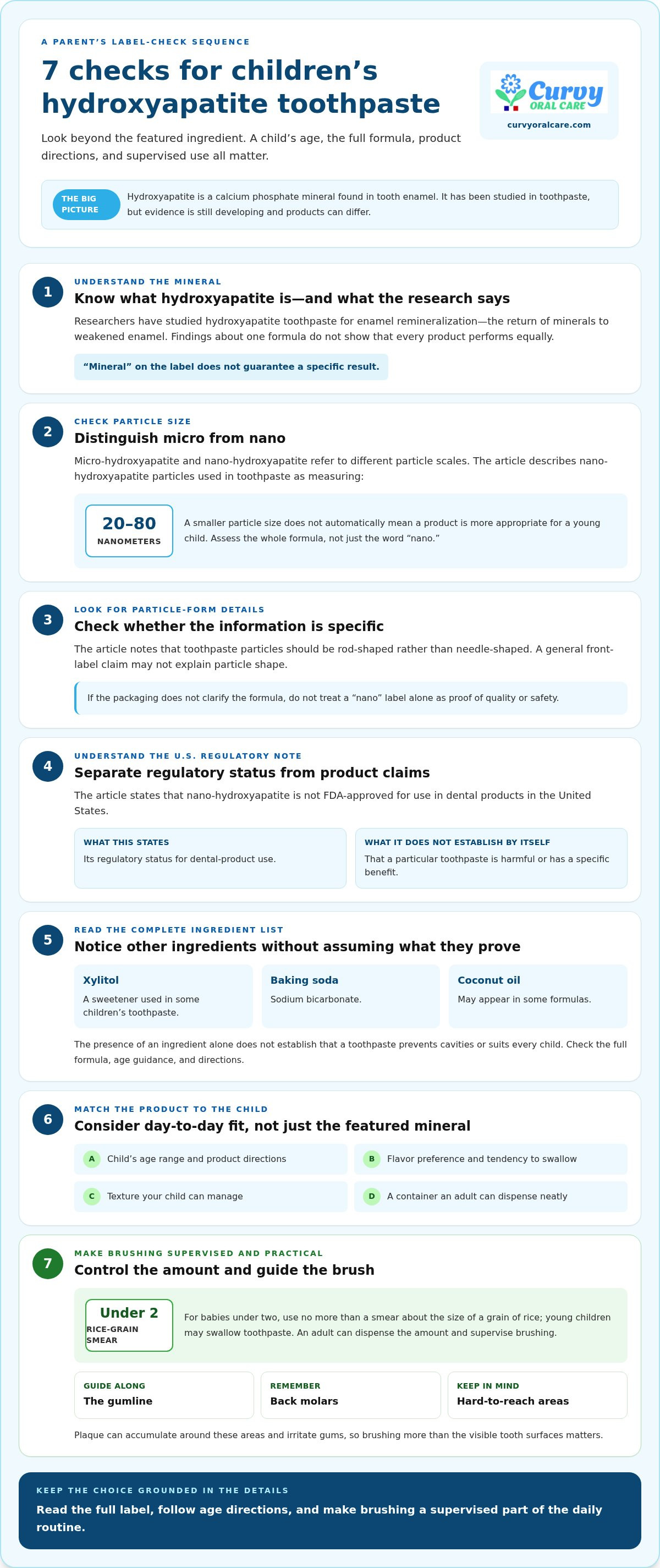
Particle size is one useful distinction. Micro-hydroxyapatite and nano-hydroxyapatite refer to different particle scales; nano-hydroxyapatite particles described for toothpaste measure 20 to 80 nanometers. Smaller particles don’t automatically mean a product is more appropriate for a young child. Look for clear ingredient information and assess the whole formula rather than choosing based on the word “nano.”
Particle shape is another consideration in discussions of nano-hydroxyapatite. Toothpaste particles should be rod-shaped rather than needle-shaped. A general claim on the front label may not explain particle shape, so examine the detailed ingredient information and product claims. If the packaging doesn’t clarify the formula, don’t treat a “nano” label alone as proof of quality or safety.
There’s also a regulatory distinction for shoppers in the United States: nano-hydroxyapatite isn’t FDA-approved for use in dental products. Understand that status precisely. By itself, it doesn’t prove a particular toothpaste is harmful or establish that it has a specific benefit. Separate the regulatory fact from claims about effectiveness and your family’s decision about what to use.
For a toddler, practical use matters as much as the featured mineral. Check the stated age range and directions, and make sure an adult can dispense a controlled amount. Consider whether your child can manage the texture and whether the container helps prevent spills or unsupervised use. A product that’s difficult to dispense neatly can make an already hands-on routine harder.
Hydroxyapatite also occurs in dentin, the layer beneath enamel. That detail helps explain why the mineral is discussed in oral-care products, but it isn’t a reason to assume every toothpaste offers the same result. Read the complete formula, pay attention to the child’s age, and keep professional dental visits part of routine care. For a travel setup that keeps toothpaste and a brush together, consider this toothbrush and toothpaste travel case.
3. Ingredients including xylitol, baking soda, and coconut oil
Start with the ingredient list, not claims such as “natural” or “gentle.” Xylitol is a sweetener used in some kids’ toothpaste, while baking soda is sodium bicarbonate. Coconut oil may also appear in some formulas. These ingredients serve different purposes, and their presence alone doesn’t establish that a toothpaste prevents cavities or suits every child. Check the product’s age guidance, directions, and complete ingredients before choosing.
What should children avoid, including SLS, artificial sweeteners, or essential oils? There isn’t one universal avoid list supported by the information available here. Instead, check for known sensitivities, follow the product’s age directions, and ask a dental professional about your child’s specific needs. Sodium lauryl sulfate (SLS) helps create foam, but foam doesn’t measure cleaning. Evaluate an artificial sweetener or essential oil by its exact name, not a broad label.
For a baby or toddler, keep the routine simple: read the full label and use only the amount directed for the child’s age. Don’t treat “organic,” “plant-based,” or “chemical-free” as proof of safety. These phrases don’t tell you whether your child tolerates the flavor, whether the texture is suitable, or how much toothpaste to use. If irritation develops after use, stop using the product and seek professional advice.
Texture matters, too. Baking soda can make a paste feel different from a smooth gel, while mineral formulas may contain fine particles. A child who dislikes a gritty texture or strong mint flavor may resist brushing. Choose a flavor your child accepts, then supervise brushing and guide the brush along the gumline, around back molars, and across other hard-to-reach spots. A pleasant flavor can help with cooperation, but it doesn’t replace thorough brushing.
Packaging claims can blur the difference between ingredient choice and demonstrated performance. “Sulfate-free” tells you the formula excludes sulfates, not that it cleans better. “Non-toxic” doesn’t explain the dose, age range, or what to do if toothpaste is swallowed. When comparing non-toxic children’s mineral toothpaste, consider the ingredient panel, directions, flavor, and package statements together. Look for specific ingredient names rather than relying on colors, badges, or broad promises.
Keep your child’s needs in mind as you compare options. If xylitol, coconut oil, or a particular essential oil is listed, consider whether your child has reacted to that ingredient before. Don’t assume every ingredient is harmful or every botanical ingredient is automatically gentle. A practical choice is one your child tolerates, a caregiver can dispense appropriately, and your family can use consistently alongside careful cleaning and regular dental visits.
4. Toothpaste safety for children who may swallow it
Young children often swallow toothpaste while brushing, so the amount on the brush matters. For babies under two, use no more than a smear about the size of a grain of rice. For toddlers ages two to three, use a pea-sized amount. These portions are easier to control than covering the brush with paste. An adult should dispense the toothpaste and stay close while the child brushes.
Supervise children under six while they brush. Watch how much toothpaste goes onto the brush, whether your child spits, and whether they try to eat the paste. Keep the tube out of reach between brushing sessions. A child still learning to spit needs close guidance, even if the toothpaste is fluoride-free or marketed as remineralizing.
Read the label carefully for xylitol, just as you would for other ingredients. Check the package directions and age range, and don’t let a baby handle or suck on the tube. When comparing a paste with xylitol to one without it, consider the complete formula and your child’s likelihood of swallowing it.
“Natural,” “gentle,” and “baby-safe” are package claims, not substitutes for directions. Read the full ingredient list, including sweeteners, flavorings, and botanical extracts. A toothpaste containing an herb extract, for example, still needs to be used as directed. The same applies to a named brand, such as Risewell: its name alone doesn’t tell you the right amount or how a child should use it.
Make brushing a guided routine. Dispense the age-appropriate smear or pea-sized amount, brush the teeth, and prevent your child from eating toothpaste straight from the tube. Focus on the gumline and back molars, where a child may need an adult’s help reaching. If a strong flavor or unfamiliar texture puts your child off, a milder-tasting formula may make supervised brushing easier without changing the amount used.
After brushing, store the tube securely and wipe paste from the cap. Keep the packaging handy so you can refer to the ingredients and directions. Tooth powder needs the same attention to portions and supervision as paste; loose particles can be harder for a young child to control. Choose a format an adult can dispense neatly, and focus on calm, consistent brushing rather than letting a child manage the product alone.
5. Toothpaste and tooth powder product investigations
Compare the whole label, not just the words “mineral” or “non-toxic.” Check the active ingredients, particle form, age directions, flavor, and amount to use. For example, a toothpaste listing hydroxyapatite should name it in the ingredients. A claim on the front label alone doesn’t tell you its concentration or particle shape.
Particle details matter in nano-hydroxyapatite formulas. The available product guidance describes toothpaste particles measuring 20 to 80 nanometers and says they should be rod-shaped, not needle-shaped. That detail gives caregivers a specific label question to investigate. Nano-hydroxyapatite is not FDA-approved for use in dental products in the United States. This regulatory fact doesn’t, by itself, establish whether an individual formula is harmful or effective.
Toothpaste and tooth powder also differ in how caregivers dispense them. Paste comes in a tube; powder is loose and needs careful handling. For a young child, an adult should measure the amount rather than letting the child scoop or shake product onto a brush. Check the package directions for age guidance and use instructions. A product labeled for babies ages 6–24 months, for example, should be evaluated against the child’s age and the package’s stated use.
Flavor is another practical consideration. Vanilla, fruit, or mint can make a formula more or less appealing to a child, but flavor doesn’t show how well the product cleans. Likewise, color, “natural” wording, and packaging badges don’t replace the ingredient panel. Look for clear information about the formula, how to use it, and whether the label names a specific mineral form.
Match claims to the evidence they describe. “Remineralizing” refers to restoring minerals to weakened enamel, but it doesn’t mean every product has identical ingredients or study results. “Sulfate-free” describes an excluded ingredient category; it doesn’t establish cleaning performance. An EWG baby-toothpaste category listing, for instance, is a product listing, not proof that all formulas share the same composition or results.
Use a simple comparison before choosing: note the child’s age, the listed ingredients, the product format, and the directions. Then consider whether an adult can dispense it neatly and supervise brushing along the gumline and back molars. For a routine that keeps toothpaste and a toothbrush together, choose the toothbrush and toothpaste travel case. A clear label and controlled use make product comparisons more practical than broad claims.
Curvy Oral Care: Sonic Toothbrushes
Curvy Oral Care offers sonic and angled toothbrushes for people looking to make daily brushing more thorough. An angled brush can help reach areas that may be awkward to access with a conventional straight brush, including back molars and the gumline. Guide the brush across each tooth surface rather than rushing over only the visible areas.
Replacement brush heads and brush head subscriptions can help you keep replacement heads in your regular oral-care routine. These tools complement, rather than replace, careful brushing and regular dental visits. To refine your family’s brushing routine, explore Curvy Oral Care’s toothbrush options and choose a style suited to the areas that are harder to reach.
Visit curvyoralcare.com to learn more about Curvy Oral Care’s toothbrushes.
Build a Routine Your Child Can Keep
Toothpaste is only one part of a child’s oral-care routine. The next step is making the whole routine calm, consistent, and easy to repeat. Notice what helps your child take part: a familiar flavor, a steady brushing rhythm, or choosing their toothbrush. Small preferences can encourage cooperation without making oral care feel like a battle.
As you compare non-toxic children’s mineral toothpaste, keep the product label and your child’s everyday experience in view. A routine that works for your family should include careful brushing, attention to the gumline, and regular dental visits. Bring ingredient questions or changes in your child’s mouth to a dental professional, especially if concerns persist.
For a simple way to keep brushing essentials together, explore the toothbrush and toothpaste travel case. Choose one manageable habit to reinforce tonight, and help your child build confidence with each brushing.
Frequently Asked Questions
Does Hydroxyapatite Belong In The Best Non-Toxic Toothpaste For Toddlers?
Hydroxyapatite can be one ingredient to consider, but it shouldn’t be the only deciding factor. For a toddler, compare the product’s age directions and packaging, and consider whether an adult can dispense it neatly. Think about whether your child accepts the taste and texture, too. A formula that’s difficult to use or routinely refused can make a consistent brushing habit harder to maintain.
Fluoride–Should It Be Used Inside Toothpaste or Drinking Water?
Toothpaste and drinking water are separate sources of fluoride exposure, so consider them separately in your family’s oral-care decisions. A toothpaste label identifies its ingredients; it doesn’t tell you about the water your household uses. Keep both details in mind when discussing your child’s routine with a dental professional, especially if you have questions about your local water supply or your child’s individual needs.
What Is Hydroxyapatite and Why Does It Matter for Babies?
Hydroxyapatite is a mineral used in some oral-care formulas and associated with tooth structure. Its presence alone doesn’t determine whether a product is suitable for a baby. Check that the intended age range and directions fit your baby’s stage, and keep the tube or container in an adult’s hands during use. The ingredient name alone doesn’t explain how to use the product safely.
What Toothpaste for Ages 2–5?
Choose toothpaste with clear directions for your child’s age, and consider whether its flavor and texture make brushing manageable. Children of the same age can differ in how comfortably they use a paste or gel, so observe how your child handles the routine rather than relying on packaging images. An adult can help keep brushing orderly and ensure the product is used as directed.
Can children’s hydroxyapatite toothpaste really help prevent cavities?
Hydroxyapatite is used in toothpaste intended to support enamel, but no ingredient name alone establishes how well a particular product prevents cavities. Look at the specific formula and its directions, then support prevention with thorough daily brushing and regular dental visits. If your child has a history of cavities or new dental concerns, share the product label with their dentist for advice tailored to their oral-health needs.
What ingredients should I look for in non-toxic mineral toothpaste for children?
There isn’t one ingredient checklist that suits every child. Start with the complete ingredient panel, then note anything your child has reacted to before, such as a particular flavoring or botanical ingredient. Compare the directions and intended age range, too. Terms like “natural” or “clean” don’t replace specific ingredient names, so use the actual label when comparing products or discussing a sensitivity.
Is fluoride-free mineral toothpaste effective for preventing cavities in children?
A fluoride-free label identifies an ingredient choice, but doesn’t by itself establish how well a product prevents cavities. Consider the formula, its directions, and whether your child can use it consistently as part of a thorough routine. Keep dental checkups on schedule so a professional can monitor changes and discuss prevention strategies suited to your child, rather than relying on a toothpaste label to answer every concern.
Which children's mineral toothpastes have fluoride and which are fluoride-free?
Use ingredient labels to distinguish products; don’t infer fluoride content from words like “mineral” or “children’s.” Curvy Natural Toothpaste is fluoride-free. For another product, read its ingredient panel and packaging rather than assuming formulas in the same category match. If a label is unclear, bring the package or a clear photo of its ingredients to your child’s dental appointment.
Health & Medical Disclaimer: This information is for general education and isn’t a substitute for professional dental or medical advice, diagnosis, or treatment. Consult a qualified professional about your child’s individual oral-health needs or persistent symptoms.

Article by
Aline Peixe Nebot
Aline Peixe Nebot is a Veterinarian and passionate advocate for better oral health, committed to raising awareness of oral health as a matter of public health. She actively promotes the importance of simple, effective oral care routines and works to educate the public about the often-overlooked link between oral health and overall systemic health. Her mission is to make better oral care knowledge accessible to everyone and encourage healthier habits for life.
Disclaimer
Disclaimer: The information provided in this article is intended for general educational and informational purposes only. It is not intended to replace professional medical, dental, or healthcare advice, diagnosis, or treatment.
Some content may be AI-assisted and is provided to support health education and awareness. While we strive to share accurate and up-to-date information, health recommendations and scientific evidence can evolve, and the information presented may not apply to every individual.
The connection between oral health and overall systemic health is an important and developing area of research. Associations discussed in this article should not necessarily be interpreted as proof of cause and effect.
Always consult a qualified dentist, physician, or other healthcare professional regarding your individual health, symptoms, medications, or treatment decisions. Do not delay or discontinue professional care based on information presented in this article.
This content is for education and awareness—not diagnosis or treatment.