
Kids Electric Toothbrush: How to Choose the Right One
The most feature-packed kids electric toothbrush isn’t necessarily the right one for your child. A timer, app, or bright design may sound helpful, but comfort, age suitability, and a brush your child can guide gently matter more.
It’s understandable to wonder whether an electric brush will make brushing easier, whether your child might press too hard, or how much help they still need. Choose a brush that fits your child’s mouth and ability, then build a consistent routine around it. No brush makes careful brushing effortless.
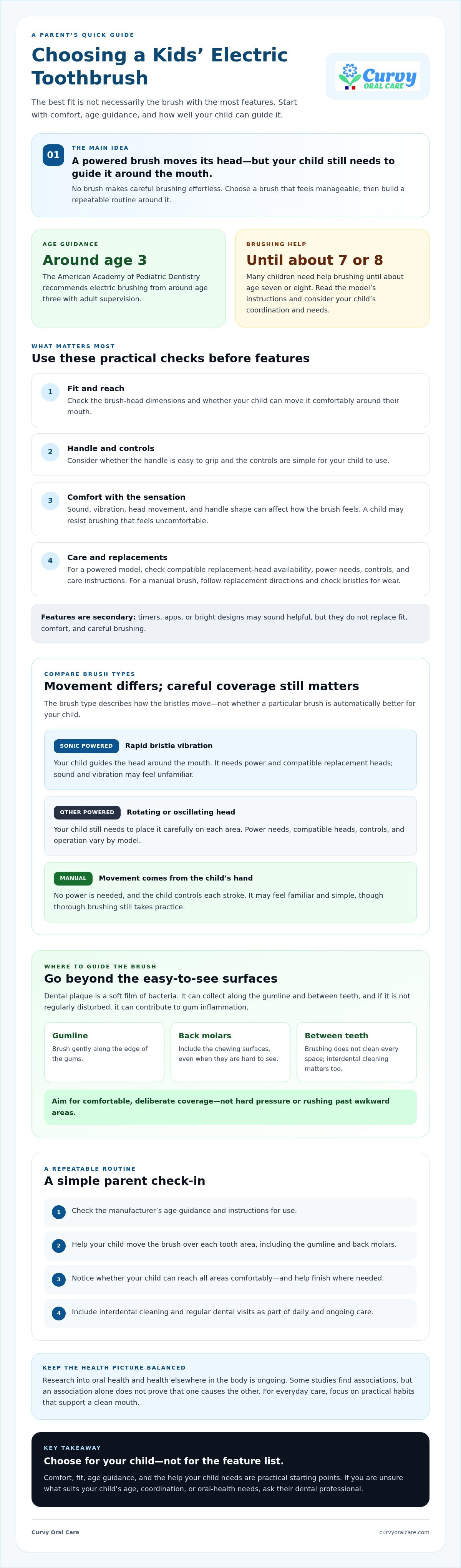
This guide compares practical features such as brush-head size, bristle softness, reminders, and handle comfort. It also covers age guidance: the American Academy of Pediatric Dentistry recommends electric brushing from around age three with adult supervision, and many children need brushing help until about age seven or eight. You’ll learn how to support gentle cleaning along the gumline and around back molars, and when to ask a dental professional for advice tailored to your child.
Key Takeaways
- Choose a kids electric toothbrush by fit, comfort, and how easily your child can handle it, not by the number of features.
- Compare sonic, other powered, and manual brushes by movement, upkeep, and what feels manageable for your child.
- Check product details such as brush-head dimensions, controls, replacement-head availability, and care instructions before buying.
- Build a repeatable routine that covers every tooth surface, then check whether your child needs help finishing.
- Use your child’s comfort and brushing ability to guide your choice, and ask a dental professional for advice tailored to their needs.
What matters when choosing a kids electric toothbrush?
Start with three practical questions: Is the brush comfortable for your child to hold? Can they tolerate how it feels and sounds? Can you help them use it as part of a routine you can repeat? A powered toothbrush moves its head using a motor, but it doesn’t guide itself around the mouth. Your child still needs to reach each area, and a caregiver may need to supervise or help.
Comfort and fit matter more than a long list of features. Electric brushes use different movements, including sonic vibration and oscillation. This overview of electric toothbrush classifications explains the broad categories, but the label alone can’t tell you which brush will suit your child. Check the product’s age guidance, brush-head dimensions, and instructions for use rather than assuming one age threshold applies to every model or child.
Gum health is also part of overall health and well-being. Research into connections between oral health and health elsewhere in the body is ongoing. Some studies find associations, but an association alone doesn’t prove that one causes the other. For everyday care, focus on practical habits that support a clean mouth, including brushing carefully along the gumline.
What makes a toothbrush appropriate for a child?
A suitable brush should feel manageable in your child’s hand and let them move the head comfortably around their mouth. Consider whether the handle is easy to grip, the controls are simple to use, and the brushing sensation is acceptable. If brushing feels uncomfortable, your child may resist using the brush, so a feature-rich model isn’t necessarily a practical choice.
Age guidance and supervision needs can vary. Read the manufacturer’s current instructions, and ask your child’s dental professional if you’re unsure what suits their age, coordination, or oral-health needs. A powered or manual brush may work, depending on the individual child. Curvy Oral Care’s mini sonic angled toothbrush for kids is one option to assess by reviewing its product details alongside your child’s comfort and ability.
Why gumline and back-tooth access matter
The front surfaces are only part of the job. Dental plaque, a soft film of bacteria, can collect along the gumline and between teeth. If it isn’t regularly disturbed, it can contribute to gum inflammation. Back molars and other hard-to-reach spots need attention too, even when they’re difficult to see.
Encourage your child to guide the brush deliberately over their teeth and gently along the gumline, including the chewing surfaces of back molars. Don’t press hard or rush past awkward areas. Brushing supports daily care, but it doesn’t clean every space between teeth or replace interdental cleaning and regular dental visits. Aim for a comfortable routine that covers more than the visible surfaces, not a promise that any brush will remove all plaque or prevent gum disease.
Sonic, oscillating, and manual brushes: what should parents compare?
Brush type tells you how the bristles move, not whether a particular brush is automatically better for your child’s gums. Compare how it feels, how your child can guide it, and what daily care it requires. With any type, thorough coverage still matters. A powered brush won’t automatically reach every surface, and gentle technique remains important.
| Brush type | Movement and handling | Routine and replacement | Child comfort |
|---|---|---|---|
| Sonic powered | Uses rapid vibration to move the bristles. The child guides the head around the mouth. | Requires power and compatible replacement heads. Check the product’s care instructions. | Sound and vibration may feel unfamiliar; consider the child’s response. |
| Other powered | May use a rotating or oscillating head. The child still needs to place it carefully on each area. | Requires power and compatible replacement heads. Controls and operation vary by model. | Head movement, sound, handle shape, and controls can affect comfort. |
| Manual | Bristles move through the child’s hand motion, so the child controls each stroke. | No power is needed. Replace the brush as directed, and check the bristles for wear. | May feel familiar and simple, though thorough brushing still takes practice. |
How a sonic toothbrush differs from other brush types
A sonic toothbrush uses fast bristle vibration, while some other powered brushes use a rotating or oscillating head. These terms describe movement, not a guaranteed cleaning result. Check product claims about performance against reliable evidence for that specific model. For a plain-language look at how sonic brushing is described for children, see this gentle sonic toothbrush guide for kids.
When a manual brush may fit a child’s routine
A manual brush can be a straightforward choice if your child is comfortable guiding it and you can help them brush thoroughly. Powered options may offer a different brushing feel or operation, but neither type removes the need to cover each tooth surface, the gumline, and back teeth. Choose what your child can tolerate and use with appropriate adult support.
For a manual option, review this angled manual toothbrush for kids and compare its product information with your child’s needs. If you’re also comparing a sonic toothbrush and toothpaste option, the sonic toothbrush and toothpaste travel-case product details offer another point of comparison.
Which kids electric toothbrush features are genuinely useful?
A useful feature solves a real routine problem. A brush that fits comfortably, is easy to guide, and can be cleaned and maintained without hassle may serve your child better than one with lots of extras. Focus first on fit and handling, then consider which additional features your child will actually use.
Brush-head design, bristles, and access
Check the product listing for brush-head dimensions and bristle details rather than assuming every child-sized brush is the same. The head should be manageable in your child’s mouth and easy to guide around the gumline and back molars. Spaces between teeth need separate interdental cleaning, since a toothbrush head may not reach between closely spaced teeth effectively.
Gentle contact and a steady pattern matter more than pressing hard. Encourage your child to move methodically across their teeth instead of scrubbing aggressively or rushing over less visible areas. If brushing brings persistent discomfort, bleeding, or another concern, ask a dental professional for advice rather than trying to solve it through a product change alone.
Controls and features that can support routine
Consider whether your child can hold the handle comfortably and operate its controls, or whether you’ll need to manage them. Timers, modes, and other features vary by model, so confirm what’s included on the current product page. A feature may support a routine, but it doesn’t prove a particular health outcome or replace attentive brushing.
Replacement-head availability and care instructions matter over time. Check which heads fit the brush, how the manufacturer says to clean and store it, and when to replace the head. A kid-friendly design is only practical if its upkeep fits your household routine.
To compare a kids’ angled sonic toothbrush, review its stated dimensions, age guidance, controls, replacement-head information, and care directions. Then consider how the design feels in your child’s hand and mouth. Curvy Oral Care describes its angled design as intended to help reach difficult areas. Treat that as a design detail to assess, not a promise of a specific cleaning result. The best fit is one your child can tolerate and use with your support.
How can parents make electric brushing work for kids?
A powered brush can make brushing feel different, but a simple routine helps a child cover the whole mouth. Keep the steps predictable and supportive. The goal isn’t a perfect performance every time; it’s to build steady habits and notice where your child still needs help.
A child-friendly brushing routine
Before brushing, check the brush’s instructions, add an age-appropriate amount of toothpaste, and help your child get into a comfortable position. Then use calm, specific prompts to guide them around the mouth instead of saying only “brush everywhere.” For example:
- “Start with the outside surfaces, including the teeth near your cheeks.”
- “Now guide the brush gently along the gumline.”
- “Reach the chewing surfaces and the back molars.”
- “Let’s check the inside surfaces before we finish.”
A caregiver can demonstrate the movement, guide the child’s hand, or check areas that are easy to miss, based on the child’s age and coordination. Keep the brush moving deliberately without forceful scrubbing. As children’s skills develop, adjust how much help you provide, but keep checking that all surfaces are included.
Brushing is one part of daily care. Follow your dental professional’s guidance on cleaning between teeth, since a toothbrush doesn’t replace interdental cleaning. Tongue cleaning can also be included in the routine. Regular dental visits help a professional monitor your child’s oral health and answer questions as their needs change.
Common concerns that deserve a dental professional’s advice
Persistent bleeding, swelling, pain, or another noticeable change in your child’s mouth deserves professional evaluation. These signs can have different explanations, so don’t try to diagnose the cause or assume a new toothbrush will resolve it. Contact your child’s dental professional for advice, especially if a concern continues or brushing is uncomfortable.
Questions about the right brush, technique, supervision, or your child’s individual oral-health needs are also worth raising at a dental visit. A professional can offer guidance based on your child, rather than general product claims.
To compare a product as part of your routine planning, review the details for this sonic toothbrush and toothpaste travel-case option, including its current instructions. Consider whether it suits your child’s comfort and your family’s brushing habits. A kids electric toothbrush is one tool in the routine; patient guidance and consistent care matter too.
Choosing a kids electric toothbrush: a practical decision and next step
There’s no single brush type that suits every child. A practical choice is one your child can tolerate and handle, and that you can help them use consistently. Compare powered and manual options based on your child’s comfort, coordination, and daily routine, not feature count alone.
A quick checklist before choosing
Before buying a kids electric toothbrush, check the details that affect everyday use:
- Fit: Review the brush-head dimensions and consider whether your child can move it around their mouth comfortably.
- Age guidance: Confirm the manufacturer’s current age recommendations and instructions for supervision.
- Comfort and handling: Think about the handle, controls, sound, and brushing sensation. A feature is only useful if your child can tolerate it.
- Access: Consider whether your child can guide the brush to the gumline and back teeth, with your help as needed.
- Upkeep: Check which replacement heads fit, how to clean the brush, and how to care for it between uses.
- Included items: Confirm the current product listing rather than assuming what comes with a brush or bundle.
A manual brush may feel familiar and straightforward. A powered model may suit a child who enjoys its sensation or finds it manageable. Curvy Oral Care offers a children’s angled sonic toothbrush as one option to assess. The brand describes its angled design as helping reach difficult areas, but this is a design consideration, not a promise of a particular health result. Compare the current product information with your child’s needs, just as you would with any brush.
Make the routine the priority
The right toothbrush supports a repeatable routine. Help your child brush gently across all tooth surfaces, including along the gumline and around the back molars. Continue to supervise or assist according to their ability, and include cleaning between teeth and the tongue as part of broader oral care. A toothbrush supports daily brushing, but it doesn’t replace those steps or regular dental visits.
Ask your child’s dental professional for individualized advice if you’re unsure which brush or technique is suitable. Seek professional evaluation for persistent bleeding, swelling, pain, or other ongoing changes in oral health. These concerns need a professional’s assessment, not a guess based on a product description.
Ready to review an option for your routine? Explore the Curvy toothbrush and oral-care bundle and check its current product details before deciding.
Choose a brush that supports a steady routine
The right kids electric toothbrush isn’t necessarily the one with the most features. Choose based on your child’s comfort, ability to handle the brush, and how well the routine helps them cover tooth surfaces, the gumline, and back molars. Powered and manual brushes can both be part of daily care when used consistently and with appropriate adult support.
Before choosing, check current product guidance for age suitability, brush-head details, replacement heads, care instructions, and included items. Remember that brushing is only one part of oral care. Cleaning between teeth and regular dental visits matter too, and a dental professional can offer individualized guidance if you have questions or notice persistent changes.
Curvy Oral Care offers children’s toothbrushes, including sonic and angled models. Review the current product information to see whether the described features fit your child’s needs, without treating any brush as a substitute for professional advice. Explore the Curvy toothbrush and oral-care bundle, then choose the option that feels practical for your family. Small, consistent habits are a positive step toward caring for your child’s teeth and gums.
Frequently Asked Questions
Is an electric toothbrush suitable for every child?
No. A powered brush may suit a child who is comfortable with its movement and can use it with appropriate help, but sound, vibration, grip, or controls may not work for everyone. Check the manufacturer’s current age guidance and instructions, and consider your child’s comfort and coordination. A dental professional can help you choose if your child has specific oral-health needs or finds brushing difficult.
Are sonic toothbrushes better than manual toothbrushes for kids?
Not for every child. A sonic brush uses vibration to move the bristles, while a manual brush is guided by hand. Research on powered brushes suggests potential plaque-removal benefits, but results vary by brush and study, and they don’t establish one format as the right choice for every child. Consistent, thorough brushing and suitable adult support matter whichever type your child uses.
What should I look for in a kids electric toothbrush?
Choose a kids electric toothbrush that fits your child’s mouth and feels manageable to hold and operate. Check the brush-head dimensions, bristle description, age guidance, replacement-head details, and care instructions on the current product page. Consider whether your child tolerates its sound and movement. Timers or modes may support a routine, but they aren’t proof of better health outcomes and can’t replace careful brushing.
Can a child use an electric toothbrush without adult supervision?
Not necessarily. Children’s coordination and brushing skills develop at different rates, so supervise or assist based on your child’s ability to reach every area and use the brush gently. The American Academy of Pediatric Dentistry recommends electric brushing from around age three with parental supervision; caregivers often need to help children brush effectively until about age seven or eight. Follow product instructions and ask your child’s dentist for individual guidance.
How should a child brush along the gumline and around back molars?
Encourage your child to guide the brush gently along the edge where teeth meet the gums, then cover the outer, inner, and chewing surfaces. Use simple prompts to move from one area to the next, including the back molars, which can be easy to miss. Avoid forceful scrubbing. Stay nearby to check coverage or help with spots your child can’t reach or manage confidently.
What should I do if my child's gums keep bleeding?
Arrange an evaluation with your child’s dental professional if bleeding continues, or if you notice swelling, pain, or another persistent change. Bleeding can have different explanations, so it isn’t possible to diagnose the cause from this symptom alone. Keep brushing gently unless a dental professional advises otherwise, and share when the bleeding happens and any other changes you’ve noticed to help guide their assessment.
Does an electric toothbrush replace flossing or dental checkups?
No. A toothbrush cleans tooth surfaces, but it may not adequately clean the spaces between teeth. Ask your child’s dental professional how to clean between their teeth and which approach is appropriate. Brushing also doesn’t replace regular dental visits, where a professional can monitor your child’s oral health and offer tailored advice. Think of an electric brush as one possible tool in a broader daily care routine.

Article by
Aline Peixe Nebot
Aline Peixe Nebot is a Veterinarian and passionate advocate for better oral health, committed to raising awareness of oral health as a matter of public health. She actively promotes the importance of simple, effective oral care routines and works to educate the public about the often-overlooked link between oral health and overall systemic health. Her mission is to make better oral care knowledge accessible to everyone and encourage healthier habits for life.
Disclaimer
Disclaimer: The information provided in this article is intended for general educational and informational purposes only. It is not intended to replace professional medical, dental, or healthcare advice, diagnosis, or treatment.
Some content may be AI-assisted and is provided to support health education and awareness. While we strive to share accurate and up-to-date information, health recommendations and scientific evidence can evolve, and the information presented may not apply to every individual.
The connection between oral health and overall systemic health is an important and developing area of research. Associations discussed in this article should not necessarily be interpreted as proof of cause and effect.
Always consult a qualified dentist, physician, or other healthcare professional regarding your individual health, symptoms, medications, or treatment decisions. Do not delay or discontinue professional care based on information presented in this article.
This content is for education and awareness—not diagnosis or treatment.