
Kids Angled Toothbrush: How to Choose the Right Brush for Your Child
Choosing a kids angled toothbrush is less about a clever shape and more about helping your child reach the teeth they often miss. An angled design may make positioning easier, but a familiar straight brush can also work well. Comfort, a manageable handle, and a routine your child can stick with all matter.
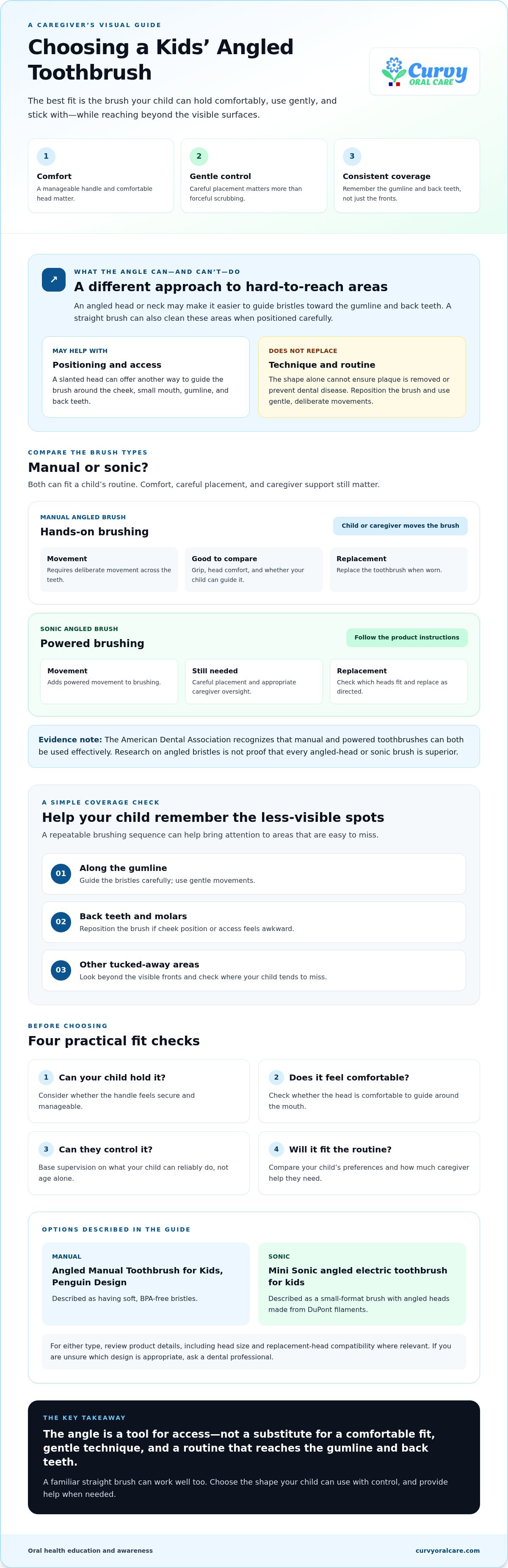
An angled head is designed to help reach areas that can be tricky to access with a conventional straight brush, including the gumline and back teeth. The brush still needs to feel comfortable in your child’s hand and mouth, and gentle technique matters more than technology alone.
This guide compares kids’ angled manual and sonic toothbrush options so you can choose based on your child’s comfort, brushing habits, and need for caregiver support. We’ll cover useful features, differences between brush types, and how an angled design may help with reach. The goal is a gentle, consistent routine that cleans beyond the visible surfaces, including along the gumline and around hard-to-reach teeth.
Key Takeaways
- Choose a kids angled toothbrush based on how comfortably your child can hold and use it, not appearance alone.
- Compare manual and sonic options against your child’s preferences, routine, and need for caregiver support.
- Look for soft bristles and a comfortable grip, and encourage gentle brushing rather than forceful scrubbing.
- A simple, repeatable brushing sequence can help children remember less-visible areas, including the gumline and back molars.
- Compare the manual penguin design, Mini Sonic brush, and compatible replacement heads to find an option that fits your family’s routine.
What makes a kids’ angled toothbrush different from a straight brush?
Children can brush the visible fronts of their teeth and still miss the gumline, back molars, and other tucked-away spots. A kids angled toothbrush has a slanted head or neck that changes how the bristles approach these areas. The angle may make positioning easier, but the brush’s shape alone can’t ensure plaque is removed or prevent dental disease. Careful technique and a routine your child can follow still matter.
Brush design has changed over time, as this overview of the history of the toothbrush illustrates. It’s useful to distinguish an angled head or neck, which can affect access and handling, from angled bristles, which describes the direction of the bristles themselves. These features aren’t interchangeable, and one design isn’t automatically right for every child.
How an angled head may help reach difficult areas
A slanted head can give a caregiver or child a different way to guide bristles toward the back teeth and along the gumline, especially when cheek position or a small mouth makes a straight approach awkward. A conventional straight brush can also clean these areas when positioned carefully. The practical question is which shape helps your child reach each surface with control.
Use gentle, deliberate movements. Pressing harder won’t make an awkward angle more effective, and forceful scrubbing can irritate the gums. Reposition the brush instead, and include less-visible areas in the routine.
What matters for a child’s comfort and control
Access only helps if the brush feels manageable. Consider whether your child can hold the handle securely, guide the head comfortably around their mouth, and reach the back teeth without strain. Check that the head size suits your child, and review the product information rather than assuming an age range. If you’re unsure which design is appropriate, ask a dental professional.
Coordination develops at different rates, so base supervision on what your child can reliably do, not age alone. Stay nearby or help with brushing if they miss surfaces, rush, or struggle to control the brush. For example, Curvy Oral Care describes its small-format Mini Sonic angled toothbrush for kids as having an angled head. Whether you choose a manual or powered brush, comfort and caregiver support remain central to a steady routine.
How to choose between a kids’ manual and sonic angled toothbrush
The right brush is one your child can use comfortably and consistently, with help when needed. A manual brush keeps brushing fully hands-on; a sonic brush adds powered movement. Neither replaces gentle technique or attention to the gumline and back teeth. The American Dental Association recognizes that manual and powered brushes can both be used effectively. Its research on toothbrush design discusses angled bristles, but that evidence shouldn’t be treated as proof that every angled-head or sonic brush is superior.
| What to compare | Manual angled brush | Sonic angled brush |
|---|---|---|
| Power source | Child or caregiver moves the brush by hand. | Powered brushing; follow the product’s instructions. |
| Brushing involvement | Requires deliberate movement across the teeth. | Still needs careful placement and caregiver oversight as appropriate. |
| Replacement needs | Replace the toothbrush when worn. | Check which replacement heads fit the brush and replace as directed. |
When a manual angled toothbrush may suit the routine
A manual brush may suit families who prefer a simple, hands-on routine or want to guide each brushing movement themselves. Curvy Oral Care describes its Angled Manual Toothbrush for Kids, Penguin Design, as having soft BPA-free bristles. Consider the angled kids’ penguin manual toothbrush if its design fits your child’s grip and brushing routine. The shape may help with positioning, but steady coverage matters more than the handle or head alone.
When to consider a kids’ sonic angled toothbrush
A powered option may be worth considering if your child prefers it or finds manual brushing movements challenging. Curvy Oral Care describes its Mini Sonic angled electric toothbrush for kids as a small-format brush with angled heads made from DuPont filaments. It still requires thoughtful placement and supervision suited to your child. Check the product information for compatible replacement heads; the supplied description identifies a two-pack with soft DuPont bristles.
Choose based on comfort, cooperation, and what your family can maintain morning and night. A sonic brush is an option, not a requirement for effective brushing. When comparing a kids angled toothbrush, start with the routine your child is most likely to follow, then check head fit, bristle softness, and replacement needs. You can also browse the kids’ toothbrush options to compare designs.
Which features should caregivers compare before choosing a kids’ angled toothbrush?
A useful brush should help your child reach beyond the visible fronts of their teeth without feeling awkward to hold or uncomfortable to use. Compare the head’s access, bristle softness, handle grip, and how easily the brush can be rinsed and kept clean. No single feature guarantees a thorough clean; gentle technique and caregiver support still matter.
Bristles, gumline comfort, and gentle technique
Plaque is a sticky film of bacteria that can collect on teeth and along the gumline. Bristles need to reach these areas without being pushed hard against the gums. Soft bristles are a helpful feature to look for, but a product description alone doesn’t prove a treatment effect or guarantee plaque removal. Guide your child to brush gently and deliberately, rather than scrubbing harder when an area feels difficult to reach.
If your child has persistent bleeding, swelling, or discomfort, seek guidance from a dental professional instead of trying to solve it by changing brushes or applying more pressure.
Brush-head fit and replacement compatibility
Check that the head feels manageable in your child’s mouth and that they can guide it around the back teeth. For a sonic brush, confirm replacement-head compatibility before buying replacements; heads aren’t automatically interchangeable across brushes. Curvy Oral Care describes its Replacement Toothbrush Head for Mini Sonic KIDS (Pack of 2) as compatible with the kids’ sonic brush and made with soft DuPont bristles.
Use this checklist to separate confirmed product details from questions worth checking:
- Confirmed: The Mini Sonic is described as small, with angled heads made from DuPont filaments. Its compatible replacement-head product is a two-pack with soft DuPont bristles.
- Verify: Does the head fit comfortably around your child’s teeth? Can they hold and guide the brush? Is the replacement head compatible with the exact sonic brush model?
- Check the routine: Can your child reach the gumline and back molars without pressing hard? Will you be able to supervise or assist where needed?
With any kids angled toothbrush, comfort and access should work together. A suitable brush supports access and control, while technique completes the routine.
How to build a child-friendly brushing routine with an angled toothbrush
A predictable sequence can make brushing easier to remember and help prevent rushed, skipped areas. An angled head may help with positioning, but the routine should still cover every tooth surface gently. The American Dental Association recommends brushing twice a day for two minutes; follow any individual guidance from your child’s dental professional.
A simple brushing sequence for hard-to-reach areas
Move around the mouth in the same order each time. A consistent path can help your child remember each area and make it easier for a caregiver to spot spots that need more attention.
- 1. Get ready. Use the child’s usual toothpaste and settle somewhere they can see or feel comfortable brushing. Start with a calm reminder to use gentle pressure.
- 2. Work around the teeth. Brush the outer surfaces, then the inner surfaces, and finish with the chewing surfaces. Follow a consistent pattern, such as top teeth before bottom teeth, so each area gets attention.
- 3. Slow down at the gumline and back molars. Guide the bristles near the gumline and use the angled head to help position the brush around the back teeth. Small, controlled movements are more useful than pressing harder.
- 4. Check and support. Invite your child to show you where they brushed. Help with surfaces they can’t yet reach or clean reliably, keeping the tone encouraging rather than critical.
Some children can manage most of the sequence independently; others benefit from hands-on help. Adjust your support to their coordination and consistency, and ask a dental professional if you’re unsure about their brushing technique.
Habits that support a healthy mouth beyond brushing
Brushing is one part of prevention. Plaque can remain between teeth, so clean those spaces when appropriate and follow a dental professional’s advice about suitable interdental cleaning. Gently cleaning the tongue can also be part of a daily routine. Regular dental visits give a professional the opportunity to check your child’s oral health and offer guidance tailored to their needs.
Healthy gums matter: plaque around the gumline can contribute to inflammation, so don’t focus only on the visible fronts of teeth. Research has found associations between oral health and aspects of overall health, but an association by itself doesn’t prove that one causes the other. Consistent care is a practical step toward a healthier mouth and supports general well-being.
A kids angled toothbrush may make positioning easier, while a steady routine builds thoroughness. Explore kids’ toothbrush options to compare designs for your family’s routine.
Which kids angled toothbrush option fits your family’s needs?
Start with the routine your child is most likely to manage. Some families prefer a simple manual brush they can guide themselves; others want to try a powered option their child enjoys. If you already use the Mini Sonic, compatible replacement heads are for maintenance, not a separate toothbrush.
A quick decision guide for the available kids’ options
- For manual simplicity: The penguin-design angled manual toothbrush is described as having soft BPA-free bristles. It may suit families looking for a non-powered brush and a hands-on brushing routine.
- For powered brushing: Consider the Mini Sonic if your child prefers a powered brush and its small format feels manageable. Its angled heads are described as being made from DuPont filaments. Check product details and supervise brushing as needed.
- For ongoing Mini Sonic care: The compatible replacement-head option is a two-pack with soft DuPont bristles. It’s intended for the Mini Sonic, not as a standalone brush, so confirm compatibility with your brush before choosing heads.
A multi-brush option may also be practical for families who want more than one manual brush. The listing for the three-pack of angled manual kids’ toothbrushes identifies a three-brush option; check the current product listing for its details rather than assuming what else is included.
Check the details and choose the next step
Match the brush to your child’s comfort, grip, and ability to follow a gentle routine. An angled design may help with positioning near the gumline and around back teeth, but no brush replaces careful coverage or caregiver help when needed. For questions about EMF and sonic toothbrushes, read the EMF-free sonic toothbrush guide and consider discussing individual concerns with a dental professional.
The right fit is the option your child can use consistently and comfortably, with support where needed. Explore kids’ angled toothbrush options to review the current choices and product details.
Make the Next Brush a Comfortable Fit
The right kids angled toothbrush isn’t simply the one with the most features. Look for a brush your child can hold and use comfortably, then build a gentle routine that covers the gumline, inner and outer surfaces, and back molars. An angled design may help with positioning, but consistent technique and caregiver support where needed complete the job.
For a manual option, the penguin-design brush is described as having soft BPA-free bristles. The Mini Sonic is described as having angled heads made from DuPont filaments, with compatible replacement heads available. Compare these details with your child’s preferences and brushing habits, and ask a dental professional if you’re unsure which design suits them.
Small, repeatable habits can support healthy gums and a cleaner mouth. Choose the brush that makes those habits easier to maintain, without expecting any one design to do the work on its own. Explore kids’ angled toothbrush options and review the product details as you decide what fits your family.
Frequently Asked Questions
What is a kids’ angled toothbrush?
A kids’ angled toothbrush has a slanted head or neck intended to help position the bristles around teeth that can be awkward to reach, such as back molars. The angle may make access easier for some children or caregivers, but it doesn’t guarantee plaque removal. Comfort, gentle brushing, and coverage of all tooth surfaces still matter. Check the product details to see whether the head, neck, or bristles are angled.
Is an angled toothbrush better for kids than a straight toothbrush?
Not necessarily. An angled design may help a child or caregiver reach certain areas, but a straight brush can also clean teeth effectively when it fits comfortably and is used carefully. The American Dental Association recognizes that both manual and powered brushes can be effective. Choose a brush your child can manage, then focus on a gentle routine that reaches the gumline, inner surfaces, and back teeth.
Can kids use a sonic toothbrush?
Yes, a child can use a sonic toothbrush if its head and bristles suit their mouth and they can tolerate its feel. A powered brush is an option, not a requirement for effective brushing. Check the product’s instructions and ask a dental professional if you’re unsure whether it fits your child’s needs. Stay involved according to your child’s coordination, helping them brush thoroughly and avoid swallowing toothpaste.
What should I look for in a kids’ angled toothbrush?
Look for a head your child can move comfortably around their teeth, soft bristles, and a handle they can grip and guide. Consider whether the angle helps reach the gumline and back molars without forcing an awkward wrist position. Also check how the brush is cleaned and, for powered models, which replacement heads fit. A kids angled toothbrush supports access, but technique and caregiver help complete the routine.
Are soft bristles suitable for a child’s gums?
Yes. Soft bristles are generally recommended because they can clean teeth while being gentler on gums than firmer bristles. Use light pressure and controlled movements, not forceful scrubbing. Soft bristles don’t mean brushing can be rushed or limited to visible surfaces; guide the brush along the gumline and around each tooth. If your child has ongoing gum discomfort or bleeding, ask a dental professional for advice.
How can I help my child brush the back teeth and gumline?
Use the same sequence each time so fewer surfaces are missed. Guide the brush gently along the outer, inner, and chewing surfaces, pausing at the gumline and back molars. For children, the American Dental Association recommends brushing for two minutes twice a day. An angled head may help with positioning, but check and assist with areas your child can’t yet reach or clean reliably.
When should I replace a kids’ sonic toothbrush head?
Follow the instructions for the specific sonic brush and replacement head, since compatible heads can have product-specific guidance. The American Dental Association advises replacing toothbrushes every three to four months, or sooner if bristles are visibly frayed or matted; check whether the manufacturer gives a different interval for the powered head. Use only heads confirmed as compatible with your child’s brush, and replace a worn head promptly.

Article by
Aline Peixe Nebot
Aline Peixe Nebot is a Veterinarian and passionate advocate for better oral health, committed to raising awareness of oral health as a matter of public health. She actively promotes the importance of simple, effective oral care routines and works to educate the public about the often-overlooked link between oral health and overall systemic health. Her mission is to make better oral care knowledge accessible to everyone and encourage healthier habits for life.
Disclaimer
Disclaimer: The information provided in this article is intended for general educational and informational purposes only. It is not intended to replace professional medical, dental, or healthcare advice, diagnosis, or treatment.
Some content may be AI-assisted and is provided to support health education and awareness. While we strive to share accurate and up-to-date information, health recommendations and scientific evidence can evolve, and the information presented may not apply to every individual.
The connection between oral health and overall systemic health is an important and developing area of research. Associations discussed in this article should not necessarily be interpreted as proof of cause and effect.
Always consult a qualified dentist, physician, or other healthcare professional regarding your individual health, symptoms, medications, or treatment decisions. Do not delay or discontinue professional care based on information presented in this article.
This content is for education and awareness—not diagnosis or treatment.