
Innovative Toothbrush Design: What Makes a Brush Work Better?
What if the toothbrush that looks most advanced isn’t the one that helps you clean better? A striking shape or smart feature can catch your eye, but useful innovative toothbrush design should address an everyday brushing challenge, such as reaching the gumline or back molars with comfort and control.
If you’ve wondered whether a new-looking brush offers a real benefit, focus on what it helps you do. A brush’s design can affect how easily you reach less-visible areas and maintain a consistent routine, but appearance and marketing claims aren’t proof of better results. This guide explains which features may make brushing more practical and how to assess claims realistically.
We’ll look at brush-head shape, angled designs, manual and powered options, and the role of technique in cleaning around teeth and gums. You’ll also learn how to choose a brush that suits your needs and build a simple routine that includes cleaning between teeth. Healthy gums are a foundation of oral health, and research continues to explore how oral health relates to overall well-being. The goal is practical: find a brush you can use effectively, day after day.
Key Takeaways
- Useful innovative toothbrush design addresses a real brushing need rather than relying on appearance or extra features to signal value.
- Consider how a brush’s head shape and handle feel affect access and control. Comfort and fit vary from person to person.
- Distinguish a design idea or marketing claim from evidence that a brush improves plaque removal or gum health.
- Use your own routine and hard-to-reach areas to guide your choice between manual and powered brushes.
- An angled toothbrush may help you reach difficult spots, but it still needs to be paired with consistent brushing technique.
Innovative Toothbrush Design: When Is a New Idea Actually Useful?
A toothbrush can look different without making brushing easier. A practical definition is simple: innovative toothbrush design is a change intended to improve access, control, comfort, or consistency during brushing, without guaranteeing better oral-health outcomes.
The distinction matters because plaque can collect along the gumline, between teeth, and around back molars, where it can be harder to position a brush. Reaching these areas depends both on the tool and the person using it. A thoughtful design may make brushing more manageable, but it can’t replace suitable technique or regular use.
Toothbrushes have changed in shape and mechanism over time. For a broad overview of the history and types of toothbrushes, consider how designs have evolved around the basic task of cleaning teeth. The useful question isn’t simply whether a brush is new. It’s what everyday brushing challenge the change is meant to address.
What makes a toothbrush design innovative?
Changes to the brush head, handle, or powered movement can target different needs. A smaller or differently shaped head may help some users maneuver around back teeth. A handle’s form may make a brush easier to guide. A powered brush changes how the head moves, but the user still needs to position it across tooth surfaces and near the gumline.
These are design intentions, not automatic results. The right fit varies from person to person, and every brush depends on consistent use and appropriate technique.
Useful improvement versus novelty
A feature deserves attention when it supports a real task: reaching a difficult spot, maintaining control, or making a routine easier to repeat. A dramatic appearance, entertaining interaction, or bold marketing phrase may attract interest, but none of these alone shows that a brush cleans better.
Unusual concepts, including double-sided or paste-less brushes, also need evidence before claims can be made about their effectiveness. Ask what the feature is designed to do and whether testing demonstrates a meaningful brushing outcome.
Use this practical test when considering a new brush:
- Name the challenge. Is access awkward, is the brush difficult to control, or is it hard to stick with your routine?
- Connect the feature to the task. Look for a clear explanation of how the design may help, not just an appealing appearance or technical language.
- Separate intention from evidence. A design may be plausible, but claims about results need appropriate support.
- Consider your own use. A feature is useful only if the brush feels manageable and you can use it consistently.
For example, an angled brush is intended to help users reach difficult spots. Curvy Oral Care designs angled toothbrushes with access in mind; its angled toothbrush for children is one example. The practical test is whether the shape helps you position the brush where you need it and use it comfortably as part of your routine.
How Toothbrush Design Can Affect Access, Control, and Brushing
A toothbrush is a tool you guide around a three-dimensional surface. Its head, handle, and movement can affect how easily you reach an area and control each stroke, but no single shape works best for every mouth. Think of design as support for your technique, not a substitute for it.
Brush-head design and hard-to-reach areas
Head size and shape affect how the brush fits around teeth, especially near the back of the mouth. A compact head may feel easier to maneuver for some people, while another shape may better suit someone else’s reach and comfort. Angled bristles or a slanted head are intended to change how the brush approaches a surface, but shape alone can’t clean an area you don’t deliberately visit.
Effective daily cleaning means brushing the gumline and back molars, not only the broad, visible tooth surfaces. Move systematically around your mouth. Place the bristles where each tooth meets the gum, then adjust your hand to reach the outer, inner, and chewing surfaces. For more guidance on positioning a brush around less-accessible areas, see this angled toothbrush guide to plaque and access.
Handle design, grip, and control
The handle connects your hand to the brush head. Its shape and size may affect how naturally you can hold and guide the brush, especially when changing direction around inner surfaces or far-back teeth. There isn’t one handle form that suits everyone. Consider whether you can maintain a comfortable grip and make small, deliberate movements without pressing hard or losing track of where the bristles are touching.
Try guiding the brush slowly along the gumline and around a back molar. If the handle makes it awkward to adjust your direction, another form may feel easier to control. Comfort is personal, so pay attention to how the brush feels during ordinary use rather than assuming a particular design is automatically more ergonomic.
Powered movement, safety, and user control
Powered brushes add movement at the head. Sonic models use rapid vibrations, while oscillating-rotating models move the head back and forth in a rotation pattern. These descriptions explain how a brush moves, not how well it removes plaque. Faster movement isn’t proof of better results, and a powered brush still needs to be guided across the teeth and near the gumline.
A research review of powered toothbrushes considers mechanical and brush-head design alongside safety and use. That broader view is useful: performance depends on more than a headline feature, and a review of different technologies doesn’t establish that every powered design outperforms manual brushing. Choose a brush you can use carefully and consistently. If you’re comparing a sonic option, Curvy’s sonic toothbrush and toothpaste set is one option to explore.
Toothbrush Innovation Claims: What Does the Evidence Support?
A brush feature can be promising without being proven to improve cleaning. Keep three ideas separate: a design hypothesis explains how a feature might help; a manufacturer claim describes what a company says it does; a clinical outcome is a result measured in research, such as changes in plaque or gum inflammation. Each needs its own support.
Innovation alone doesn’t establish improved oral-health outcomes. To judge a claim, look beyond the product description. Ask what researchers measured, who took part, what brush it was compared with, and whether the findings apply to the specific design being promoted.
How to read toothbrush performance claims
Start with the outcome. A shorter brushing cycle or easier handling may offer convenience, but that isn’t the same as evidence of reduced plaque or gum inflammation. Next, consider who was studied and how the comparison was made. Results can depend on participants’ brushing technique, how long they used each brush, and the features of the comparison brush.
One July 2025 randomized clinical trial compared three manual brush designs: crisscross, flat, and zigzag. It found similar plaque removal and reductions in gingival inflammation; the zigzag design’s slightly greater reduction wasn’t statistically significant. That finding applies to the brushes tested in the trial. It doesn’t settle the performance of every brush with a similar-looking head.
The table below separates what a design aims to do from what evidence can establish:
| Design intent | Plausible practical value | Evidence limit |
|---|---|---|
| Brush-head shape intended to improve access | May help some users position bristles in a challenging area | Access alone doesn’t demonstrate better plaque or gum outcomes |
| Powered movement intended to support cleaning | May change how the brush head moves during use | Movement type or speed alone doesn’t prove a clinical benefit |
| Feature marketed for speed or convenience | May make a routine feel easier to follow | Convenience isn’t the same outcome as measured cleaning effectiveness |
What toothbrush design cannot replace
Even a well-designed brush can’t clean every surface between teeth. Daily interdental cleaning and regular dental checkups remain important parts of oral care. Persistent bleeding, swelling, or pain also deserves professional evaluation. These changes can have different explanations, so don’t use a toothbrush feature or an online claim to diagnose their cause.
Oral health is part of overall health, and research continues to study links between conditions in the mouth and the rest of the body. Studies may find associations, but an association doesn’t prove that one condition causes another. Read toothbrush evidence with the same care: judge measured outcomes, not the novelty of a feature or the confidence of a claim.
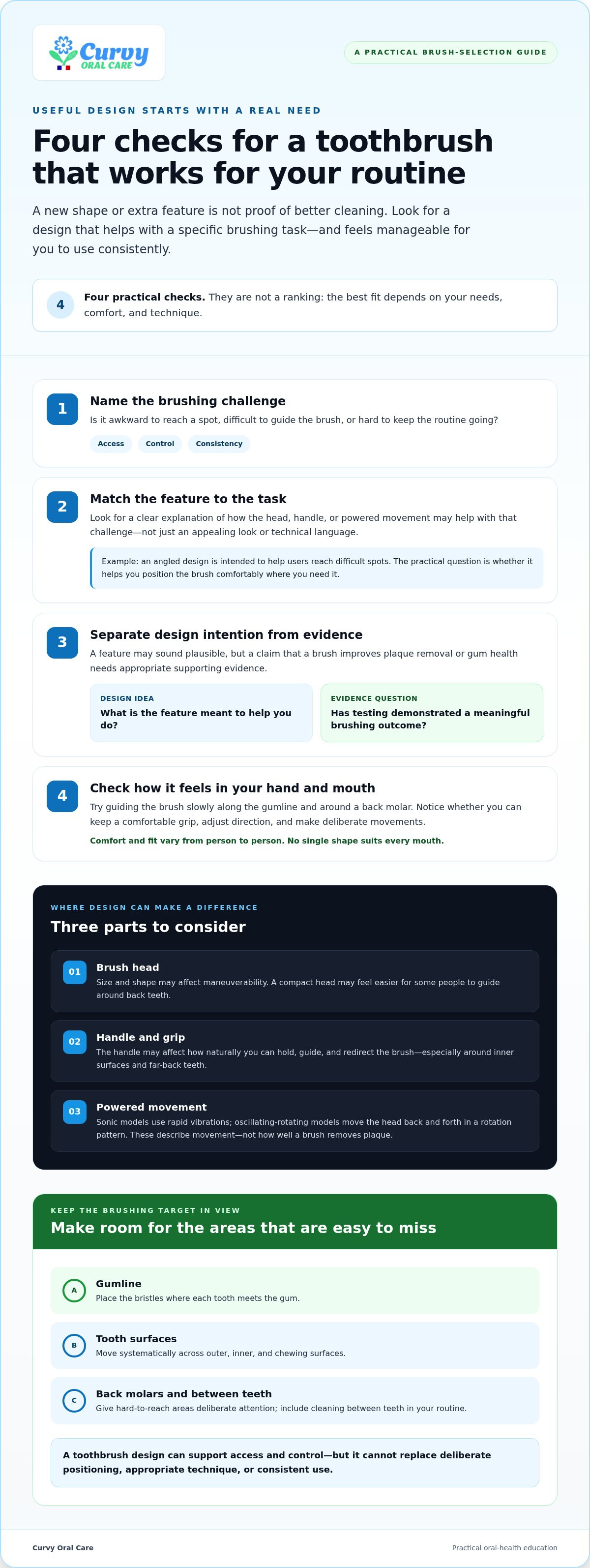
How to Choose a Toothbrush Design for Your Daily Routine
The best starting point isn’t the newest feature. It’s your routine: where brushing feels awkward, which areas are easy to miss, and what kind of brush you’ll use consistently. Use this step-by-step process to compare options based on practical fit rather than feature count.
- Notice your access challenges. Think about your gumline, the spaces between your teeth, and your back molars. If you often miss an area, consider whether a different head shape could make it easier to position the bristles there. An access-focused design may be worth exploring, but it can’t guarantee a particular cleaning result. For more on reaching the gumline and back teeth, read this guide to EMF-free sonic toothbrush design.
- Choose manual or powered based on use. A manual brush gives you direct control over each movement. A powered brush moves its head for you, but you still need to guide it across tooth surfaces. Consider which format feels comfortable and helps you brush carefully and regularly. Neither format compensates for skipped areas or rushed technique.
- Check the head and grip. Consider whether the head can reach the areas you want to clean and whether the handle feels manageable as you adjust your angle. A shape that works well for someone else may not suit your mouth or grip. Prioritize control and comfort over extra features.
- Keep brushing gentle and deliberate. The American Dental Association recommends soft-bristled toothbrushes to help minimize the risk of gum abrasion. Use light pressure and guide the bristles along the gumline rather than scrubbing forcefully. A simple brush that supports controlled movement may be more practical than one with features you won’t use.
- Build the rest of the routine around brushing. Choose toothpaste suited to your needs, clean between your teeth with an appropriate interdental method, and include tongue cleaning if it’s part of your routine. Keep regular dental visits, too. A toothbrush cleans tooth surfaces, but it doesn’t replace care between teeth or professional evaluation.
Make consistency the deciding factor
Ask yourself whether the brush is straightforward to hold, use, and clean as part of everyday life. A feature that adds complexity may not help if it makes the routine harder to maintain. If you have specific dental needs or aren’t sure how to clean a particular area, a dental professional can offer guidance suited to your mouth.
Curvy Oral Care offers manual and sonic toothbrushes, including angled designs intended to help users reach difficult spots. If you’re comparing a sonic option alongside toothpaste, explore the sonic toothbrush and toothpaste set as one choice for your daily routine. Whichever brush you choose, aim for gentle, thorough use that reaches the gumline and the surfaces that are easiest to overlook.
Curvy Oral Care's Angled Toothbrush Design in a Better Daily Routine
An angled toothbrush is one example of a design focused on access. Curvy Oral Care’s angled brushes are designed to help users reach difficult spots, including areas that may feel awkward to approach with a conventional straight brush. A different angle may make it easier to position the bristles where you want them. It doesn’t guarantee a particular cleaning result, so careful brushing still matters.
What an angled design is intended to help users do
Reaching the back teeth and positioning bristles near the gumline takes deliberate movement. An angled brush changes the approach of the brush head and may help some users guide it into less-easily reached areas. Curvy’s Y angled sonic toothbrush is one example of this design approach.
Brush methodically rather than relying on the shape to cover every surface for you. Guide the bristles along the gumline, and remember the inner, outer, and chewing surfaces of each tooth. Move patiently around your mouth, giving extra attention to the back molars and any areas you tend to miss. If a particular angle feels uncomfortable or difficult to control, adjust your hand position or seek advice from a dental professional.
Turn thoughtful design into a consistent routine
A toothbrush works as part of a wider routine, not on its own. Brush twice daily with gentle, controlled movements, and clean between your teeth using an appropriate interdental method. Brushing visible surfaces alone leaves other areas untouched. You can also clean your tongue and choose toothpaste that suits your needs. Regular dental visits provide an opportunity to get guidance tailored to your oral health and keep track of changes over time.
Make the routine easy to repeat. Keep your brush and toothpaste where you’ll remember to use them, and follow a consistent path around your teeth so no area is routinely skipped. Replace the brush or brush head when it’s due or when the bristles become worn, following relevant dental guidance. If you notice persistent bleeding, swelling, or pain, seek professional advice rather than assuming a different brush will resolve it.
Design can support a habit, but it can’t replace one. An angled brush is useful if its shape helps you reach and control the areas you need to clean while you continue to brush thoroughly and gently. Curvy Oral Care’s sonic toothbrush and toothpaste travel combo is one product option to explore as you build a routine around consistent brushing. Choose tools that fit your needs, then give equal attention to the daily technique and care that help keep the whole routine effective.
Make Your Next Brush Choice a Practical One
Start by observing your brushing, not by scanning another feature list. During your next session, notice whether your movements feel controlled and whether you can comfortably reach the areas you tend to overlook. That gives you a useful way to judge whether an innovative toothbrush design fits your real routine: does it make careful, consistent brushing easier for you?
Small adjustments matter. Slow down where access feels awkward, use gentle pressure, and keep the routine simple enough to repeat. If your needs change or you’re unsure how to clean a particular area, a dental professional can offer advice tailored to you.
Choose tools that support habits you want to keep. If you’re ready to consider a sonic option alongside toothpaste, explore the sonic toothbrush and toothpaste travel combo. Then focus on steady daily care, including the gumline, back teeth, and spaces between teeth.
Frequently Asked Questions
Can an innovative toothbrush replace flossing or interdental cleaning?
No. Even innovative toothbrush design can’t reliably clean between every tooth, where bristles may not reach. Clean between your teeth daily with an appropriate method, such as floss or an interdental brush. The right option depends on your teeth and any dental work. If you’re unsure what fits your needs, ask a dental professional to show you how to use it. Brushing and interdental cleaning reach different areas.
How often should I replace a toothbrush or brush head?
The American Dental Association recommends replacing a toothbrush every three to four months, or sooner if the bristles become visibly matted or frayed. Worn bristles may not clean as effectively. For a powered brush, follow the manufacturer’s guidance for replacing its head, and replace it sooner if the bristles show wear. Check the brush periodically rather than waiting for a scheduled date if it looks damaged.
Are powered toothbrushes safe for gums?
Yes, powered toothbrushes can be used safely when you follow the instructions and brush gently. Choose soft bristles, guide the head across your teeth without forceful scrubbing, and avoid pressing it hard against the gum tissue. Powered movement doesn’t automatically make brushing gentler. If your gums feel sore after brushing, ease the pressure and review your technique. Seek dental advice if soreness persists.
What should I do if my gums bleed when I brush?
Keep brushing gently with a soft-bristled brush, and arrange a dental evaluation if bleeding persists. Plaque near the gumline can contribute to inflammation, but bleeding can have different causes and isn’t enough to diagnose a condition. Avoid scrubbing harder or skipping the area. Note when the bleeding occurs and mention it at your appointment, especially if you also notice swelling, pain, or other changes.
Should children use a manual or powered toothbrush?
Either can work for a child if the brush is appropriate for their mouth and they can use it safely. Look for a small head and soft bristles, and help supervise brushing until your child can clean all tooth surfaces reliably. A powered brush may appeal to some children, while others prefer a manual one. A dental professional can advise on a child’s individual needs and technique.
Do toothbrush apps make brushing more effective?
Not necessarily. An app may offer reminders or show areas a user appears to have missed, which can help build awareness. But tracking or feedback doesn’t by itself prove that plaque is being removed effectively or that gum health will improve. Use prompts as a guide, not a substitute for brushing every surface with care. If the app distracts you from technique, a simple routine may suit you better.
Health & Medical Disclaimer: This content is for informational and educational purposes only. It isn’t a substitute for professional dental or medical advice, diagnosis, or treatment. Consult a qualified dental or medical professional about any health concerns, and seek their advice before making decisions about your care.

Article by
Aline Peixe Nebot
Aline Peixe Nebot is a Veterinarian and passionate advocate for better oral health, committed to raising awareness of oral health as a matter of public health. She actively promotes the importance of simple, effective oral care routines and works to educate the public about the often-overlooked link between oral health and overall systemic health. Her mission is to make better oral care knowledge accessible to everyone and encourage healthier habits for life.
Disclaimer
Disclaimer: The information provided in this article is intended for general educational and informational purposes only. It is not intended to replace professional medical, dental, or healthcare advice, diagnosis, or treatment.
Some content may be AI-assisted and is provided to support health education and awareness. While we strive to share accurate and up-to-date information, health recommendations and scientific evidence can evolve, and the information presented may not apply to every individual.
The connection between oral health and overall systemic health is an important and developing area of research. Associations discussed in this article should not necessarily be interpreted as proof of cause and effect.
Always consult a qualified dentist, physician, or other healthcare professional regarding your individual health, symptoms, medications, or treatment decisions. Do not delay or discontinue professional care based on information presented in this article.
This content is for education and awareness—not diagnosis or treatment.