
How to Clean Back Molars Better: A Gentle, Effective Brushing Guide
What if learning how to clean back molars better came down to changing your angle, not brushing harder? Reaching the teeth at the back of your mouth can feel awkward, and a brush head that triggers your gag reflex can make the task more frustrating. You’re not alone, and it doesn’t mean you’re doing anything wrong.
A simple, repeatable sequence can help you clean the chewing grooves, brush gently along the gumline, and cover the inner surfaces you might otherwise miss. You’ll also learn how to clean between back teeth, where a toothbrush can’t reach effectively on its own.
Small adjustments can make brushing more comfortable and thorough. This guide covers brush positioning, ways to improve access when a straight brush feels awkward, and what to try if gagging gets in the way. It also explains when persistent bleeding, swelling, or pain deserves a dental professional’s attention. The goal is practical care for your molars and gums, without extra pressure.
Key Takeaways
- Understand why back molars can be tricky to reach, even when your brushing routine is consistent.
- Learn how to clean back molars better with a surface-by-surface approach and light pressure.
- Use floss or a suitable interdental aid to clean spaces your toothbrush misses.
- Follow the same brushing order each time to make your routine easier to repeat and less likely to skip areas.
- Recognize when ongoing bleeding, swelling, pain, bad breath, or tooth mobility calls for a dental assessment.
Why Back Molars Are Easy to Miss During Brushing
Back molars aren’t inherently dirty or unhealthy. They’re simply farther from view and harder to reach than front teeth, so it can be difficult to tell whether the brush has covered each surface. The cheek, available space, and shape of the chewing surfaces all affect how easily you can position the bristles.
Missing a spot doesn’t mean you’ve failed. It means the back of the mouth may need more deliberate attention. Understanding what gets in the way is a useful first step toward learning how to clean back molars better, without relying on extra pressure.
What makes the back teeth difficult to reach?
Molars sit behind the premolars, where the cheek can limit room to maneuver. There may be little space to angle the brush head comfortably, especially if opening wide makes your jaw feel tense. Limited visibility adds another challenge: it’s harder to tell whether the bristles have reached the inner side, the side nearest the cheek, or the back surface of the last tooth.
Those less-visible surfaces can be overlooked even when the front teeth feel smooth. A toothbrush’s head and shape can affect how it moves around the mouth; general information about different toothbrush types can help explain why designs vary. If a conventional straight brush feels awkward to position, an angled brush is one option to consider for access.
Wisdom teeth can add variation, but not everyone has them. If present, they may sit at an angle or be partly covered by gum tissue, making them harder to brush around. A dentist can assess whether a particular tooth needs special care.
Why the gumline and chewing grooves deserve attention
Plaque is a sticky film that forms on teeth throughout the day. When it builds up along the gumline, where teeth meet gums, it can contribute to gum irritation and inflammation. Cleaning the visible middle of a tooth isn’t the whole job. The gumline needs gentle, consistent attention as part of daily brushing.
Molar chewing surfaces also have small pits and grooves. These give the teeth their textured shape and can make them harder to clean than a flat surface, especially if the bristles don’t settle over them. The grooves aren’t a sign that anything is wrong; they’re a reason to brush systematically rather than rush past the back teeth.
Oral health is part of overall health, though the relationship is still being studied. Research has found associations between gum disease and some health conditions, but an association alone doesn’t prove that one causes the other. Caring for your teeth and gums is a practical part of daily well-being.
Cleaning only the visible front surfaces leaves parts of your teeth, including the gumline and back molars, out of your daily routine. A calm, complete approach can support cleaner teeth and healthier gums without scrubbing hard.
How to Brush Back Molars Gently, One Surface at a Time
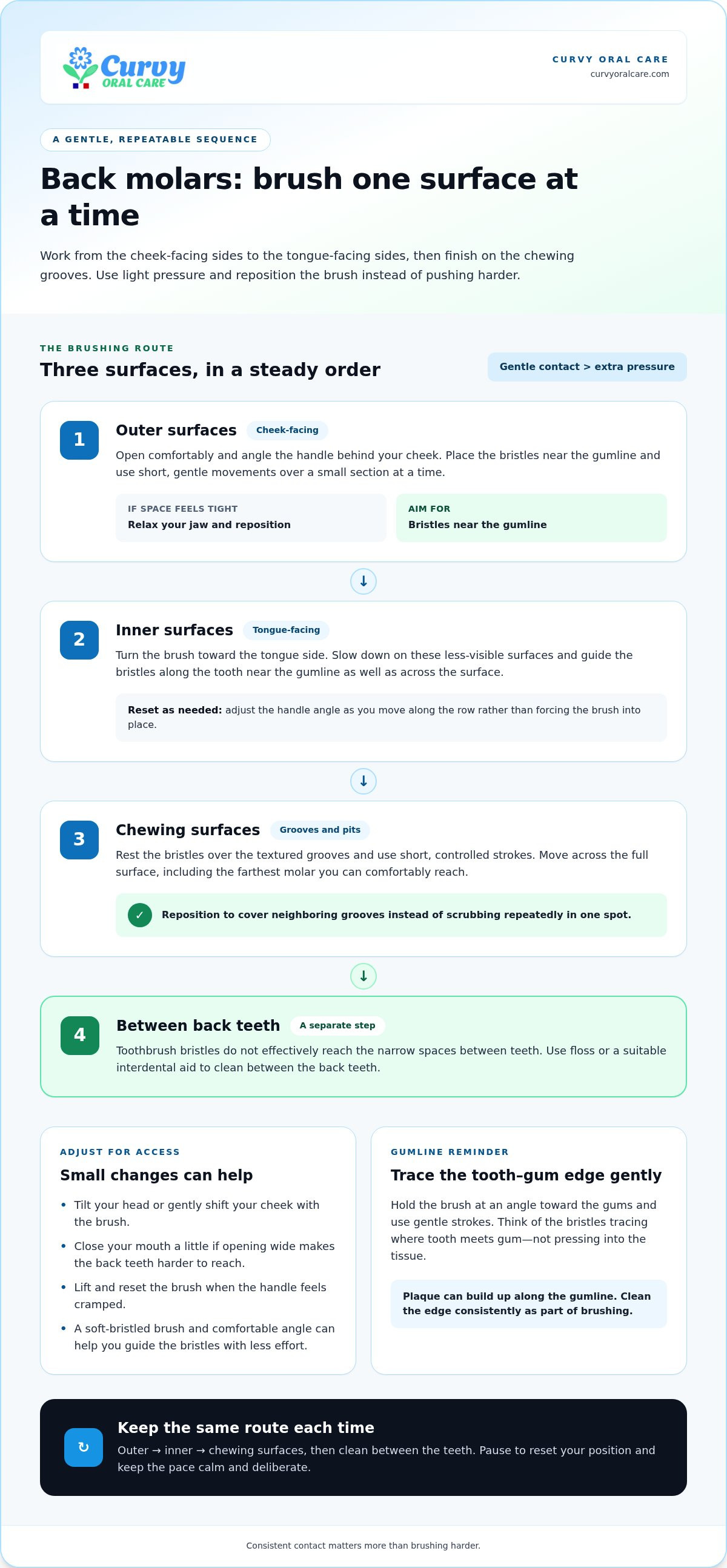
A steady sequence makes back-molar brushing easier to control. Work across the outer surfaces first, turn to the inner surfaces, then finish on the chewing surfaces. Move from one side of your mouth to the other, pausing to adjust the brush as needed. Guide the bristles over each surface rather than forcing them into place.
- Brush the outer surfaces. Open comfortably and angle the handle so the brush can reach behind your cheek. Place the bristles near the gumline and use short, gentle movements over a small section at a time. If your cheek crowds the brush, relax your jaw slightly and reposition instead of pushing harder.
- Reach the inner surfaces. Turn the brush toward the tongue side of the molars. These surfaces are easy to skip because they’re less visible, so slow down and make sure the bristles contact the tooth near the gumline as well as across its surface. Adjust the handle angle as you move along the row.
- Finish on the chewing surfaces. Rest the bristles over the grooves and use short, controlled strokes. Move steadily across the full surface, including the farthest molar you can comfortably reach. Rather than scrubbing repeatedly in one spot, reposition to cover the neighboring grooves and the tooth behind them.
Position the brush for better control
Small adjustments can help. Tilt your head, gently shift your cheek with the brush, or close your mouth a little if opening wide makes the back teeth harder to reach. Work in sections and lift the brush to reset its position when the handle feels cramped. A soft-bristled brush and a comfortable angle can help you guide the bristles with less effort.
For the gumline, the American Dental Association’s proper brushing techniques include holding the brush at an angle toward the gums and using gentle strokes. Think of the bristles as tracing the edge where tooth meets gum, rather than pressing into the tissue. If a conventional straight brush feels awkward to position, an angled toothbrush is one possible access aid.
Keep the pace gentle and deliberate
There’s no need to rush from tooth to tooth. Pause to check your position, especially when switching from the cheek-facing side to the tongue-facing side. If your jaw starts to feel tense, relax it before continuing. A calm pace gives you more control over where the bristles land and makes it easier to notice surfaces you might otherwise pass over.
Use light pressure and deliberate placement: guide the brush across each surface instead of scrubbing harder. The goal is consistent contact, especially around the gumline, not force. If a sonic toothbrush and toothpaste combination fits your routine, it can be one tool for daily brushing, but it doesn’t replace careful positioning.
How to Clean Between Back Teeth and Reach the Last Molars
Brushing cleans the surfaces your brush can touch, but bristles can’t fully clean the narrow spaces where neighboring teeth meet. This matters around back molars, where access can be awkward and plaque near the gumline may be harder to notice. Daily interdental cleaning complements brushing by reaching these gaps. Mouthwash may be part of some routines, but it doesn’t replace brushing or cleaning between teeth.
Choose an interdental method that fits the space
Floss can help clean tight spaces between teeth. Gently guide it between the teeth, curve it around each tooth, and move it along the side rather than snapping it into the gums. An interdental brush may work in spaces wide enough for it to pass comfortably. Don’t force a brush into a tight gap; the right aid depends on your spacing, dental work, and dexterity.
Crowns, bridges, braces, and other dental work can change how you clean between teeth. If you’re unsure which aid fits or how to use it around your back molars, a dental professional can give advice suited to your mouth. The aim is to choose a method you can use comfortably and consistently.
Give the last molars and wisdom teeth deliberate attention
After brushing the chewing surface of your last molar, consider whether you can reach its back-facing surface, the side facing the throat. Use a gentle touch and adjust your position rather than forcing the brush into a cramped spot. A step-by-step brushing guide can help reinforce how to reach behind back teeth and along the gumline.
Wisdom teeth, when present, may sit at different angles or be partly covered by gum tissue, making them harder to reach. Persistent difficulty cleaning an area, pain, swelling, or other concerning changes are reasons to seek a dental assessment. A home routine supports daily care, but it can’t diagnose a cavity, gum problem, or wisdom-tooth concern.
For a practical sequence, brush first, then clean between teeth with an aid that fits your mouth. Brushing covers tooth surfaces, while interdental cleaning addresses the spaces between them. When refining how to clean back molars better, focus on reaching the back-facing surface where accessible and choosing a method that feels controlled, not forced.
A sonic toothbrush and toothpaste combination can be part of your brushing routine, while floss or a suitable interdental aid handles between-tooth cleaning. Keeping these roles distinct makes the routine easier to follow without expecting one tool to do every job.
Build a Back-Molar Brushing Routine That Is Easy to Repeat
A reliable routine doesn’t depend on remembering a new technique each night. It depends on following the same route so your brush reaches the back teeth before you finish. Brush twice a day with toothpaste and give yourself enough time to cover all tooth surfaces. The American Dental Association recommends brushing for two minutes each time.
Make the technique easier to remember
Divide your mouth into four sections: upper right, upper left, lower right, and lower left. In each section, follow the same surface order: outer sides, inner sides, then chewing surfaces. This gives the back molars a place in the routine rather than leaving them until the end, when you may be tempted to rush.
Slow down where the brush feels awkward. Relax your jaw, adjust your grip, or turn your head slightly to improve your view. If you notice yourself pressing harder, pause and reposition instead. The goal is a repeatable path, not a perfect performance every time.
Choose a brush that helps with access
Brush-head shape and handle angle can affect how comfortably you reach the last teeth. A conventional straight brush works for many people, but an angled brush is another option if the usual position feels cramped. Its purpose is access, not treatment for gum disease. For more detail on technique, you can also explore Curvy Oral Care’s related guide, “Angled Toothbrush for Plaque: Gumline to Molars Guide.”
If an angled sonic toothbrush feels suited to your routine, its design can help you position the brush in areas that feel difficult to reach. Choose a brush you can control comfortably, and use gentle pressure while following your surface-by-surface route.
Complete your routine with steps that brushing alone doesn’t cover. Clean between your teeth daily using floss or an interdental aid that fits your spaces, then gently brush your tongue. These are separate parts of oral care, not extra passes over the same tooth surfaces. If you miss an area occasionally, return to your usual sequence at the next brushing. Consistency matters more than chasing perfection.
Regular dental visits can help keep your home-care routine aligned with your needs, especially if you have dental work or ongoing trouble reaching a particular spot. For a routine tool, explore the sonic toothbrush and toothpaste combination.
When to Ask a Dentist About Back-Molar Cleaning
A careful home routine can help you clean tooth surfaces and support gum health, but it can’t tell you whether a back molar has a cavity, gum disease, or a wisdom-tooth problem. Some concerns aren’t visible or easy to assess on your own. Dental evaluation is the right next step when symptoms persist or you notice a change that worries you.
Notice persistent changes without self-diagnosing
Pay attention to patterns, not just a single uncomfortable brushing session. Arrange a dental assessment for persistent bleeding, swollen gums, pain, ongoing bad breath, receding gums, tooth mobility, or another significant change in your mouth. These signs can have different causes and don’t confirm a particular condition. A dentist can examine the area and help determine what’s going on.
Also mention if a specific spot is consistently difficult to brush, if the brush causes discomfort in one area, or if you can’t reach the back-facing surface of the last molar. Difficulty may relate to tooth position, access, or another factor. A dental professional can look at the area and suggest an approach suited to your mouth, rather than asking you to guess or brush harder.
Make the next step practical
Keep regular dental check-ups as part of preventive care, even if your daily routine feels manageable. Between visits, note what you’ve observed: which side is affected, which tooth surface is hard to reach, and whether bleeding, swelling, or discomfort keeps returning. Sharing these details gives the dentist a clearer picture. You can also discuss your brushing and interdental-cleaning methods and whether they fit your teeth and any dental work.
There’s no need to feel embarrassed about missed spots or an awkward brushing technique. Back teeth can be challenging to access, and tailored guidance is a practical way to improve your routine. If you’re wondering how to clean back molars better, remember that home care and professional assessment serve different purposes: daily brushing supports prevention, while a dentist can evaluate symptoms and identify concerns a toothbrush can’t.
Oral health is part of overall well-being, and small, consistent habits can support a healthier mouth. Keep brushing twice daily with gentle attention to the gumline, clean between your teeth, and seek advice for persistent symptoms or meaningful changes. An oral-care tool can support your routine, but it isn’t a substitute for an examination or treatment. As an optional daily-care tool, explore the sonic toothbrush and toothpaste combination.
Make Your Next Brushing Session Feel More Manageable
A more comfortable routine can start with one small intention: notice how your brush feels as you reach the back of your mouth. If you tense your jaw or find yourself pushing, pause, adjust your position, and try again gently. That simple reset can help you build confidence in how to clean back molars better, without expecting every brushing session to be perfect.
The right tool is one you can use comfortably and consistently. Curvy Oral Care offers angled manual and sonic toothbrushes designed to help reach difficult areas, along with toothpaste and replacement brush heads. These are optional daily-care tools, not substitutes for professional dental advice or treatment.
Ready to add a sonic brush and toothpaste to your routine? Explore the sonic toothbrush and toothpaste combination, and keep making small, gentle adjustments to support your oral health each day.
Frequently Asked Questions
Why are back molars harder to clean than front teeth?
Back molars sit farther inside the mouth, so your cheeks and jaw movement can limit how easily you position a brush. Their chewing surfaces are uneven, and the last tooth may be difficult to see. Try brushing in front of a mirror and gently shifting your cheek with the brush handle to improve your view. If gagging or limited jaw movement makes access difficult, a dentist can offer technique advice suited to your mouth.
Should I brush my wisdom teeth if they are difficult to reach?
Gently clean any wisdom tooth you can reach, but don’t force the brush into a painful or cramped area. Wisdom teeth can emerge at different angles, and some people don’t have them. If part of a tooth is covered by gum or you can’t clean around it comfortably, a dental professional can check its position and advise you on care. Seek an assessment if you notice persistent pain or swelling.
Can an angled toothbrush help reach back molars?
An angled toothbrush may make it easier for some people to position the bristles around back teeth, especially if a straight handle feels awkward. Comfort and control matter more than the shape alone: the brush should let you reach the area without pressing hard or straining your jaw. Try adjusting the handle angle and your head position. If access remains difficult, a dentist can suggest a technique suited to your mouth.
Should I brush harder if my back teeth do not feel clean?
No. More pressure doesn’t guarantee a more thorough clean and can make brushing uncomfortable. Instead, check whether the bristles are reaching the area you mean to clean. Adjust your grip, relax your jaw, or reposition your head and brush. If a tooth still feels rough or different after careful brushing, don’t keep scrubbing it; mention the sensation at a dental visit so it can be assessed.
How do I clean between my back teeth?
Use floss for tight spaces, guiding it gently between the teeth and around each tooth rather than snapping it down. An interdental brush may suit a wider gap if it slides in comfortably without force. Dental work or crowded teeth can affect which option is practical. If you’re unsure about size or technique, ask a dental professional to demonstrate an approach that fits your teeth.
What should I do if my gums bleed when I brush my back molars?
Brush gently and notice whether the bleeding continues, returns, or happens in other areas. Bleeding can have different causes, so it doesn’t identify a condition on its own. If it persists, arrange a dental evaluation rather than avoiding the area or brushing more forcefully. Tell the dentist when you first noticed it and whether it occurs during brushing, interdental cleaning, or at another time.
Does mouthwash replace brushing or flossing around molars?
No. Mouthwash doesn’t physically brush tooth surfaces or clean the narrow spaces between teeth, so it shouldn’t replace either step. If you use a rinse, follow its label and any advice from your dental professional, especially if you have a specific oral-health concern. Check that your routine still includes brushing every tooth surface and separately cleaning between teeth, even on busy days.
Health & Medical Disclaimer: This article is for general educational purposes and is not a substitute for professional dental or medical advice, diagnosis, or treatment. Seek advice from a qualified dental professional about symptoms or concerns specific to you.

Article by
Aline Peixe Nebot
Aline Peixe Nebot is a Veterinarian and passionate advocate for better oral health, committed to raising awareness of oral health as a matter of public health. She actively promotes the importance of simple, effective oral care routines and works to educate the public about the often-overlooked link between oral health and overall systemic health. Her mission is to make better oral care knowledge accessible to everyone and encourage healthier habits for life.
Disclaimer
Disclaimer: The information provided in this article is intended for general educational and informational purposes only. It is not intended to replace professional medical, dental, or healthcare advice, diagnosis, or treatment.
Some content may be AI-assisted and is provided to support health education and awareness. While we strive to share accurate and up-to-date information, health recommendations and scientific evidence can evolve, and the information presented may not apply to every individual.
The connection between oral health and overall systemic health is an important and developing area of research. Associations discussed in this article should not necessarily be interpreted as proof of cause and effect.
Always consult a qualified dentist, physician, or other healthcare professional regarding your individual health, symptoms, medications, or treatment decisions. Do not delay or discontinue professional care based on information presented in this article.
This content is for education and awareness—not diagnosis or treatment.