
Gum Health Toothpaste: What Helps, and What Your Routine Still Needs
A tube of toothpaste can support healthy gums, but it can’t do the whole job. If bleeding or irritation has you scanning labels for a solution, it’s understandable to wonder which gum health toothpaste claims are backed by evidence and which ingredients are relevant to your needs.
The right toothpaste can be a useful part of gum care, but plaque also needs to be removed consistently from the gumline and between teeth. Brushing only the easy-to-see surfaces can leave buildup where gums are more vulnerable to irritation.
This guide explains what toothpaste can and can’t do, which ingredients and product cues to look for, and how to fit your choice into a practical daily routine. You’ll also learn why brushing technique, cleaning between teeth, and regular dental visits matter, and when persistent bleeding or swelling deserves professional attention. Small, steady habits can help you care for your gums without expecting one product to do everything.
Key Takeaways
- Choose gum health toothpaste for a clear, evidence-supported purpose, and treat it as one part of gum care rather than a stand-alone solution.
- Understand how fluoride and hydroxyapatite differ, and what each ingredient can reasonably contribute to your oral-care routine.
- Look beyond broad label promises by checking the ingredients and considering what questions to raise with a dental professional.
- Build a consistent routine: brush gently along the gumline, clean between teeth and your tongue, and follow personalized dental advice.
- Understand how gum health fits into overall well-being while keeping research associations separate from proof of cause and effect.
What Gum Health Toothpaste Can, and Cannot, Do
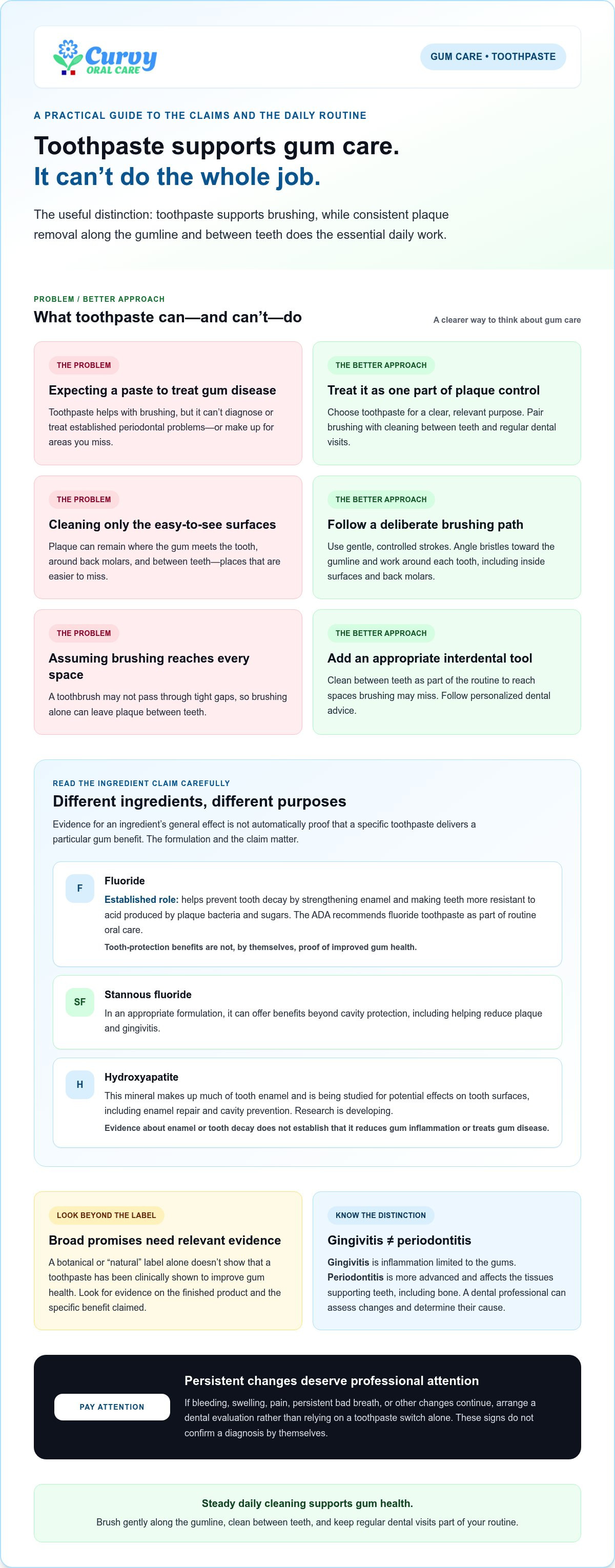
Gum health toothpaste is one part of routine plaque control, not a stand-alone treatment for gum disease. Toothpaste supports brushing, but results depend on where and how you brush. No paste can make up for missed areas or replace professional care when gum problems need attention.
Plaque is a sticky biofilm, a layer of bacteria and other material that continually forms on teeth. When it builds up around the gumline, it can irritate the surrounding tissue and contribute to inflammation. Brushing only the visible fronts of teeth may leave plaque where the gum meets the tooth, around back molars, or between teeth, where bristles often can’t reach effectively.
How plaque and gum inflammation are connected
Gums may look red or swollen, feel tender, or bleed during brushing when they’re irritated. These signs are worth noticing, but they don’t confirm a diagnosis on their own. A dental professional can assess your gums and determine what’s causing the changes.
Gingivitis is inflammation limited to the gums; periodontitis is a more advanced condition that affects the tissues supporting the teeth, including the bone. This distinction matters because toothpaste may support everyday cleaning, but it can’t diagnose or treat established periodontal problems. For an overview of gingivitis, including common signs and causes, see the linked reference.
Where toothpaste fits in prevention
Toothpaste helps with brushing, but it can’t clean every space between teeth by itself. A toothbrush may not pass through tight gaps, and brushing tooth surfaces without angling the bristles toward the gumline can leave plaque behind. Cleaning between teeth with an appropriate interdental tool reaches spaces that brushing may miss.
Give the gumline deliberate attention. Use gentle, controlled strokes rather than scrubbing hard, and work around each tooth, including the inside surfaces and back molars. Following the same path through your mouth each time can help prevent missed spots. If an area is difficult to reach, adjust your brush angle and take time to clean it carefully.
For everyday prevention, pair brushing with cleaning between teeth and regular dental visits. Curvy Natural Toothpaste is powered by hydroxyapatite, an ingredient to evaluate for its role in toothpaste, not as a gum-disease treatment. Choose products for a relevant purpose and use them as part of a complete routine.
If bleeding, swelling, pain, persistent bad breath, or other changes continue, arrange a dental evaluation rather than trying to solve the problem by switching toothpaste alone. Consistent daily cleaning supports gum health, while a dental professional can identify concerns that a product label cannot.
Which Gum Health Toothpaste Ingredients Deserve a Closer Look?
Ingredient lists can help you understand what a toothpaste is designed to do, but one ingredient doesn’t tell the whole story. Separate well-established tooth-protection benefits from claims about reducing gum inflammation. Then consider your dental needs, including any advice you’ve received from a dental professional.
Fluoride and other toothpaste ingredients
Fluoride has a well-established role in helping prevent tooth decay. It strengthens tooth enamel, making teeth more resistant to acid produced by plaque bacteria and sugars. The American Dental Association recommends brushing with fluoride toothpaste as part of routine oral care. This tooth-protection benefit shouldn’t automatically be interpreted as proof that a product improves gum health.
Some toothpaste formulas use stannous fluoride, which can offer benefits beyond cavity protection, including helping reduce plaque and gingivitis when used in an appropriate formulation. Other ingredients may also have specific purposes, but the evidence depends on the ingredient, the finished product, and the claim being made. A botanical or “natural” label alone doesn’t show that a toothpaste has been clinically shown to improve gum health.
Evidence for an ingredient’s general effect is not the same as clinical evidence that a specific toothpaste delivers a particular result. Product formulation and clinical testing matter. There’s no single formula that’s best for everyone: sensitivity, cavity risk, age, and individual dental advice can all influence a suitable choice.
How to assess hydroxyapatite claims
Hydroxyapatite is a mineral that makes up much of tooth enamel. In toothpaste, it’s studied for potential effects on tooth surfaces, including enamel repair and cavity prevention. Research is developing, and findings about one formulation or use shouldn’t be treated as proof that every hydroxyapatite toothpaste has the same effects.
Keep the claim specific. Evidence relating to enamel or tooth decay doesn’t establish that hydroxyapatite reduces gum inflammation or treats gum disease. Those are different outcomes and require relevant evidence. A gum claim should be supported by research on the finished product and the stated gum benefit, not inferred from the presence of a familiar or naturally occurring mineral.
Curvy Natural Toothpaste is powered by hydroxyapatite. Review the hydroxyapatite toothpaste details as you compare ingredient information, without assuming the ingredient is a gum treatment. Consider whether the product suits your oral-care needs and whether its stated purpose matches the evidence.
If you’re comparing toothpaste options for home or travel, the toothbrush and toothpaste travel set brings oral-care essentials together. Whatever you choose, look for clear, relevant claims and follow personalized dental guidance, especially if you have persistent symptoms or specific oral-health concerns.
How to Compare Gum Health Toothpaste Without Falling for Overpromises
A useful label tells you what an ingredient is intended to do. A sweeping phrase such as “complete gum repair” tells you much less unless the product provides evidence for that specific outcome. To compare gum health toothpaste, separate an ingredient’s known purpose from claims about the finished formula, then consider whether that purpose fits your needs.
Questions to ask when reading a toothpaste label
Start with the active ingredients and the purpose stated on the package. Is the claim about strengthening enamel, helping prevent tooth decay, easing sensitivity, freshening breath, or supporting gum health? These are different outcomes. Evidence for one shouldn’t be assumed to prove another.
Be cautious with vague terms such as “gum repair” or disease-related promises. Look for a clear explanation of what the product is intended to do, and whether evidence relates to the ingredient alone or the finished toothpaste. An ingredient list is informative, but it isn’t proof of a specific clinical result by itself.
An ingredient’s evidence describes what it may do in a defined use; a product-specific clinical claim needs evidence for that formula and outcome. This distinction helps keep label language in perspective without dismissing useful ingredients.
| Ingredient | Supported purpose | Evidence caveat | Question for a dental professional |
|---|---|---|---|
| Fluoride | Helps prevent tooth decay by strengthening enamel. | This tooth-protection role doesn’t automatically establish a gum benefit. | Does fluoride toothpaste suit my cavity-prevention needs? |
| Stannous fluoride | Helps protect against decay; appropriate formulations can also help reduce plaque and gingivitis. | Claims depend on the finished product and the evidence for its stated use. | Would this formula be a good fit for me? |
| Hydroxyapatite | Studied for potential effects on tooth surfaces. | Evidence about enamel doesn’t establish a gum-disease benefit. | What evidence and purpose should I consider for this ingredient? |
Match the toothpaste to your needs
Your choice may depend on sensitivity, cavity risk, existing dental concerns, age, and guidance from a dental professional. If you have a history of tooth decay or ongoing sensitivity, a dentist can help you choose a formula that addresses those needs instead of relying on broad gum-care language.
Children need age-appropriate toothpaste guidance. Follow product directions and ask a dental professional what’s suitable for a child’s age and oral-health needs. For adults or children, persistent bleeding, swelling, pain, or other changes deserve professional evaluation rather than repeated toothpaste switching. A label can guide a purchase, but it can’t assess symptoms or replace individualized advice.
Build a Daily Routine That Supports Healthy Gums
Healthy gums benefit from a routine that’s thorough and repeatable. Toothpaste supports brushing, but your technique and the areas you reach matter just as much. Build a sequence you can follow morning and night, then add the steps that clean between teeth and across the rest of your mouth.
- Brush twice daily with a toothpaste suited to your needs.
- Clean between your teeth with floss or another suitable interdental cleaner.
- Gently clean your tongue as part of whole-mouth care.
- Follow personalized dental advice and keep regular dental visits.
Use toothpaste with an effective brushing technique
Choose a systematic path so each tooth gets attention. Brush the outer, inner, and chewing surfaces, guiding the bristles gently along the gumline. Use small, controlled movements and light pressure. Scrubbing harder doesn’t mean you’re cleaning better; it can make brushing uncomfortable and distract from careful coverage.
Pay attention to the inside surfaces and back molars, which can be easy to rush past. If your brush angle makes some areas awkward to reach, an angled adult toothbrush is designed to help users access difficult areas that can be hard to reach with a conventional straight brush. Whichever brush you use, move deliberately rather than relying on pressure.
Complete brushing with whole-mouth care
A toothbrush may not clean the narrow spaces between teeth effectively. Clean between them daily with a suitable interdental tool, using a gentle technique that doesn’t force or snap it against the gums. If you’re unsure which option or method fits your teeth, ask a dental professional for guidance.
Finish by cleaning your tongue gently, then follow any advice tailored to your oral health. Regular dental visits provide an opportunity to discuss your routine and address changes that home care alone can’t assess. If bleeding, swelling, pain, or another concern persists, seek professional evaluation instead of repeatedly changing toothpaste.
Consistency makes the routine easier to maintain. Keep your toothbrush and interdental cleaner where you’ll remember them, and take a moment to check that you haven’t skipped the gumline or back teeth. A gum health toothpaste can be part of this routine, but no product replaces careful cleaning and individualized dental advice.
For a convenient way to bring brushing essentials together, explore the toothbrush and toothpaste travel set as you organize your daily care routine.
Choose Gum Health Toothpaste as One Part of a Better Routine
The most useful gum health toothpaste is one chosen for a clear, relevant purpose and used as part of consistent daily care. Check the ingredients and what the label says they do, then look beyond the tube: brushing carefully, cleaning between teeth, and regular dental visits all contribute to a gum-conscious routine. No toothpaste can assess symptoms or replace care tailored to your oral health.
A practical checklist for your next purchase
Before choosing a product, use these questions to keep the decision grounded:
- What is the active ingredient? Identify it on the label rather than relying on broad phrases such as “complete gum care.”
- What purpose is stated? Check whether the claim concerns tooth decay, enamel, sensitivity, breath, or gum tissue. Evidence for one benefit doesn’t prove another.
- Does it fit your needs? Consider sensitivity, dental history, age, and any advice from your dentist or other dental professional.
- Am I expecting toothpaste to solve a symptom? Persistent gum changes call for professional assessment, not a series of product switches.
A concise ingredient statement is easier to evaluate than a promise that a product will “repair” gums without explaining what that means or what evidence supports it. Product claims should match the outcome studied. If you’re unsure how a label applies to you, bring the product details to a dental appointment and discuss them in the context of your oral-health history.
When to seek professional guidance
Arrange a dental evaluation if you notice persistent bleeding, swelling, bad breath, pain, or receding gums. Tooth mobility and mouth sores that don’t heal also deserve professional attention. These signs don’t establish a diagnosis by themselves, but they’re good reasons to have a qualified professional assess what’s happening and recommend appropriate next steps.
Curvy Oral Care shares oral-health education to support informed daily habits, not to replace dental professionals. Oral health is part of overall well-being, and research has found associations between oral conditions and some health concerns. An association doesn’t prove that one causes the other, and research continues to develop. Caring for your mouth is a practical step in its own right, without assuming it guarantees a particular whole-body outcome.
Choose toothpaste for a supported purpose, follow advice suited to your needs, and keep the routine steady. If you’re organizing brushing essentials for travel, explore the toothbrush and toothpaste travel set as one convenient option.
Make Your Next Oral-Care Habit Count
Turn what you’ve learned into one small, repeatable action. Choose a cue that fits your day, such as brushing before getting ready for bed, and use it to make your routine easier to remember. Progress comes from habits you can keep, not from trying to change everything at once.
Keep your gum health toothpaste choice connected to your own needs, and seek personalized dental advice if you’re unsure what suits you. Curvy Oral Care’s educational resources can help you stay informed, while a dental professional can assess concerns specific to your mouth.
If a travel-ready setup would make it easier to keep your routine going, explore the Curvy Sonic Toothbrush, Toothpaste, and Travel Case Combo. Keep taking manageable steps, and give your oral health consistent attention.
Frequently Asked Questions
Can toothpaste regrow receding gums?
No. Toothpaste can’t regrow gum tissue that has receded. It may support everyday cleaning, but it won’t reverse recession or address its cause. Recession can have different contributing factors, so a dental professional can examine the area and recommend appropriate care. In the meantime, brush gently and avoid trying to scrub the gumline in an attempt to restore it.
Is whitening toothpaste suitable for people with sensitive gums?
It depends on what’s causing the sensitivity and how the product affects you. Some whitening formulas may feel uncomfortable for people with sensitive teeth or irritated gums. Stop using a product if it causes persistent discomfort, and ask a dental professional about a suitable option, especially if sensitivity is new or worsening. Check whether the label’s whitening claim refers to removing surface stains or another effect.
How much toothpaste should an adult use when brushing?
For most adults, a pea-sized amount is a practical guide, unless the product label or a dental professional recommends otherwise. Using a larger ribbon doesn’t make brushing more effective; careful coverage and technique matter more. If you’re using prescription toothpaste, follow its specific directions. Keep toothpaste out of reach of young children, and supervise their brushing so they use an age-appropriate amount.
Should you rinse your mouth with water after brushing?
It’s generally better to spit out the toothpaste rather than rinse immediately with water. Rinsing can wash away some of the fluoride left on tooth surfaces. If you prefer rinsing, ask your dental professional what’s appropriate for your needs, particularly if they’ve recommended a specific toothpaste or brushing routine. Don’t swallow toothpaste, and follow the product directions.
Can children use adult toothpaste for gum health?
Not automatically. Children’s toothpaste choice and amount should suit the child’s age and ability to spit, and an adult formula may not match those needs. An adult should supervise brushing, particularly for younger children, to help prevent swallowing toothpaste. Ask a dentist or other dental professional for age-specific advice, especially if the child has a higher risk of tooth decay or special oral-health needs.
Does gum health toothpaste replace flossing or interdental cleaning?
No. Toothpaste is used with a toothbrush, while floss or another interdental cleaner reaches spaces a brush may not clean well. For example, if adjacent teeth touch closely, bristles may not pass between them. Choose a method that fits your teeth and dexterity, and ask a dental professional to show you how to use it comfortably. Toothpaste is only one part of daily care.
When should bleeding gums be checked by a dental professional?
Book an evaluation if bleeding keeps happening, returns regularly, or occurs alongside swelling, pain, persistent bad breath, or other changes. A single episode after accidentally brushing too hard may have a simple explanation, but symptoms alone can’t establish the cause. A dental professional can examine your gums, review your cleaning technique and health history, and advise whether further care is needed.
Health & Medical Disclaimer: This content is for educational purposes only and is not a substitute for professional dental or medical advice, diagnosis, or treatment. Consult a qualified dental or medical professional with questions about your health or before making changes to your care.

Article by
Aline Peixe Nebot
Aline Peixe Nebot is a Veterinarian and passionate advocate for better oral health, committed to raising awareness of oral health as a matter of public health. She actively promotes the importance of simple, effective oral care routines and works to educate the public about the often-overlooked link between oral health and overall systemic health. Her mission is to make better oral care knowledge accessible to everyone and encourage healthier habits for life.
Disclaimer
Disclaimer: The information provided in this article is intended for general educational and informational purposes only. It is not intended to replace professional medical, dental, or healthcare advice, diagnosis, or treatment.
Some content may be AI-assisted and is provided to support health education and awareness. While we strive to share accurate and up-to-date information, health recommendations and scientific evidence can evolve, and the information presented may not apply to every individual.
The connection between oral health and overall systemic health is an important and developing area of research. Associations discussed in this article should not necessarily be interpreted as proof of cause and effect.
Always consult a qualified dentist, physician, or other healthcare professional regarding your individual health, symptoms, medications, or treatment decisions. Do not delay or discontinue professional care based on information presented in this article.
This content is for education and awareness—not diagnosis or treatment.