
Electric Toothbrush Cleaning Modes: Which Ones Matter to You
More cleaning modes don’t automatically mean a cleaner mouth. An electric toothbrush with multiple vibration cleaning modes offers options, but most people can manage everyday plaque removal with one well-designed daily mode. The bigger priorities are brushing for two minutes, using light pressure, and consistently reaching the gumline and back teeth.
It’s natural to wonder whether Sensitive, Gum Care, Deep Clean, and Whitening settings each do something meaningfully different. This guide explains what those modes are designed to do, when they may be useful, and why brushing technique and consistency usually matter more than frequently changing settings. You’ll also learn how to choose features that suit your mouth without mistaking a longer mode list for a better routine.
Key Takeaways
- Extra cleaning modes can offer more choice, but more settings don’t automatically mean better cleaning.
- Sensitive modes are designed for a gentler feel, while gum care and deep clean modes emphasize different brushing experiences.
- Whitening modes may help with surface stains, but they don’t replace professional whitening treatments.
- When comparing brushes, look beyond mode names to the brushing motion and how comfortably you can use the brush.
- A consistent routine and careful attention to the gumline and hard-to-reach areas matter more than frequently changing modes.
Do you need multiple modes in an electric toothbrush?
For most people, multiple modes aren’t essential: a well-designed Daily Clean mode can handle everyday plaque removal. Brushing technique, comfort, and reaching the gumline matter more than how many settings appear on the handle.
Oscillation and Pulsation Differences
Oscillation describes a brush head moving from side to side, while pulsation describes movement in and out against the teeth. Some electric toothbrushes combine pulsations with a spinning brush head, so the brushing action varies between models. These differences may affect how the brush feels in your hand and against your teeth, but they don’t make mode count a reliable measure of cleaning quality. Choose a motion you can use comfortably and consistently.
Technique and Brushing Consistency
Guide the brush across every tooth surface with light pressure rather than scrubbing quickly. Brush for two minutes and work through each section of your mouth systematically, paying attention to the gumline, back molars, and other difficult areas. Feather-light pressure is enough. Pressing harder doesn’t remove more plaque and can irritate gums or harm teeth. A consistent routine matters more than frequently switching modes.
What should you consider when choosing a toothbrush with multiple modes? Consider whether you’ll use a gentle setting, whether the brush feels comfortable in motion, and whether its head can reach your gumline and back teeth. For example, a Sensitive setting may be more useful than several modes you rarely select.
Daily Clean is the everyday setting for plaque removal. Start there and focus on brushing every surface rather than quickly switching between modes. Bluetooth connectivity, when available, can provide app-based feedback about habits such as brushing time or coverage. Use that feedback as a prompt to improve your routine, not as a substitute for careful brushing.
Brush heads can also affect comfort and access. A smaller head may be easier to guide around back molars, while bristle designs can create a different feel along the gumline. The right choice depends on where you need better access and how the bristles feel during use. A sonic toothbrush bundle with a travel case is one example of a brush option to consider when portability matters.
How much do multi-mode electric toothbrushes cost in the United States? Cost varies with features such as connectivity, included brush heads, and charging design. Compare features you’ll use instead of paying extra simply for a longer mode list.
How long does the battery last, and how long does recharging take? Battery life and recharge time depend on the battery, motor, and charging system. Check the specifications for the model you’re considering, especially if you travel or prefer not to charge your brush frequently.
Sensitive and Super Sensitive modes
A Sensitive mode is designed to feel gentler by producing fewer brush-head movements for people with sensitive gums. A Super Sensitive setting usually signals an even gentler option, but the name alone doesn’t explain exactly how its motion differs. See how each setting feels during careful brushing rather than assuming the label guarantees a particular result.
Tender gums can make a powerful brushing sensation uncomfortable, especially along the gumline or around a sore spot. A gentler setting may make it easier to brush those areas instead of avoiding them. Use a light touch and guide the head across each tooth. If an area hurts, don’t press harder or linger there to compensate.
Using a Sensitive Mode
Start with Sensitive mode if your usual setting feels too intense. Angle the brush toward the gumline and move slowly from tooth to tooth. Cover the outer, inner, and chewing surfaces, including the back molars. A slower pace helps you assess whether the sensation is comfortable while keeping your attention on areas where plaque can collect.
A softer setting doesn’t replace good technique. Pressing hard can irritate gums, even when the brush is set to a gentler level. Let the bristles make light contact and avoid scrubbing back and forth. If you tend to rush, use the brush’s timer, when available, to keep your routine steady and complete.
How Sensitive and Gum-Care Modes Differ
Sensitive mode changes how brushing feels, while Gum Care may use a different pattern intended to focus attention near the gumline. Mode names and actions vary by toothbrush, so compare the settings on the specific model. Neither label changes the importance of brushing carefully where teeth meet gums, rather than focusing only on visible front surfaces.
Healthy gums depend on regular plaque removal along the gumline and between teeth. An electric toothbrush can clean accessible tooth surfaces, but it doesn’t reach every space between teeth. Add a suitable interdental cleaning method to your routine, and seek dental advice for persistent bleeding, swelling, or pain. Ongoing symptoms deserve professional evaluation, not repeated mode changes.
If a gentler feel helps you maintain a comfortable brushing habit, choose a setting you’ll use consistently. For travel, a sonic toothbrush bundle with a travel case can keep your brush routine together away from home. A mode should support careful brushing, not distract from reaching the gumline and hard-to-clean back teeth.
Gum Care and Deep Clean modes
Gum Care and Deep Clean are mode names, not universal descriptions of a single brushing action. A Gum Care setting may emphasize a gentler or changing pattern near the gumline, while Deep Clean may alter the brush’s pace or intensity. The exact motion depends on the model. Read its instructions to understand each setting before choosing it for daily use.
The gumline deserves attention because plaque can collect where teeth meet gums. If plaque remains there, gums can become inflamed. A Gum Care label doesn’t clean the area by itself; careful brush placement does. Guide the head along the gumline, tooth by tooth, and include the inner surfaces and back molars. Don’t focus only on the visible front teeth.
Deep Clean can sound like a shortcut for missed areas, but a stronger-feeling setting doesn’t replace thorough coverage. Follow a consistent route: brush the outer surfaces, then the inner surfaces, and finish with the chewing surfaces. Repeating the same sequence helps prevent a rushed change in direction from leaving an area untouched. Two minutes gives you time to cover your mouth without hurried scrubbing.
Mode labels don’t tell you whether a brush reaches tight spaces or awkward angles. Check how its head sits against the gumline and whether you can guide it behind your last molars. A small adjustment in hand position can help you reach a difficult surface. If your usual route skips one side of your mouth, changing the route may help more than selecting Deep Clean.
Spaces between teeth need separate attention. Bristles may not reach every surface between adjacent teeth, even during a full brushing session. Add an appropriate interdental cleaning method to your routine. The Gum Care setting supports brushing, but it doesn’t replace cleaning between teeth or regular dental visits.
Choose Gum Care if its brushing pattern feels comfortable and helps you focus along the gumline. Choose Deep Clean only if its specific motion suits your routine and you can maintain light pressure. If either setting feels harsh, return to a comfortable mode rather than pressing harder. Persistent bleeding, swelling, or pain calls for professional dental evaluation, not repeated mode changes.
Think of both labels as prompts, not guarantees. A Gum Care setting can remind you to brush carefully near the gums; a Deep Clean setting can encourage a deliberate pass over overlooked surfaces. In either case, use a two-minute routine, cover every tooth surface, and clean between teeth. Those actions give the modes a practical role without asking their names to do the brushing for you.
Whitening mode and front-teeth focus
A Whitening mode may gradually help remove surface stains, but it doesn’t replace professional whitening treatments. Its name describes a brushing setting, not a guaranteed shade. Coffee or tea stains on tooth surfaces are examples of discoloration it may target. Results depend on the type of stain and the brush’s design, so judge the setting by its brushing action, not its label alone.
Front teeth draw attention because they’re visible when you smile, but focusing only on them leaves other surfaces out. During a two-minute session, follow a consistent route across your front and back teeth. Include the gumline, inner surfaces, and chewing surfaces. A Whitening setting doesn’t remove the need to reach your back molars or clean between teeth, where a toothbrush head can’t cover every space.
Use gentle contact when brushing the front surfaces. Hold the brush against each tooth rather than scrubbing rapidly from side to side. Move along the row, then angle the head to reach the gumline and the edges beside neighboring teeth. Pressing harder doesn’t remove more plaque and can irritate gums or harm teeth. A Whitening mode is no reason to increase pressure or brush one visible area repeatedly.
Surface stains and a tooth’s underlying color aren’t the same thing. A brush setting may work on surface staining, while professional whitening treatments are a separate option. If one tooth changes color noticeably or discoloration persists despite regular brushing, arrange a dental evaluation. A mode name can’t identify why a tooth looks different, and repeated brushing can’t replace an assessment of a persistent change.
Make the setting part of a complete routine. Brush all tooth surfaces with light pressure, clean between teeth using an appropriate method, and keep regular dental visits. If you choose a Whitening mode, use it as directed for your toothbrush and switch to a comfortable setting if it feels harsh. Pay attention to your gums as well as your front teeth, since healthy gums support a healthy-looking smile.
Whitening settings can help people address surface stains during daily brushing. They’re not a substitute for professional whitening, and they don’t justify neglecting less visible areas. For example, check that your route includes the backs of your front teeth and the outer surfaces of your molars. Consistent coverage matters more than concentrating your routine on the teeth you see in a mirror.
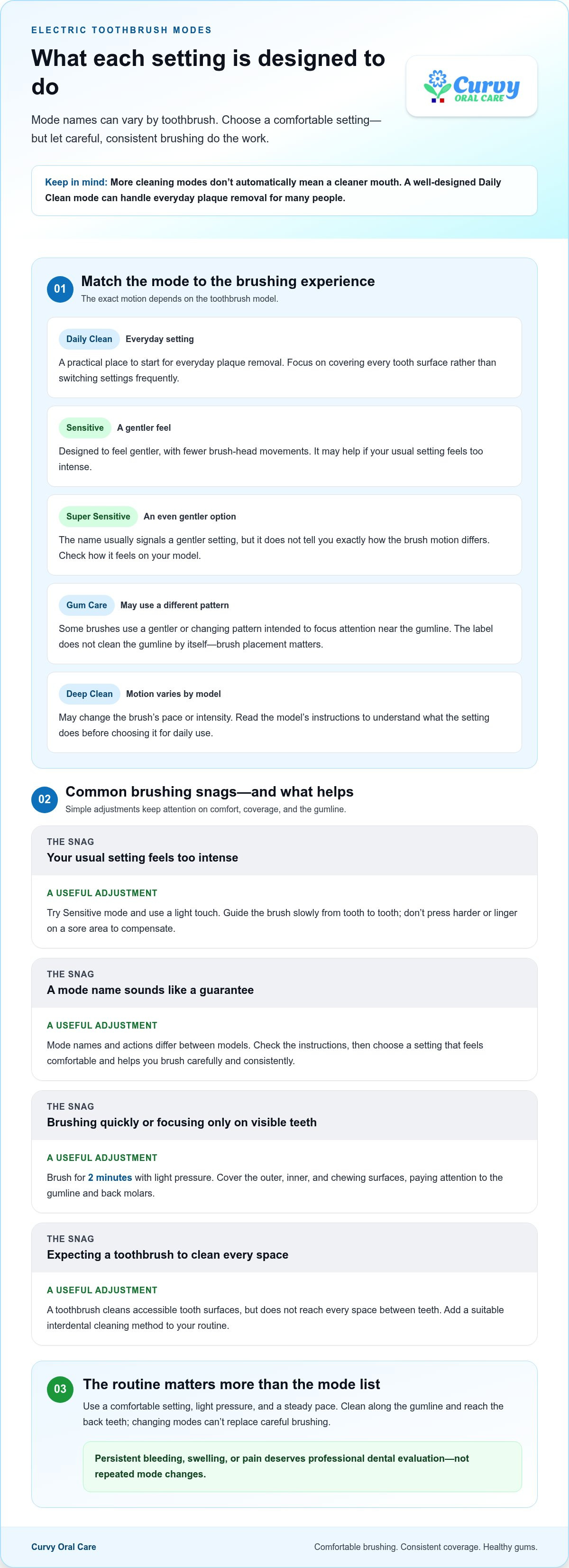
How electric toothbrush cleaning modes vary
Mode names aren’t standardized descriptions of identical brushing actions. Daily Clean handles everyday plaque removal on many brushes, while other settings adjust the brushing experience. One model’s Sensitive mode may use fewer movements; another may use a different pattern. Compare what the settings actually do on the toothbrush you’re considering instead of judging by the number of modes.
Brush-head movement also varies between models. Rotating heads spin around, while oscillating heads move from side to side. Some brushes combine spinning with pulsations that move the head in and out against the teeth. These terms describe how a brush works, not a promise that one motion or mode cleans better for everyone. Comfort and control matter during daily brushing.
Mode labels suggest a purpose, but they don’t guarantee the same action across brands. Sensitive may reduce movements for a gentler feel. Whitening may gradually help remove surface stains, but it doesn’t replace professional whitening treatments. Gum Care and Deep Clean can also describe different presets from one model to another. Read the specific brush’s instructions to understand its modes.
For most people, a well-designed everyday setting can handle the core brushing task. Differences in cleaning effectiveness between modes tend to be modest. Frequent switching matters less than using suitable technique and brushing consistently. For example, covering each tooth surface is more useful than repeatedly changing settings while missing the gumline or back teeth.
Use a simple comparison when selecting a brush: identify its motion, consider whether a gentler setting would help, and check whether the head feels manageable around your back molars. Bluetooth feedback may help you notice brushing habits, but it doesn’t replace attentive brushing. Brush for two minutes, use feather-light pressure, and work systematically through each section of your mouth. These steps make a mode one part of a complete routine.
Multiple settings can add value when they address a real preference, such as wanting a gentler sensation. If you’ll use only Daily Clean, extra modes may not change your routine meaningfully. Choose according to comfort, brushing action, and ease of reaching difficult areas. Explore a sonic toothbrush bundle with a travel case as one option for building a consistent brushing routine at home and away.
Curvy Oral Care: Sonic Toothbrushes
Curvy Oral Care offers sonic toothbrushes for your daily routine. If reaching awkward areas is a priority, its angled toothbrushes are designed to help you access spots that can be difficult to reach with a conventional straight brush. Replacement brush heads and brush-head subscriptions support regular head replacement.
Choose based on practical needs, such as brushing comfort, access around the gumline, and whether you’ll use extra cleaning modes. A long list of settings isn’t essential if one comfortable daily mode helps you brush consistently and reach surfaces you often miss.
Visit Curvy Oral Care to explore its toothbrush options and find one that suits your routine.
Build a routine that fits your mouth
Your next toothbrush can make daily care feel more intentional. Rather than collecting settings you may never use, consider whether brushing feels comfortable and helps you reach the areas you tend to miss. An electric toothbrush with multiple vibration cleaning modes is useful when its options support your habits, not simply when its mode list looks impressive.
Notice what makes brushing easier to maintain: a familiar setup, a brush that feels manageable, or having essentials together when you travel. Small, practical choices can help make oral care a steady part of your day. Keep paying attention to gumline access and changes in your mouth, and seek professional advice for persistent symptoms.
If a sonic toothbrush bundle suits your routine, explore the toothbrush bundle with a travel case. Choose the approach that helps you care for your mouth consistently, and keep moving toward healthier daily habits.
Frequently Asked Questions
Do Multiple Modes Provide Meaningful Value?
Multiple modes add value when a particular setting makes brushing more comfortable or easier to maintain. If you select the same setting every time, extra choices may not change your routine. Try a mode during a normal brushing session, then consider whether it feels suitable and helps you brush attentively. Keep the setting that supports consistent care, and don’t choose a toothbrush by mode count alone.
What modes are available?
Common settings include Daily Clean, Sensitive, Super Sensitive, Gum Care, Deep Clean, and Whitening. Daily Clean is intended for everyday plaque removal. Sensitive settings offer a gentler brushing experience, while Gum Care and Deep Clean refer to settings whose actions can differ by model. Whitening modes may gradually help remove surface stains. Check the brush’s instructions to see how its named settings work.
Which brushes have which modes?
Mode combinations vary by toothbrush, so there isn’t one universal chart for every brand. A product description or user manual is the best reference for a specific handle. Compare the listed settings and their explanations before choosing, especially if you want an option such as Sensitive. Don’t assume two brushes labeled “Gum Care” use the same brushing pattern.
Which electric toothbrushes offer multiple vibration cleaning modes?
Some sonic and oscillating electric toothbrushes include several cleaning settings, while others focus on one everyday mode. The mode menu depends on the model, not just the brush type. Compare the stated settings with the options you expect to use. For example, if you want a gentler sensation, check that the model explicitly describes a Sensitive setting rather than relying on general claims about vibration.
What cleaning modes do electric toothbrushes offer, and what does each mode do?
Common choices include Daily Clean for routine plaque removal, Sensitive for a gentler brushing feel, and Super Sensitive for an especially gentle option. Gum Care and Deep Clean settings can vary by toothbrush. Whitening settings may gradually address surface stains, but they aren’t professional whitening treatments. Since labels aren’t standardized, use the model’s instructions to understand each setting before making it part of your routine.
How do sonic and oscillating electric toothbrushes compare?
Sonic brushes use rapid vibrations to move the brush head, while oscillating models use a head that moves from side to side. Some electric brushes also combine spinning and pulsating movements. These descriptions explain how different brush designs move; they don’t determine which will feel right for you. Consider your comfort, how easily you can guide the head, and whether you can reach your back teeth without awkward handling.
What are the best electric toothbrushes with multiple modes in 2026?
The best fit in 2026 depends on the settings you’ll actually use, the brush’s movement, and how comfortably you can guide it around your mouth. Rather than choosing a model for the longest mode list, compare its instructions, handle, and replacement-head options. A model with a suitable everyday setting and a useful gentler option may fit your routine better than one with settings you rarely select.
Which electric toothbrush modes are best for sensitive teeth, gum care, whitening, and daily cleaning?
For a gentler feel, choose a Sensitive setting, or Super Sensitive if the model offers it. Use Daily Clean for everyday brushing. Gum Care may suit someone seeking a mode focused on brushing near the gumline, though its action varies by model. Whitening may gradually help with surface stains. If your teeth remain sensitive or your gums persistently bleed or swell, seek professional dental advice.
Health & Medical Disclaimer: This content is for educational purposes only and isn’t a substitute for professional dental or medical advice, diagnosis, or treatment. Consult a qualified healthcare professional about personal health concerns or persistent oral symptoms.

Article by
Aline Peixe Nebot
Aline Peixe Nebot is a Veterinarian and passionate advocate for better oral health, committed to raising awareness of oral health as a matter of public health. She actively promotes the importance of simple, effective oral care routines and works to educate the public about the often-overlooked link between oral health and overall systemic health. Her mission is to make better oral care knowledge accessible to everyone and encourage healthier habits for life.
Disclaimer
Disclaimer: The information provided in this article is intended for general educational and informational purposes only. It is not intended to replace professional medical, dental, or healthcare advice, diagnosis, or treatment.
Some content may be AI-assisted and is provided to support health education and awareness. While we strive to share accurate and up-to-date information, health recommendations and scientific evidence can evolve, and the information presented may not apply to every individual.
The connection between oral health and overall systemic health is an important and developing area of research. Associations discussed in this article should not necessarily be interpreted as proof of cause and effect.
Always consult a qualified dentist, physician, or other healthcare professional regarding your individual health, symptoms, medications, or treatment decisions. Do not delay or discontinue professional care based on information presented in this article.
This content is for education and awareness—not diagnosis or treatment.