
Curved Neck Toothbrush: Why Angle Matters for Molars
What if the reason you struggle to reach your back molars isn't a lack of effort, but a fundamental flaw in your toothbrush's design? Standard straight toothbrushes are geometric misfits for the human jaw. They often force you to choose between an uncomfortable gag reflex and leaving plaque behind. If you've ever dealt with persistent bad breath or bleeding at the very back of your mouth, you know the frustration of trying to clean an area you can't even see. Finding the right curved neck toothbrush for wisdom teeth is the evolution your daily routine has been waiting for.
You deserve a comfortable brushing experience that doesn't feel like a battle against your own anatomy. This article will show you how a curved neck provides the specific precision needed to reach those difficult third molars and protect your long-term gum health. We'll dive into the science of the "molar blind spot" and explain why an angled design is a necessity for a truly clean gumline. Discover how small, proactive changes in your tools can lead to better reports from your dentist and the confidence of a healthier, more holistic oral care routine.
Key Takeaways
- Learn why your jaw's natural anatomy creates a "blind spot" that makes standard straight toothbrushes ineffective for reaching back molars.
- Understand how using a curved neck toothbrush for wisdom teeth provides the 45-degree angle necessary to disrupt plaque along the gumline.
- Discover the "closed mouth" technique to relax your jaw muscles, allowing for deeper reach without triggering a gag reflex.
- Compare the benefits of manual and sonic angled brushes to determine which technology best navigates tight spaces in your mouth.
- Shift from reactive to proactive care by addressing hidden bacteria traps that research suggests may be linked to your systemic health.
Why Wisdom Teeth are the "Blind Spot" of Oral Hygiene
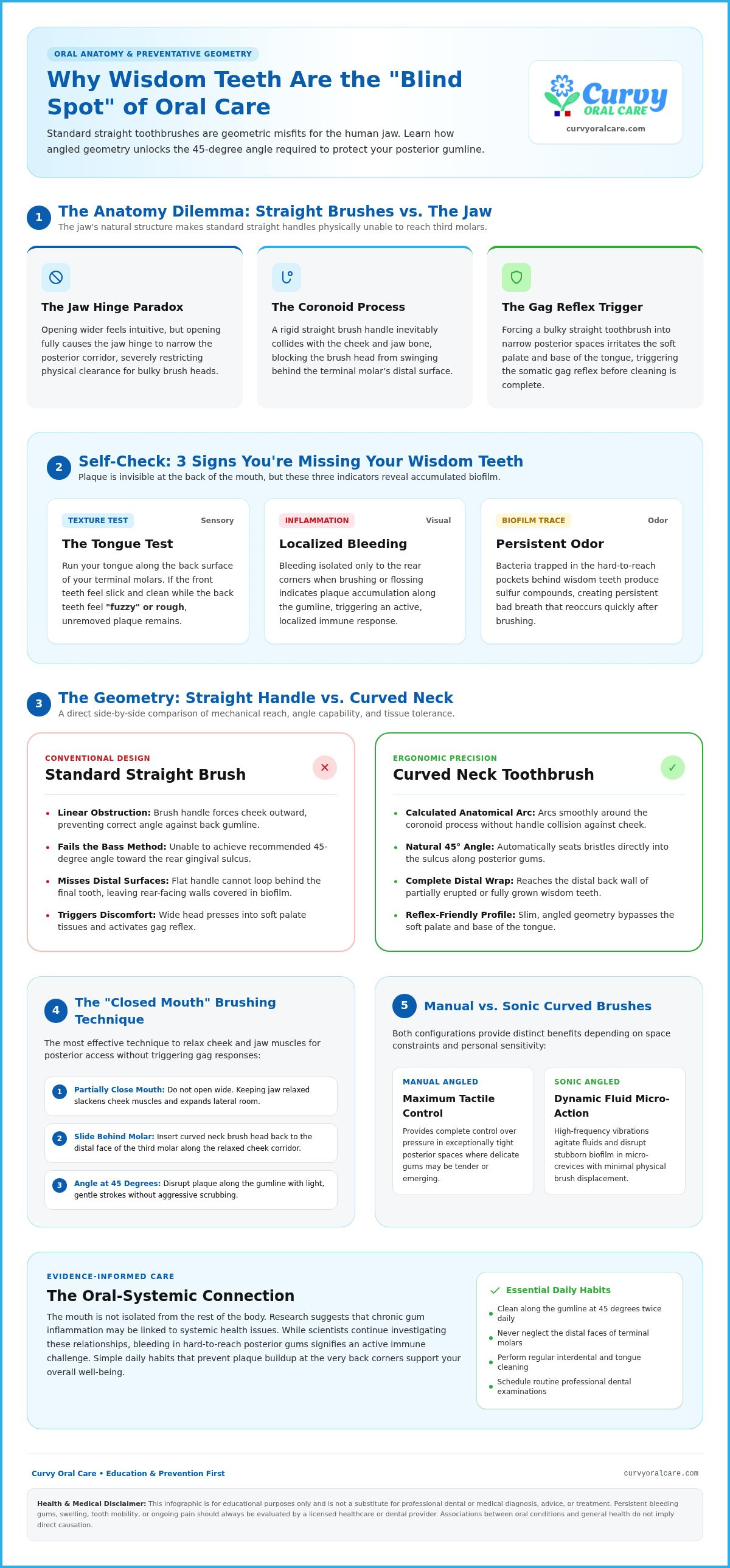
Your mouth isn't a flat surface; it's a complex architectural space. The biggest challenge lies at the very end of the dental arch, where the anatomy of wisdom teeth creates a natural "blind spot." Most people assume that opening wider makes brushing easier, but the opposite is often true. When you open your mouth to its full extent, the jaw hinge actually narrows the space available for a toothbrush head. This mechanical limitation is why a standard straight brush often fails to reach the distal, or back, surface of the third molars.
This lack of access leads to a rapid buildup of plaque, a sticky biofilm of bacteria that triggers inflammation. Because you can't see the back of your mouth, you might stop brushing before you've actually cleaned the area. Over time, this neglect results in persistent bad breath and localized gum sensitivity. Using a curved neck toothbrush for wisdom teeth solves this problem by allowing the brush head to wrap around the molar without the handle colliding with your cheek or front teeth.
The Oral-Systemic Connection
Oral health doesn't exist in a vacuum. Research suggests that chronic gum inflammation may be linked to systemic health issues. While scientists are still investigating these relationships, the presence of bleeding gums in the back of the mouth is a sign of an active immune response. Preventing inflammation in these hard-to-reach areas is a simple, practical step toward supporting your overall well-being. A clean mouth is the foundation of a healthy body, and that foundation includes the very back corners.
Signs You Are Missing Your Wisdom Teeth
It's easy to overlook plaque when it's out of sight. You can identify hidden buildup using a few simple indicators:
- The Tongue Test: Run your tongue along the back of your last molars. If the surface feels "fuzzy" or rough while your front teeth feel smooth, you've missed a spot.
- Localized Bleeding: If your gums only bleed in the back corners during brushing or flossing, it's a sign that plaque is accumulating along the gumline.
- Persistent Odor: Bacteria trapped behind the wisdom teeth can produce sulfur compounds, leading to bad breath that returns shortly after brushing.
Switching to a curved neck toothbrush for wisdom teeth provides the mechanical advantage needed to disrupt this hidden plaque. It's about precision and access, ensuring that every part of your gumline receives the same level of care as your visible smile. By focusing on these signs today, you can prevent the discomfort of inflammation tomorrow.
The Science of the Curved Neck: How Geometry Improves Access
Straight toothbrushes assume your mouth is a straight line. It's not. The human jaw curves at the back, creating a narrow corridor where teeth often trap plaque and food debris. To clean this area effectively, you need more than just reach; you need the correct geometry. Most dentists recommend the Bass method, which involves angling bristles at 45 degrees toward the gumline. A straight handle makes this angle nearly impossible to achieve at the back molars because the handle hits your cheek. A curved neck acts as a mechanical extension of your hand, naturally positioning the bristles into the sulcus without forcing your jaw into an uncomfortable position.
This design shift prioritizes precision over surface area. While bulky, straight brush heads might cover more of the tooth's visible face, they lack the maneuverability to navigate tight posterior corners. A slimmer, angled profile stays away from the soft palate and the back of the tongue, which significantly reduces the gag reflex. It's a smarter way to brush that respects your body's natural somatic defenses while ensuring no surface is left untouched.
Anatomy-First Design
A scientifically engineered curve isn't just a bent handle. It's a calculated arc designed to bypass the coronoid process of the jaw. This specific geometry allows the head to wrap around the terminal molar to reach the distal surface, the very back face of the tooth that most people miss. Using a curved neck toothbrush for wisdom teeth ensures that you aren't just cleaning the tops of your teeth, but the hidden faces where bacteria thrive. This level of access is essential for preventing the localized inflammation that often goes unnoticed until it causes pain.
Soft Bristles and Gum Protection
The tissue surrounding third molars is often tender, especially if a tooth is partially erupted or emerging. Scrubbing aggressively with a straight brush in a "blind" area can cause micro-trauma to these delicate gums. Our Angled Adult Toothbrushes utilize soft bristles that prioritize gum protection while maintaining high cleaning efficiency. By combining the right angle with gentle materials, you can disrupt the biofilm without causing irritation or bleeding. If you're looking for a comprehensive way to upgrade your routine, consider a complete oral care kit that pairs ergonomic design with advanced plaque-fighting technology.
Choosing Between Manual and Sonic Curved Brushes
Selecting the right tool depends on your specific oral anatomy and comfort levels. Manual curved brushes offer unparalleled tactile feedback. This is particularly useful for post-surgical care or when navigating partially erupted teeth where you need to feel the exact pressure applied. You can control every movement with precision, ensuring you don't irritate sensitive gum tissue. However, manual brushing relies entirely on your technique, which can be difficult to maintain in the tight corridors of the back mouth.
Sonic technology changes the mechanical approach. Instead of physical scrubbing, it uses high-frequency vibrations to disrupt plaque. When using a curved neck toothbrush for wisdom teeth, the sonic motor creates fluid dynamics that reach into tight spaces where bristles might not make direct contact. This is crucial for the back molars, where the jaw hinge restricts manual movement. It's an efficient way to achieve a professional-level clean without the need for aggressive hand motions.
The Benefits of Sonic Vibration
High-frequency vibrations, often ranging between 24,000 and 40,000 strokes per minute, generate acoustic microstreaming. This process helps dislodge plaque biofilm slightly beyond the reach of the bristle tips. The Y Angled Sonic Toothbrush is specifically engineered for this purpose. Its geometry ensures the sonic energy is directed exactly where it is needed: the gumline of your back molars. Unlike traditional oscillating brushes that can feel aggressive or bulky on sensitive wisdom tooth sites, sonic tech provides a thorough clean using gentle, rapid pulses that respect your enamel.
Safety and Holistic Health
Most electric toothbrushes on the market emit electromagnetic fields (EMFs) directly against the jaw and close to the brain. While many brands ignore this factor, a holistic approach to oral care prioritizes EMF-free technology. Choosing a motor that minimizes these emissions is a proactive step for your long-term daily routine. This commitment to safety should also include the use of non-toxic, BPA-free materials in the brush head and handle. Your oral hygiene tools should support your whole-body health, not compromise it. For a deeper look at why this technology is a necessary evolution in dental care, read our EMF-Free Sonic Toothbrush Guide.
Brushing Your Back Molars Without the Gag Reflex
The gag reflex is an involuntary somatic defense mechanism. It's your body's way of protecting your airway, but it often makes cleaning the back of the mouth a miserable experience. When you use a standard straight brush, the handle and head often crowd the soft palate or the posterior third of the tongue. This physical contact triggers the glossopharyngeal nerve, resulting in that familiar, uncomfortable urge to gag. Finding a curved neck toothbrush for wisdom teeth is only half the battle; mastering the correct technique is what ensures a comfortable, effective clean.
One of the most common mistakes is opening your mouth too wide. While it seems counterintuitive, opening wide actually lifts the coronoid process of your jaw, which blocks the space behind your molars. The "Closed Mouth" technique is the solution. By keeping your mouth halfway closed, you relax the buccinator muscle in your cheek and create the clearance needed for the brush head to slide into the retromolar pad. This is the area of gum tissue directly behind your last tooth, and it's a primary site for plaque accumulation.
Step-by-Step Molar Cleaning
To ensure consistency, try starting with the most difficult areas first while your focus and energy are highest. This prevents the "rushed finish" that often leaves wisdom teeth neglected.
- Relax the Jaw: Close your mouth slightly to create space between your cheek and your molars.
- Position the Angle: Use the curve of the neck to guide the bristles at a 45-degree angle toward the gumline.
- The Jiggle and Sweep: Use short, vibratory "jiggles" to disrupt the biofilm. Follow this with a "sweep" motion away from the gumline toward the biting surface.
- Navigate the Back: Use the "Y" angle of the handle to maintain a firm grip as you wrap the bristles around the very back face of the last molar.
Complementary Tools for Wisdom Teeth
Effective oral care requires a holistic approach. Even with the best technique, the back of the mouth benefits from specialized support. Using Hydroxyapatite Toothpaste is a proactive way to remineralize enamel in these high-risk areas. Unlike traditional ingredients, hydroxyapatite is a biocompatible mineral that can help strengthen the tooth surface where plaque is most likely to hide.
Don't forget the surrounding environment. Tongue cleaning is essential because the back of the tongue acts as a reservoir for the same bacteria that cause molar inflammation. If you find that manual cleaning still feels like a chore, you can upgrade to a complete sonic oral care system. Pairing a curved neck toothbrush for wisdom teeth with advanced sonic vibration and remineralizing toothpaste provides the ultimate defense against the "blind spot" of oral hygiene.
The Curvy Solution: A Modern Approach to Preventative Care
Curvy Oral Care isn't just another name in a crowded dental aisle. We're a necessary evolution in an industry that has stayed stagnant for too long. For years, the dental world accepted that wisdom teeth were simply "hard to reach." We didn't accept that. Our approach is fundamentally problem-solving. By focusing on the anatomical reality of the human jaw, we've created tools that prioritize precision over tradition. We position ourselves as a knowledgeable mentor, guiding you toward a more effective daily routine that respects your body's unique geometry.
The core of our philosophy is simple: the right tools make better habits inevitable. When you use a curved neck toothbrush for wisdom teeth, you aren't fighting your own anatomy. You're working with it. This shift in health literacy empowers you to take charge of your well-being before problems develop. Prevention is always more comfortable and cost-effective than reactive surgery or deep cleanings. By providing the precision needed to reach the molar blind spot, we help you close the gap between "brushing" and actually being clean.
Building Your Better Routine
Consistency is the foundation of oral health. A Combo Kit simplifies this by providing everything you need to maintain those difficult posterior sites. This isn't just about the brush handle. It's about a holistic system that includes remineralizing toothpaste and the right sonic technology. When these elements work together, the result is a professional-level clean that you can achieve in two minutes at home.
Hygiene also requires maintenance. You should replace your brush heads every 3 to 4 months, or sooner if you notice the bristles becoming frayed. Splayed bristles lose their ability to navigate the tight corridors around your molars, making your efforts less effective. By staying proactive with your replacements and your technique, you ensure that plaque never has the chance to harden into tartar along the gumline. This simple, practical step is one of the most effective ways to support your long-term gum health.
Final Takeaway: Small Habits, Big Impact
Your oral health is a gateway to your whole-body wellness. While research is still investigating the specific mechanisms, studies suggest a strong association between gum inflammation and systemic health. Cleaning the back of your mouth isn't just about avoiding a cavity. It's about reducing the overall inflammatory burden on your body. Every time you successfully disrupt the biofilm on your back molars, you're making a meaningful contribution to your general well-being.
There is a profound psychological relief that comes with a truly clean mouth. You no longer have to worry about the "blind spots" you can't see or the persistent bad breath that returns midday. Investing in a curved neck toothbrush for wisdom teeth is a small daily action that yields massive long-term dividends. Start today. Your future self, and your dentist, will thank you for the proactive care you provide right now.
Take Control of Your Molar Health Today
You have discovered how the "blind spot" in your jaw hinge makes straight brushes ineffective for posterior care. Using a curved neck toothbrush for wisdom teeth aligns with your natural anatomy, allowing for the precise 45-degree angle required to keep gums healthy. This simple shift in your daily routine helps reduce the inflammatory burden on your body and supports your overall well-being. Experience the relief and confidence of a truly clean mouth by choosing tools designed for the way your mouth is actually built.
To support your long-term oral health, take these simple, proactive steps today:
- Brush twice a day using an effective, gentle technique.
- Pay particular attention to cleaning along the gumline.
- Clean between the teeth and don't neglect the back molars.
- Clean your tongue daily to remove hidden bacteria.
- Maintain regular checkups with your dental professional.
Upgrade to the Y Angled Sonic Toothbrush for better molar access and start your journey toward a healthier lifestyle. If you notice persistent bleeding, swelling, or pain, seek professional advice promptly. Small daily habits make a meaningful difference, and you now have the knowledge to protect your smile for years to come.
Health & Medical Disclaimer: This content is for educational purposes only and is not a substitute for professional medical advice, diagnosis, or treatment. Always seek the advice of your dentist or other qualified healthcare provider with any questions you may have regarding a medical condition. Never disregard professional medical advice or delay in seeking it because of something you have read in this article.
Frequently Asked Questions
Is a curved neck toothbrush better than a straight one for wisdom teeth?
Yes, a curved neck is superior for third molars because it bypasses the jaw's mechanical limitations. Straight brushes often collide with the cheek or front teeth, preventing the head from reaching the back face of the molar. A curved design naturally positions the bristles into the gumline without forcing your jaw to open too wide. This ensures you disrupt plaque in areas where a standard brush simply cannot fit.
Can I use an angled toothbrush if I have braces?
Absolutely. An angled toothbrush is highly effective for navigating around brackets and wires. The unique geometry allows you to reach behind the archwire and clean the gumline more effectively than a flat brush. It's especially useful for cleaning the molars that serve as anchor points for your braces, where plaque tends to accumulate heavily. Consistent use helps prevent the white spots and inflammation often associated with orthodontic treatment.
How do I stop gagging when brushing my back molars?
To reduce the gag reflex, use the "closed mouth" technique by keeping your jaw halfway closed to relax your cheek muscles. This creates more space for the brush head to slide back. Choosing a curved neck toothbrush for wisdom teeth also helps because its slimmer, angled profile avoids contact with the sensitive posterior third of your tongue and soft palate. Focus on breathing through your nose to stay relaxed.
Does an angled toothbrush help with bleeding gums at the back of the mouth?
Yes, an angled brush targets the primary cause of bleeding: plaque accumulation along the gumline. Bleeding is often a sign of inflammation, or gingivitis, caused by bacteria you've missed. By using the correct angle to reach the back corners, you can effectively disrupt this biofilm. Over time, consistent cleaning in these hard-to-reach areas helps the tissue heal, leading to healthier gums and better reports during your dental checkups.
Is the Curvy sonic toothbrush safe for sensitive teeth?
The Curvy sonic toothbrush is designed with sensitivity in mind. It uses high-frequency vibrations rather than aggressive mechanical scrubbing, which is gentler on enamel and delicate gum tissue. When paired with soft bristles, the sonic action effectively cleans without requiring heavy pressure. This makes it an ideal choice for individuals who experience discomfort from traditional oscillating brushes or those with sensitive areas around erupting wisdom teeth.
How often should I replace the head on my angled toothbrush?
You should replace your brush head every 3 to 4 months according to ADA standards. If you notice the bristles becoming splayed, matted, or frayed before that time, replace it immediately. Worn bristles lose the precision needed to navigate the tight spaces around your back molars. Regular replacements ensure your routine remains effective and hygienic, preventing the buildup of bacteria on the tool itself.
What is the best technique for cleaning partially erupted wisdom teeth?
Cleaning partially erupted teeth requires a gentle, targeted approach. Use the "jiggle and sweep" method to clean the visible portion of the crown and the surrounding gum tissue. The curved neck allows you to reach the distal surface without irritating the soft tissue flap that often covers these teeth. Using a curved neck toothbrush for wisdom teeth ensures you can disrupt plaque in the small crevices where food debris frequently gets trapped.
Why does Curvy emphasize EMF-free technology?
Curvy emphasizes EMF-free technology because we believe oral care should support your holistic health. Most electric toothbrushes use motors that emit electromagnetic fields close to the jaw and brain. By eliminating these emissions, we provide a safer daily routine for our users. This proactive approach ensures that your commitment to dental hygiene doesn't introduce unnecessary environmental stressors to your body, aligning your oral care with your broader well-being.

Article by
Aline Peixe Nebot
Aline Peixe Nebot is a Veterinarian and passionate advocate for better oral health, committed to raising awareness of oral health as a matter of public health. She actively promotes the importance of simple, effective oral care routines and works to educate the public about the often-overlooked link between oral health and overall systemic health. Her mission is to make better oral care knowledge accessible to everyone and encourage healthier habits for life.
Disclaimer
Disclaimer: The information provided in this article is intended for general educational and informational purposes only. It is not intended to replace professional medical, dental, or healthcare advice, diagnosis, or treatment.
Some content may be AI-assisted and is provided to support health education and awareness. While we strive to share accurate and up-to-date information, health recommendations and scientific evidence can evolve, and the information presented may not apply to every individual.
The connection between oral health and overall systemic health is an important and developing area of research. Associations discussed in this article should not necessarily be interpreted as proof of cause and effect.
Always consult a qualified dentist, physician, or other healthcare professional regarding your individual health, symptoms, medications, or treatment decisions. Do not delay or discontinue professional care based on information presented in this article.
This content is for education and awareness—not diagnosis or treatment.