
Best Toothbrush for Plaque Buildup: What Actually Helps?
What if the best toothbrush for plaque buildup isn’t simply the most powerful one? If plaque keeps collecting along your gumline or around your back teeth, it’s natural to wonder whether a manual or powered brush would work better. Brush design and how easily you can reach each area matter too.
Plaque is a sticky film of bacteria that can collect on teeth, especially near the gums and in spots that are easy to miss. If it isn’t removed regularly, it can irritate the gums. A new toothbrush may help you clean more comfortably, but no feature replaces reaching every area and brushing with care.
This guide explains how to compare manual and powered brushes, which design details may help with access, and how to brush thoroughly without scrubbing too hard. You’ll also find a practical daily routine for cleaning the gumline, spaces between teeth, and back molars. The aim isn’t to chase the biggest product claims. It’s to find a brush you can use consistently and pair it with habits that support healthier teeth and gums.
Key Takeaways
- Plaque is a sticky bacterial film that can irritate gums when it builds up along the gumline, so visible tooth surfaces aren’t the whole picture.
- The best toothbrush for plaque buildup depends on more than whether it’s manual or powered. Access, brushing technique, and consistency matter too.
- Choose a comfortable brush you can guide around your whole mouth, including along the gumline and around back molars.
- Brush twice a day for two minutes, using gentle strokes and taking time to cover every surface.
- An angled sonic toothbrush is one option designed to help reach areas that can be difficult to access with a conventional straight brush.
Best Toothbrush for Plaque Buildup: Why Gumline Cleaning Matters
Choosing the best toothbrush for plaque buildup starts with understanding what you’re trying to remove. Plaque is a sticky biofilm, a thin layer of bacteria and other material that continually forms on tooth surfaces. It can collect even when teeth look clean, particularly in areas your brushing doesn’t reach well.
Plaque control means cleaning tooth surfaces consistently so the film doesn’t remain undisturbed and irritate the gums. A toothbrush helps remove soft plaque, but plaque left on teeth can harden into tartar. Brushing can’t remove tartar once it has formed; a dental professional needs to clean it away.
Where plaque tends to collect
Some areas are easier to overlook than others:
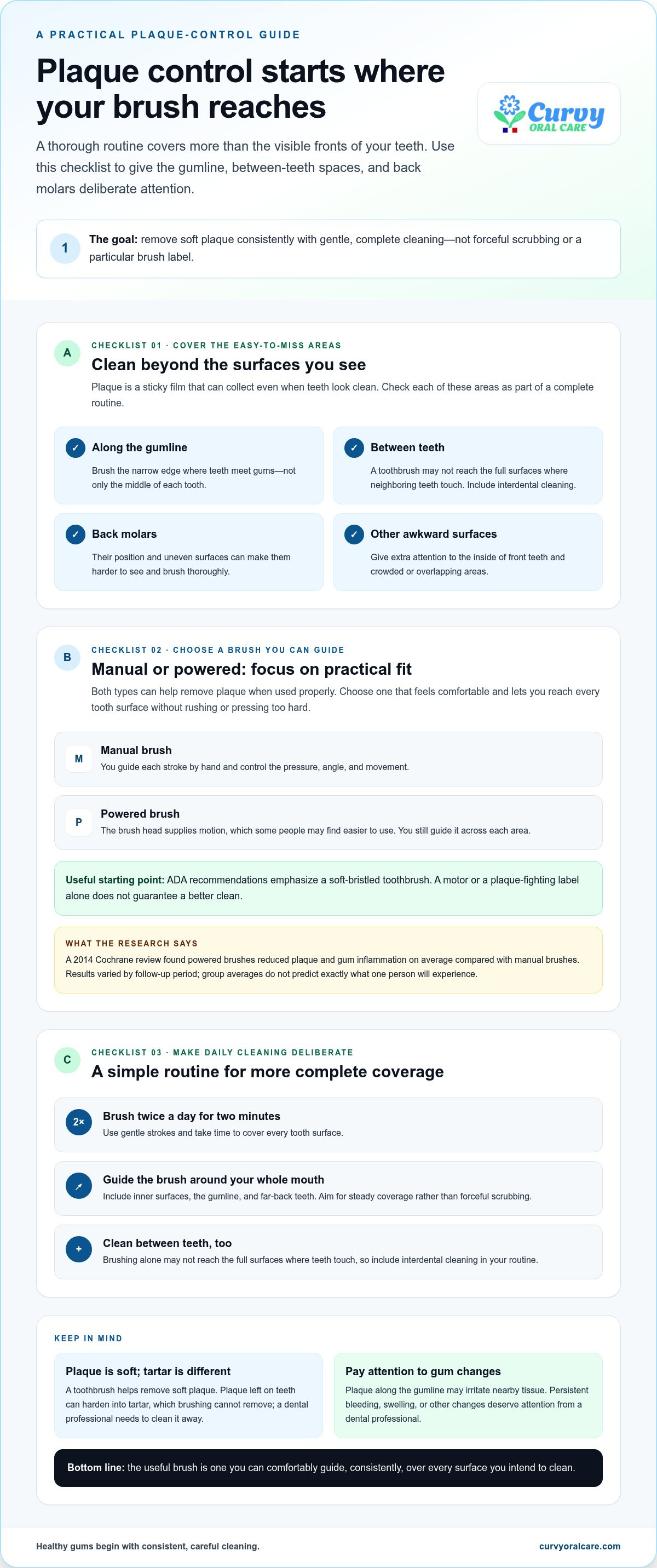
- Along the gumline: The narrow edge where teeth meet gums can be missed if you brush only the middle of each tooth.
- Between teeth: A toothbrush may not reach the full surfaces where neighboring teeth touch, so interdental cleaning matters too.
- Around back molars: Their position and uneven surfaces can make them harder to see and brush thoroughly.
- Other awkward surfaces: The inside surfaces of front teeth and crowded or overlapping areas may need extra attention.
Brushing only the visible fronts can leave the inner surfaces, gumline, and far-back teeth without enough cleaning. Plaque in one spot doesn’t prove that someone has gum disease, but it does highlight an area to include in a more complete routine. For a general overview of types of toothbrushes and their effectiveness, readers can explore how toothbrush designs have developed. Whatever style you use, the brush needs to reach the surfaces you intend to clean.
Plaque, gum health, and the whole-body connection
Gums respond to what accumulates around them. When plaque remains along the gumline, bacteria in the film may irritate nearby gum tissue. Gums can become inflamed, meaning irritated and swollen, and may bleed during brushing or flossing. These signs can have different causes, so they aren’t a diagnosis on their own. Persistent bleeding, swelling, or other changes deserve attention from a dental professional.
The mouth is part of the body, and researchers are studying how oral health may relate to overall health. Studies have found associations between gum disease and certain health conditions, but an association doesn’t prove that one directly causes the other. Research is ongoing, and individual concerns are best discussed with qualified dental or medical professionals.
For daily prevention, clean beyond the surfaces you see in the mirror. A brush that feels comfortable and is easy to guide can help you give the gumline, spaces between teeth, and back molars deliberate attention. Aim for steady, thorough cleaning, not forceful scrubbing.
Manual, Sonic, or Other Electric: What Research Says About Plaque Removal
There isn’t one brush type that works best for everyone. With a manual brush, you guide each stroke by hand. A powered brush moves the brush head for you, which can make brushing feel more assisted. Either can be part of a thorough routine. What matters in practice is whether you can comfortably guide the brush around your mouth, reach all tooth surfaces, and clean consistently.
The American Dental Association recognizes that both manual and powered toothbrushes can help remove plaque when used properly. Its ADA recommendations for toothbrushes also emphasize choosing a soft-bristled brush. That’s a more useful starting point than assuming a motor or a plaque-fighting label guarantees a better clean.
What a toothbrush comparison can, and cannot, tell you
Clinical reviews compare results across groups and study conditions. A 2014 Cochrane review found that powered brushes reduced plaque and gingivitis, or gum inflammation, on average compared with manual brushes, with results varying by follow-up period. Group averages don’t predict exactly what one person will experience, and they don’t mean every powered brush performs the same way. Study findings also aren’t interchangeable with marketing claims, which may not explain what was measured or how.
Comparisons can help identify patterns, but they can’t account for each person’s grip, brushing habits, mouth shape, or ability to reach difficult areas. A feature or technology may be useful, but it isn’t a guarantee of superior cleaning. Treat evidence as a guide to possible benefits, not a promise about an individual result.
How manual and powered brushes differ in everyday use
A manual brush gives you direct control over pressure, angle, and movement. It may suit someone who prefers a simple tool and is comfortable making slow, deliberate passes. A powered brush supplies the head’s motion, which some people may find easier to use, including people who have difficulty with hand movements. You still need to guide the head across each area.
No brush replaces careful coverage of every tooth surface. Comfort matters because an awkward brush may be harder to use thoroughly, particularly around back teeth and along the gumline. When comparing the best toothbrush for plaque buildup, consider whether you can reach every area without rushing or pressing too hard, rather than choosing by power alone.
Curvy Oral Care offers manual and sonic options, including an angled design intended to help users reach difficult-to-access areas. If a sonic brush suits your routine, explore this sonic toothbrush and toothpaste combo. Whichever brush you choose, give each surface deliberate attention and follow dental guidance tailored to your needs.
How to Choose a Toothbrush for Plaque Buildup
A useful toothbrush is one you can hold comfortably and guide around your whole mouth. Rather than choosing by the number of modes or promotional claims, picture your actual routine. Can you angle the head along the gumline? Can you maneuver it behind the last molars and around crowded or awkward surfaces? A brush that helps you reach those areas is more practical than one with features you won’t use.
Brush-head access, bristles, and comfort
Brush-head shape can affect how easily you guide the bristles around teeth, but shape alone doesn’t show how well a brush will remove plaque for every user. A smaller-feeling or angled head may be easier for some people to maneuver into tight spaces; comfort and mouth anatomy vary. Choose soft bristles and use a gentle touch. Pressing harder doesn’t replace careful coverage, and people with limited dexterity may find some handles or powered options easier to manage.
Think about the parts of your mouth you tend to rush. If the inner surfaces or back teeth are difficult to reach, prioritize a design that feels controllable there. Curvy Oral Care’s angled adult toothbrush with soft bristles is designed to help users reach areas that may be harder to access with a conventional straight brush. For more detail on access from gumline to molars, the sibling guide, “Angled Toothbrush for Plaque: Gumline to Molars Guide,” explores the topic further.
Useful features versus promotional extras
Start with the basics: a comfortable grip, a head you can guide reliably, and a brushing experience you’ll stick with. A timer or pressure reminder may help some people follow a routine, but neither replaces deliberate brushing. Motor speed, multiple modes, and phrases such as “plaque fighter” shouldn’t be treated as proof that a brush will clean your mouth better. Evidence summaries, including the Oral Health Foundation’s research on electric toothbrush effectiveness, can offer context, but results don’t predict exactly how a brush will work for you.
| Brush type | What to consider |
|---|---|
| Manual | Direct control over movement; you guide each stroke yourself. |
| Sonic | A powered option with sonic movement; check that you can guide the head across all areas. |
| Other powered | Assisted brush-head movement may suit your preferences or dexterity; technique and coverage still matter. |
The best toothbrush for plaque buildup is a personal fit, not a feature count. If you’re interested in a powered option as part of a simple routine, Curvy Oral Care’s sonic toothbrush and toothpaste combo brings those oral-care basics together. Choose a brush you can use comfortably and consistently, then focus on reaching each surface with care.
A Daily Brushing Routine That Targets Plaque and Protects Gums
A useful routine gives you a repeatable path through your mouth. Dental guidance recommends brushing twice a day for two minutes, using gentle, short strokes and angling the bristles toward the gumline. Give every surface attention, not just the teeth that are easiest to see.
Brush deliberately around the gumline and back teeth
Move in a steady pattern so you don’t skip areas. Keep pressure light; scrubbing harder can irritate gums without making your cleaning more thorough. With a powered brush, guide its head across each area rather than brushing as you might with a manual brush. An angled brush may help some people position the bristles in spots that feel awkward to reach.
- Start with the outer surfaces. Work from one side of the mouth to the other, following the gumline around upper and lower teeth.
- Clean the inner surfaces. Give the inside of each tooth the same attention, including the backs of the front teeth.
- Cover the chewing surfaces. Brush across the grooves of the molars, especially the far-back teeth.
- Make a final pass where access is tricky. Pause around crowded or hard-to-see areas and adjust the brush angle instead of pressing harder.
This sequence helps make brushing a whole-mouth habit. For more guidance on brush angle and access, see Angled Toothbrush for Plaque: Gumline to Molars Guide. If dental work or another concern makes a particular spot difficult to clean, ask a dental professional for advice suited to your mouth.
Complete the routine beyond brushing
Brushing doesn’t clean every surface between teeth, so pair it with interdental cleaning. Floss or another suitable interdental cleaner reaches spaces a toothbrush may miss; it complements brushing rather than replacing it. Tongue cleaning can also be part of your routine, along with regular dental checkups.
- Clean between teeth: Choose an interdental method that fits your needs and use it consistently.
- Support daily health: A balanced eating pattern and steady oral-care habits contribute to general well-being.
- Notice changes: Seek professional advice for persistent bleeding, swelling, pain, or other significant changes.
The toothbrush is one part of daily care. A manageable routine can help you give each area attention without rushing. Make one small adjustment at a time, then keep the habits that work for you.
A Sonic Angled Toothbrush as One Option for Hard-to-Reach Plaque
Curvy Oral Care shares oral-health education and products, not a replacement for care from a dental professional. Its EMF-free angled sonic toothbrush is one option for people considering a powered brush. The design is intended to help users reach difficult spots, while careful brushing and a complete oral-care routine remain essential.
What the angled design is intended to help with
Brush design is one part of choosing a tool that feels manageable in daily use. Curvy’s Y angled sonic toothbrush combines sonic brushing with an angled design. Consider how it feels in your hand and whether it suits your routine; no particular brush can guarantee an individual plaque-removal result.
Make the next step part of a complete routine
Brushing is one part of daily care. Clean between teeth with an appropriate interdental method, and keep up with regular dental visits for guidance tailored to your needs. If you have persistent oral-health concerns, a dental professional can help assess them.
Small, steady habits can make oral care easier to maintain. If you’re considering a powered brush as part of your routine, explore the sonic toothbrush and toothpaste travel combo, then choose the routine and tools that feel practical for you.
Make Your Next Brush Choice Work for You
Choosing the best toothbrush for plaque buildup is a starting point, not a finish line. Notice how your routine works in real life. Is brushing comfortable enough to stick with? Are there spots you tend to rush? Use what you notice to make one realistic adjustment, then give yourself time to build the habit.
Small, repeatable choices are more useful than chasing a perfect product. If you’re comparing brushes, focus on the option that fits your preferences and makes daily care manageable. Keep regular dental visits on your calendar, and seek professional guidance for oral-health concerns that persist or change.
If you’d like a powered option to support your routine, explore the sonic toothbrush and toothpaste travel combo. Choose what feels practical for you, build the habit one day at a time, and keep moving toward a healthier mouth with confidence.
Frequently Asked Questions
Can a sonic toothbrush damage enamel or gums?
A sonic toothbrush doesn’t inherently damage or protect enamel or gums; pressure and brushing technique matter regardless of brush type. Use a gentle touch and avoid forcing the bristles against teeth or gum tissue. If brushing causes sensitivity or discomfort, or you’re unsure about your pressure, a dental professional can assess your technique and offer advice suited to your needs.
Should I brush before or after breakfast?
Either timing may fit your routine, depending on what you eat or drink and your individual oral-health needs. If breakfast includes acidic foods or drinks, ask your dental professional whether your timing or technique should be adjusted. The practical priority is brushing consistently twice a day. If you have a specific dental concern, get personalized guidance rather than relying on a universal timing rule.
Can I use an electric toothbrush if I have sensitive teeth?
Some people with sensitive teeth can use an electric toothbrush, but sensitivity has several possible causes, and this FAQ can’t identify yours. Choose a brush that feels comfortable, use gentle pressure, and avoid pressing on tender areas. A different brush alone may not address the reason for sensitivity. If sensitivity persists or you have pain, arrange a dental evaluation so a professional can assess the cause and advise you.
Are whitening toothbrushes better at removing plaque?
“Whitening” describes a product claim about tooth appearance, not proof of better plaque removal. A whitening label or polishing feature doesn’t establish that a brush cleans more effectively. For plaque care, look for clear product information rather than treating a marketing label as evidence. If staining persists or changes, a dental professional can help identify possible explanations and discuss appropriate next steps.
Can I use a sonic toothbrush around braces, crowns, or dental implants?
People with braces, crowns, or implants may need cleaning guidance tailored to their appliances and restorations. Cleaning around brackets, edges, and restoration margins takes care, and the right approach can vary with the specific device and your dental needs. Follow your dental professional’s instructions, including any recommended tools or technique. Don’t assume a brush is suitable for every appliance or restoration without individualized advice.
Why might my gums bleed when I brush?
Bleeding can have several possible causes, including irritation from brushing pressure or changes in gum health, so it doesn’t identify a specific condition by itself. Notice whether it happens in one area or across the mouth, and consider whether your brushing technique has changed. If bleeding continues, a dental professional can assess what may be contributing and recommend care suited to you.
Health & Medical Disclaimer: This content is for educational purposes only and is not a substitute for professional dental or medical advice, diagnosis, or treatment. Consult a qualified dental or medical professional about personal health concerns.

Article by
Aline Peixe Nebot
Aline Peixe Nebot is a Veterinarian and passionate advocate for better oral health, committed to raising awareness of oral health as a matter of public health. She actively promotes the importance of simple, effective oral care routines and works to educate the public about the often-overlooked link between oral health and overall systemic health. Her mission is to make better oral care knowledge accessible to everyone and encourage healthier habits for life.
Disclaimer
Disclaimer: The information provided in this article is intended for general educational and informational purposes only. It is not intended to replace professional medical, dental, or healthcare advice, diagnosis, or treatment.
Some content may be AI-assisted and is provided to support health education and awareness. While we strive to share accurate and up-to-date information, health recommendations and scientific evidence can evolve, and the information presented may not apply to every individual.
The connection between oral health and overall systemic health is an important and developing area of research. Associations discussed in this article should not necessarily be interpreted as proof of cause and effect.
Always consult a qualified dentist, physician, or other healthcare professional regarding your individual health, symptoms, medications, or treatment decisions. Do not delay or discontinue professional care based on information presented in this article.
This content is for education and awareness—not diagnosis or treatment.