
Best Compact Head Toothbrush for Gag Reflex: 2026 Guide
What if the retching you dread every morning isn't an unavoidable personal flaw, but simply a design problem with your toothbrush? Finding an effective compact head toothbrush for gag reflex sensitivity can completely transform your daily routine. When a bulky, conventional brush head bumps your soft palate or the base of your tongue, your body's protective reflex fires automatically. That sudden spasm turns cleaning your back molars into an ordeal, leaving stubborn plaque to accumulate along vulnerable gumlines.
You know the frustration of cutting your brushing short, along with the quiet worry over missed wisdom teeth and bleeding gums. You are far from alone in that struggle, as research suggests roughly 10 to 15 percent of people live with a hypersensitive gag reflex. You don't have to sacrifice your gum health just to stay comfortable. An ultra-compact, angled brush navigates narrow cheek corridors with precision, clearing plaque away from back molars without crowding your palate. In this 2026 guide, you'll discover the best compact designs, ergonomic shapes, and gentle techniques to keep your mouth healthy and your morning routine calm.
Key Takeaways
- Understand the biological triggers behind the pharyngeal reflex and why standard brush heads accidentally set off morning nausea.
- Discover how choosing a low-profile compact head toothbrush for gag reflex sensitivity protects back molars without crowding the soft palate.
- Learn why combining a slim head with an angled neck design unlocks tight posterior cheek corridors without uncomfortable stretching.
- Master simple desensitization habits and diaphragmatic nasal breathing techniques to relax throat muscles while you brush.
- Protect vulnerable posterior gumlines against plaque buildup to prevent inflammation and support your overall well-being.
Understanding the Gag Reflex: Why Back Molar Brushing Triggers Nausea
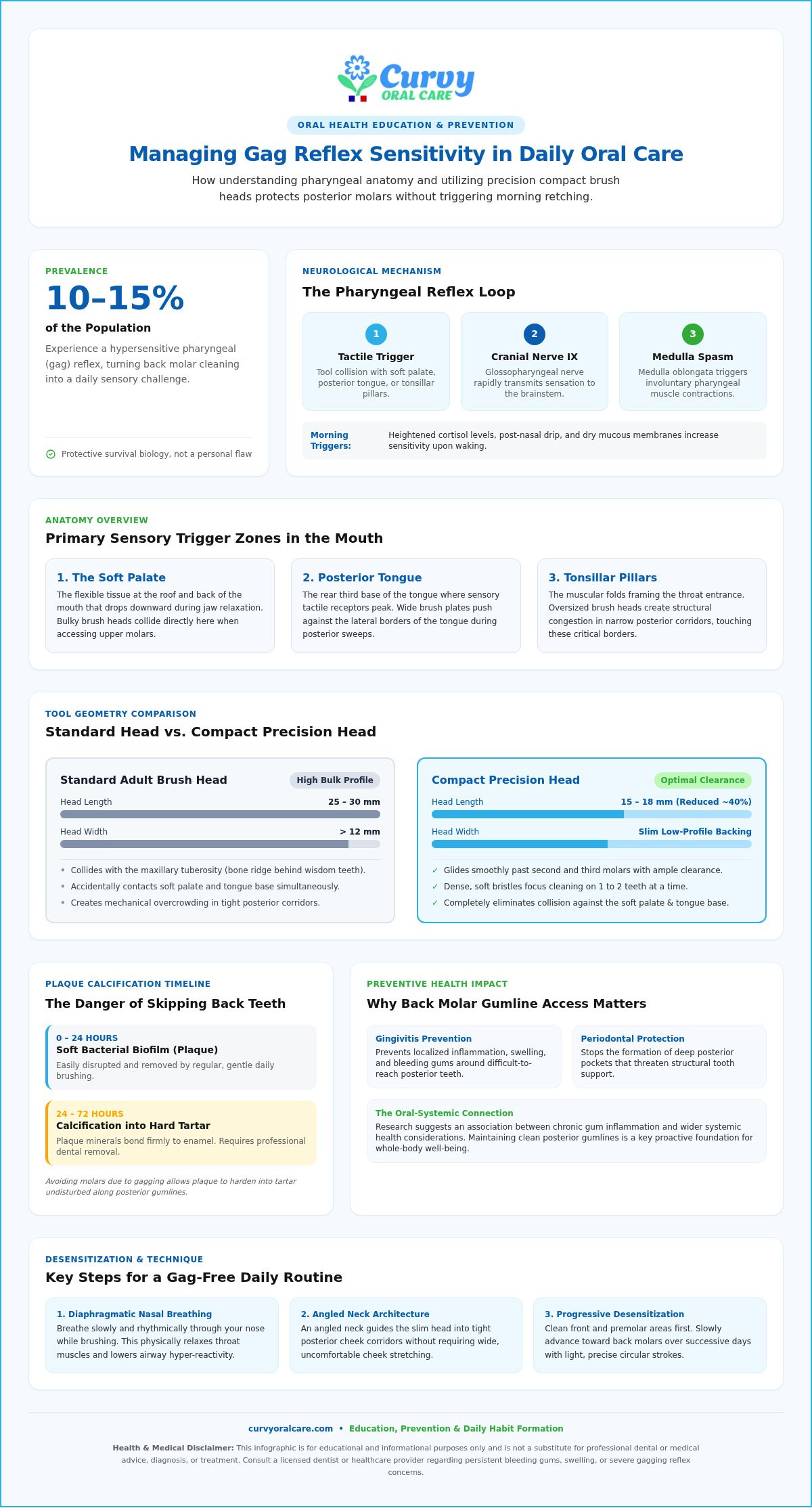
That sudden, violent retch while brushing isn't just an annoyance; it is hardwired survival biology. Clinically termed the pharyngeal reflex, this response is an involuntary muscle contraction designed to protect your airway from foreign objects and prevent choking. The problem arises when oversized oral care tools turn this protective response into a daily obstacle. Using a standard, blocky toothbrush turns routine morning hygiene into an intense sensory battleground.
Sensory triggers cluster tightly around three primary anatomical zones:
- The soft palate: The fleshy back tissue that drops down when you relax your jaw.
- The posterior tongue: The rear third of the tongue base where tactile sensitivity peaks.
- The tonsillar pillars: The muscular folds framing the entrance of your throat.
Switching to a slim compact head toothbrush for gag reflex management solves the core physical problem: unwanted tool collision against these sensitive zones.
The Anatomy of the Pharyngeal Trigger Zones
The neurological pathway begins with the glossopharyngeal nerve (cranial nerve IX). When a brush head grazes your rear palate or deep tongue tissue, this nerve instantly signals the medulla oblongata in your brainstem, sparking an immediate pharyngeal spasm. Early mornings make this worse. Cortisol rhythms, dry mucous membranes after sleep, and post-nasal drip heighten nervous system reactivity. Standard brush heads measuring an inch or more simply lack the clearance needed around the upper second and third molars, virtually guaranteeing contact with the soft palate.
The Hidden Oral Health Cost of Avoiding Back Teeth
When brushing causes persistent retching, you naturally pull back. You skip the rearmost surfaces, sweep past posterior gumlines, and cut your routine short. Unfortunately, dental plaque, a sticky, soft biofilm of bacteria, calcifies into hard tartar in these skipped pockets within 24 to 72 hours. Once hardened, tartar requires professional removal by a dental team.
Avoiding these zones causes serious consequences:
- Plaque accumulation sparks localized gingivitis, showing up as puffy, tender, or bleeding gums.
- Deep posterior periodontal pockets can form, threatening the supporting structures of your teeth.
- Emerging scientific research suggests an association between chronic gum inflammation and wider systemic health considerations. While studies continue to investigate these links, maintaining healthy gums around back molars remains a cornerstone of proactive preventive health.
Using a precision-sized compact head toothbrush for gag reflex relief lets you access tight posterior zones calmly, breaking the cycle of nausea, missed plaque, and persistent gum inflammation.
Anatomy of a Gag-Free Toothbrush: Compact Heads Versus Standard Brushes
Most drugstore shelves push oversized toothbrush heads designed to scrub wide swaths of enamel in a single pass. Standard adult brush heads typically measure 25 to 30 millimeters in length and over 12 millimeters in width. That extra bulk turns the back of your mouth into a structural traffic jam. In contrast, an intentional compact head measures roughly 15 to 18 millimeters. That reduced footprint transforms your brushing experience by clearing tight rear corridors without touching sensitive tissues.
A smaller head does not compromise on cleaning power. Instead of relying on brute surface area, engineered compact brushes utilize higher bristle density. Tensely packed, soft bristles maintain full surface contact along the enamel while you target one or two teeth at a time. The result is clinical precision: maximum plaque disruption along the posterior margin without triggering unwanted spasms.
Dimensional Profiles: Head Height, Width, and Clearance
Head length tells only half the story. The true culprit behind morning retching is often head thickness: the depth of the plastic plate holding the bristles. When you slide a bulky brush past your upper second molars, the hard backing collides with the maxillary tuberosity, the bony ridge behind your upper wisdom teeth. A low-profile, slim back plate provides critical clearance in this narrow passage. Narrow widths prevent sideways collision with the lateral borders of your tongue, while tapered bristle arrangements glide across oral mucosa without aggressive friction.
Why Neck Angle Matters More Than Bristle Force
Even the smallest head will fail if it sits on a rigid, straight handle. Conventional straight necks demand awkward wrist gymnastics to reach behind back molars. To reach posterior surfaces, you are forced to stretch your cheeks wide, driving the handle inward against the soft palate. An ergonomic forward neck angle eliminates this problem entirely.
Thoughtful neck geometry offers distinct mechanical advantages:
- Natural arch tracking: The neck follows the dental arch effortlessly, slipping behind molars without aggressive cheek retraction.
- Precise 45-degree positioning: The built-in angle naturally rests bristles along the gumline to lift plaque without excessive downward force.
- Tissue protection: Gentle alignment stops you from over-scrubbing, protecting tender gingival margins from recession and abrasion.
Finding the right balance of a slim profile, angled reach, and gentle sonic vibration is easy with a dedicated setup like the Curvy sonic toothbrush travel set. Choosing an anatomically designed compact head toothbrush for gag reflex comfort ensures your posterior molars receive thorough daily care without uncomfortable palatal contact.
Key Buying Criteria: How to Choose a Compact Head Toothbrush
Selecting the best tool requires evaluating specific mechanical features rather than picking whatever catches your eye in the dental aisle. An effective compact head toothbrush for gag reflex management balances low-bulk hardware with precise cleaning performance. Use this quick checklist when assessing your options:
- Head clearance: Look for heads under 18 millimeters long and less than 12 millimeters wide.
- Chassis depth: Ensure the backing plate is ultra-thin to slip past upper rear arches effortlessly.
- Bristle density: Choose multi-tufted, ultra-soft filaments that sweep away plaque bio-films gently.
- Handle geometry: Prioritize an ergonomic neck offset to reduce cheek-stretching strain.
Manual Versus Sonic: Evaluating Vibration and Control
Manual brushes provide total tactile control. You regulate the exact depth, angle, and speed with every stroke, which helps lower anxiety when navigating sensitive zones. Sonic technology, however, introduces dynamic fluid action. Instead of requiring wide, physical scrubbing sweeps that repeatedly bump sensitive tissues, low-amplitude sonic vibrations do the heavy lifting in place. The resulting micro-bubbles flush between teeth and along the posterior gumline while the brush head stays nearly motionless. Modern sonic units offer gentle, whisper-quiet frequencies that cleanse thoroughly without rattling your jaw or triggering sensory overload.
Bristle Geometry: Soft, Tapered, and Protective
Bristle choice makes or breaks your comfort around the retromolar pad. The American Dental Association consistently recommends soft bristles, and this advice is vital for sensitive mouths. Hard and medium bristles abrade soft tissue, increase mucosal sensitivity, and resist bending around tight corners. High-grade compact brushes utilize end-rounded, tapered micro-bristles. These filaments flex readily within the narrow crevice between your back molars and cheek walls. They reach into the gingival sulcus to disrupt bacteria without provoking sharp pain or defensive gagging.
Sensory-Friendly Toothpaste and Formulation Pairings
Hardware represents only half of the equation; chemical triggers matter just as much. Traditional foaming pastes contain sodium lauryl sulfate (SLS). This harsh surfactant generates massive froth that floods the back of the mouth, coating your soft palate and quickly inducing nausea. Switching to a low-suds, mildly flavored formula keeps your airway clear while you clean. Pairing your brush with a soothing, remineralizing hydroxyapatite toothpaste protects enamel and calms exposed dentin without dense, choking foam. It leaves your mouth feeling refreshed, clean, and completely calm.
Practical Brushing Techniques to Desensitize Your Gag Reflex
Pairing thoughtful engineering with deliberate neuromuscular habits transforms your daily hygiene. Even when using a dedicated compact head toothbrush for gag reflex comfort, your brain may anticipate discomfort and tense up automatically. You can short-circuit that defensive reaction by retraining your body's physical responses with a systematic, 5-step approach:
- Engage an acupressure point: Tuck your left thumb into your palm and make a firm fist; this mild neurological distraction helps dampen the pharyngeal response.
- Adopt a forward chin tilt: Lean forward over the sink rather than standing upright, letting gravity guide fluids away from your throat.
- Initiate slow nasal breathing: Take deep diaphragmatic breaths through your nose to keep your airway open and throat muscles relaxed.
- Start in low-sensitivity zones: Clean the front surfaces first to build a calm rhythm before venturing toward posterior teeth.
- Glide along the cheek corridor: Slide the compact head between your cheek and upper rear molars, letting the bristles do the work without forcing the handle inward.
Postural and Neuromuscular Adjustments
Body mechanics play a major role in pharyngeal sensitivity. Tilting your head slightly down and forward widens the buccal space between your cheek and molars. It also keeps saliva from pooling near the back of the palate, which is a common nausea trigger. Make a conscious effort to drop your tongue flat against the floor of your mouth. When the tongue rises defensively, it narrows the oral cavity and collides with the brush head. Steady diaphragmatic breathing through your nose actively signals your autonomic nervous system to stay calm, preventing sudden throat spasms.
Sequencing Your Brushing Routine for Maximum Comfort
Never rush straight to your rear molars right after turning on the water. Sensory alertness peaks the moment you begin brushing. Instead, clean the lower front incisors first, then transition across the upper front arches. Once your mouth adapts to the sensation, glide along the outer cheek-facing surfaces of your back teeth. Finish with the lingual, tongue-facing surfaces, where gag triggers are most easily activated.
Pacing is everything. Rely on an integrated two-minute interval timer to guide your session with structured 30-second quadrants. To put these methods into practice with purpose-built tools, upgrade your setup with the Curvy complete sonic toothbrush kit. Using an angled compact head toothbrush for gag reflex sensitivity alongside these steady habits turns a stressful morning chore into a calm, confident daily win.
Engineered for Difficult Angles: Why Ergonomic Design Solves the Problem
Miniature head size solves only half of the accessibility equation. A truly comfortable, retch-free brushing experience requires uniting compact head dimensions with purposeful neck architecture. When you push a standard straight handle toward rear molars, the rigid shaft levers against the corner of your lips. This mechanical pinch forces the brush head inward toward the center of your mouth, directly threatening the palatal curtain. Using a dedicated compact head toothbrush for gag reflex relief only succeeds when the brush neck is built to bend around natural oral anatomy.
Angled geometry changes the physics of brushing. By placing the brush head on a subtle, forward-reaching offset, the tool glides along your dental arch rather than cutting across it. You reach the farthest molar surfaces smoothly without stretching your cheek muscles or crowding your throat.
The Geometric Advantage of the Curvy Angled Brush
Conventional straight designs force awkward wrist positions that inevitably tilt the back of the brush into the uvula. The Y Angled Sonic Toothbrush EMF Free circumvents this dilemma with an anatomically sculpted neck. This curve bypasses the tight corner of the mouth, directing high-frequency sonic energy precisely where plaque bio-films gather behind wisdom teeth. Because the low-profile head navigates the posterior corridor without palate contact, gentle fluid dynamics sweep the gumline clean while your pharyngeal reflex stays calm and quiet.
Transforming Your Daily Routine with Low-Stress Tools
When brushing stops triggering nausea, psychological dread disappears. Your routine transforms from a rushed, stressful scramble into a calm, empowering self-care habit. Consistent daily plaque removal along the posterior gumline protects against localized gingivitis and prevents bleeding tissue. Because research continues to explore how chronic gum inflammation connects to systemic wellness, establishing a peaceful, twice-daily cleaning routine is essential for whole-body health.
Investing in a purpose-built compact head toothbrush for gag reflex sensitivity provides the exact clearance, gentle bristles, and balanced reach your mouth needs. Taking simple, practical steps with the right tools ensures your back molars receive the daily protection they deserve without the battle.
Transform Your Daily Routine into a Calm, Retch-Free Habit
Morning oral hygiene shouldn't feel like an endurance test. Overcoming brushing nausea comes down to choosing tools aligned with your oral anatomy rather than fighting against it. Switching to an ergonomic compact head toothbrush for gag reflex relief eliminates the physical friction that sparks retching, ensuring your back molars and posterior gumlines receive the dedicated daily care they need.
The solution lies in smarter engineering. Featuring a patented angled neck design that eliminates awkward palate contact, an ultra-compact head reaches back molars effortlessly without crowding sensitive trigger zones. Supported by gentle, EMF-free sonic technology, it cleans thoroughly along the gumline through fluid motion rather than abrasive, gag-inducing scrub strokes. You deserve an oral care ritual that leaves you feeling refreshed and protected instead of stressed. Upgrade to the Complete Sonic Care Kit for Retch-Free Brushing and take a proactive step toward healthier gums and lasting peace of mind.
Frequently Asked Questions
Why do I suddenly gag when brushing my back teeth?
Sudden gagging usually happens when a toothbrush head bumps the soft palate, tonsillar pillars, or the sensitive base of your tongue. Heightened stress, nasal congestion, or morning acid reflux can make these sensory nerves extra reactive. When your mouth feels crowded by a rigid, bulky tool, your pharyngeal reflex fires automatically to guard your airway against accidental choking.
Is a compact head toothbrush as effective at cleaning plaque as a regular brush?
Yes, compact heads clean plaque just as effectively as standard brushes, and often much better in tight spaces. Rather than relying on large surface area, an engineered compact head toothbrush for gag reflex relief uses dense, soft bristles. This smaller profile lets you focus directly on one or two teeth at a time, ensuring complete plaque removal along posterior gumlines without mucosal irritation.
Can an electric or sonic toothbrush make my gag reflex worse?
Heavy, mechanical oscillating brushes with thick heads can worsen gagging, but low-amplitude sonic models usually help. High-frequency sonic vibrations clean through dynamic fluid action, breaking up sticky bacterial biofilms without requiring wide, sweeping scrub motions. Choosing a lightweight, slim sonic brush keeps the back of your mouth feeling spacious, steady, and calm throughout your routine.
What toothbrush head size is considered compact?
Dental guidelines consider a compact head to measure roughly 15 to 18 millimeters in length and under 12 millimeters in width, compared to standard adult heads that stretch 25 to 30 millimeters. A true compact design also features an ultra-thin backing plate. This slim profile ensures the brush glides between the upper molar gumline and inner cheek wall without colliding with sensitive tissues.
Does toothpaste flavour or foam trigger the gag reflex?
Strong artificial flavors and heavy foaming agents frequently trigger gagging episodes. Toothpastes formulated with sodium lauryl sulfate produce dense lather that pools near the throat, blocking nasal airflow and initiating retching. Switching to a mild, non-foaming paste powered by soothing ingredients like hydroxyapatite protects your enamel while keeping your airway completely clear while brushing rear molars.
How do I clean my wisdom teeth if I have a severe gag reflex?
Position your chin down over the sink, breathe slowly through your nose, and glide an angled compact head toothbrush for gag reflex sensitivity along your cheek corridor. Keep your jaw slightly closed rather than wide open to loosen your cheek muscles. Allow the slim, angled neck to reach the rearmost tooth surface so the bristles clean without touching your uvula.
When should I consult a dentist about bleeding gums near back molars?
Schedule a dental evaluation if your gums bleed consistently for more than a week, or if you notice localized swelling, persistent tenderness, or bad breath around back teeth. These signs often point to gingivitis or advancing periodontal inflammation from skipped plaque buildup. A professional dental team can safely remove hardened tartar and guide your long-term preventive routine.

Article by
Aline Peixe Nebot
Aline Peixe Nebot is a Veterinarian and passionate advocate for better oral health, committed to raising awareness of oral health as a matter of public health. She actively promotes the importance of simple, effective oral care routines and works to educate the public about the often-overlooked link between oral health and overall systemic health. Her mission is to make better oral care knowledge accessible to everyone and encourage healthier habits for life.
Disclaimer
Disclaimer: The information provided in this article is intended for general educational and informational purposes only. It is not intended to replace professional medical, dental, or healthcare advice, diagnosis, or treatment.
Some content may be AI-assisted and is provided to support health education and awareness. While we strive to share accurate and up-to-date information, health recommendations and scientific evidence can evolve, and the information presented may not apply to every individual.
The connection between oral health and overall systemic health is an important and developing area of research. Associations discussed in this article should not necessarily be interpreted as proof of cause and effect.
Always consult a qualified dentist, physician, or other healthcare professional regarding your individual health, symptoms, medications, or treatment decisions. Do not delay or discontinue professional care based on information presented in this article.
This content is for education and awareness—not diagnosis or treatment.