
Best Angled Manual Toothbrushes for Plaque: 2026 Guide
Why are you still dealing with stubborn plaque on your back molars even though you brush diligently twice a day? It's frustrating to follow every dental rule, only to experience bleeding gums, sensitive spots, or that gritty feeling behind your rear teeth. You haven't failed your oral hygiene routine; traditional, flat tools have simply failed your anatomy. That's why upgrading to an angled manual toothbrush is such a crucial shift. While rigid straight handles struggle against the tight spaces of your cheeks, an angled neck effortlessly follows the natural curvature of your dental arch.
You'll discover why the angle of your brush head is the secret to reaching back molars, protecting your gumline, and preventing plaque buildup before it leads to discomfort. We'll also clear up confusion around bristle stiffness so you can brush thoroughly without irritating sensitive tissue. In this 2026 guide, we break down the biomechanics of effective daily cleaning and reveal the best tools to help you achieve a healthier, dentist-clean smile right at home.
Key Takeaways
- Discover why conventional straight handles struggle with the mouth's natural curves and leave back molars vulnerable to plaque buildup.
- Understand the science of the gingival sulcus and how gentle, targeted cleaning protects your gums from early inflammation.
- Identify what matters most when choosing an angled manual toothbrush, from high-performance Dupont Filaments to compact head geometry.
- Explore how specialized ergonomic designs solve distinct daily challenges for adults, children, and those with orthodontic braces.
- Master a practical two-minute routine and essential tongue-care habits to establish a proactive foundation for long-term oral wellness.
The Geometry of Oral Care: Why Straight Brushes Miss the Mark
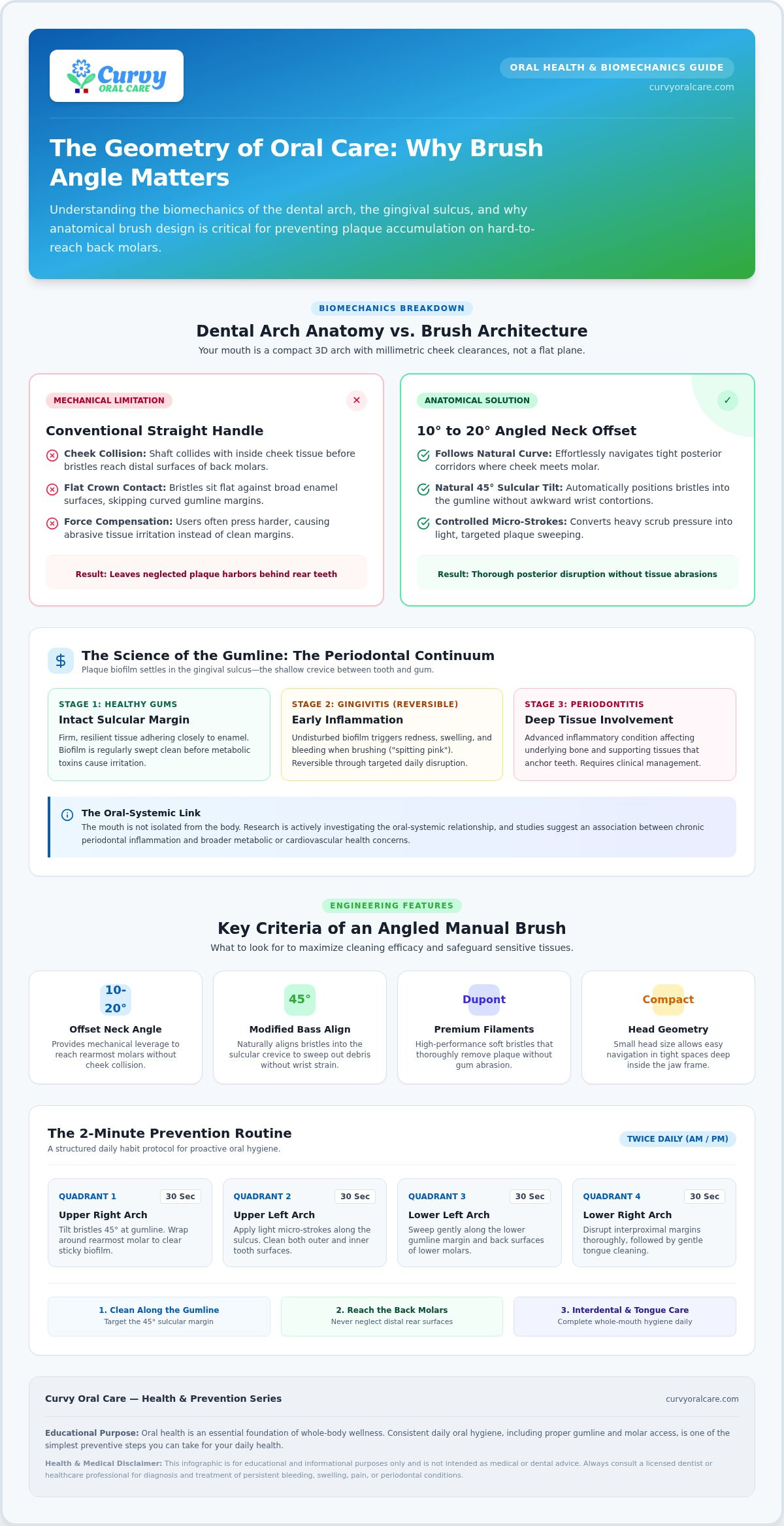
Your mouth isn't a flat surface. It's a compact, three-dimensional arch surrounded by dense cheek tissue and a narrow jaw frame. Deep inside, where the cheek meets the back molars, space shrinks to millimeters. In this anatomical blind spot, straight tools inevitably struggle. A rigid handle forces bristles flat against the broadest surfaces of your crowns, skipping right over the curved gumline margin. These neglected pockets become quiet plaque harbors, gathering sticky biofilm in spots you think you've already cleaned. An angled manual toothbrush is engineered precisely to mirror the dental arch, navigating tight corridors that flat tools simply can't negotiate.
The Problem with the Straight-Head Design
Reaching the distal, or back, surfaces of your rearmost molars requires leverage that straight handles cannot provide. As established in the evolution of manual toothbrush design and bristle configurations, flat handles force the brush head to collide with the inside cheek before reaching the tooth's far edge. To compensate for this lack of contact, many people press harder. Aggressive scrubbing doesn't dislodge hidden debris; it abrades delicate gum tissue and can accelerate gumline sensitivity. That's why your dental hygienist consistently finds stubborn plaque behind your rear teeth during checkups. The issue isn't lack of discipline, but a mechanical limitation in your brush.
Anatomy of an Angled Brush Head
Proper plaque removal at the gumline demands positioning bristles at a precise 45-degree angle toward the roots. With a straight shaft, maintaining this tilt along posterior teeth forces awkward wrist twisting and uneven contact. An angled brush head, typically built with a calculated 10 to 20-degree neck offset, naturally seats bristles into the gumline without requiring heavy hand pressure. The ergonomic handle guides your hand, turning forceful scrubbing into light, controlled micro-strokes. The Curvy angle serves as a patented solution for anatomical access, ensuring bristles wrap around back molars without irritating surrounding tissue.
The Science of the Gumline: Preventing Inflammation and Plaque
Plaque doesn't just cling to the visible enamel of your teeth; it settles along the gingival margin and creeps into the sulcus. This tiny, shallow crevice separates the tooth surface from the surrounding gum tissue. When left undisturbed, bacteria within this biofilm release metabolic byproducts that irritate soft tissues, triggering local inflammation. The mouth doesn't exist in isolation from the rest of your body. Research is actively investigating the oral-systemic link, and studies suggest an association between chronic periodontal inflammation and broader metabolic or cardiovascular health concerns. Protecting your overall vitality begins with deliberate daily habits rather than relying solely on cleanings every six months.
Understanding Periodontal Health
Periodontal conditions develop on a clear continuum. Gingivitis represents the reversible, early stage of gum inflammation, characterized by redness, swelling, and bleeding during brushing. Leaving this bacterial buildup unresolved can allow it to advance into periodontitis, an inflammatory condition affecting the tissues and underlying bone that anchor the teeth. When you spit pink in the sink, your gums aren't asking you to back off; they're signalling that microscopic biofilm needs more thorough disruption. Daily plaque management restores tissue resilience before minor irritation develops into long-term complications.
The 45-Degree Brushing Advantage
Dental professionals recommend the Modified Bass Technique to safeguard the sulcular zone. This clinical method requires tilting bristles at a 45-degree angle toward the gumline to sweep debris out of the sulcus without abrading soft tissue. As highlighted in an ADA clinical review on angled bristles, multi-angled geometries consistently outperform conventional flat configurations by reaching deep interproximal margins. A well-designed angled manual toothbrush naturally establishes this 45-degree contact without forcing you to contort your wrist, ensuring every bristle glides safely beneath the gum margin.
For everyday prevention, pairing proper technique with the Angled Adult Toothbrush Soft Bristles allows you to clean these delicate margins thoroughly. Those who prefer alternating between manual dexterity and power cleaning might also explore a complete sonic and manual care system to maintain thorough plaque defense across every surface.
What to Look for in an Angled Manual Toothbrush
Not every toothbrush on the shelf delivers equal results. An effective angled manual toothbrush relies on three essential elements: superior filament quality, compact head geometry, and ergonomic leverage. Dentists consistently recommend soft bristles because stiff, abrasive bristles can wear down enamel and contribute to gum recession. A compact, tapered head maneuvers through tight posterior spaces without jamming against your cheek or causing discomfort.
Dupont Filaments vs. Standard Nylon
Bristle material matters just as much as handle shape. Low-grade nylon filaments often feature rough, jagged tips that create microscopic scratches across enamel and lacerate vulnerable gum tissue. Premium Dupont filaments, by contrast, undergo meticulous end-rounding. This precision manufacturing produces dome-tipped fibers that safely polish tooth contours and sweep under the gumline without causing irritation. Supported by American Dental Association research on toothbrush design, high-grade filaments maintain their shape longer and resist bacterial buildup far better than generic alternatives. Kyoui incorporates these premium Dupont filaments into its patented manual lineup to protect sensitive soft tissues while maximizing daily plaque removal.
Handle Design and Ergonomics
Brushing should never feel like a wrestling match. Clunky handles force users into a fist grip, creating blunt, heavy pressure that damages the gingival margin. An intelligent handle design encourages a light "pen grasp," shifting control to your fingertips where delicate, circular vibrations happen naturally. Key ergonomic factors to evaluate include:
- Balanced neck elasticity: Absorbs excess pressure before it reaches your gums.
- Tactile non-slip grip: Maintains stable control even when wet, helping those with limited dexterity or smaller hands.
- BPA-free materials: Ensures your daily oral hygiene routine remains safe and non-toxic.
A properly weighted handle turns daily brushing from an abrasive chore into a comfortable, precision habit.
Comparing the Curvy Manual Collection: Which One is Right for You?
Every mouth presents distinct anatomical challenges. A generic brush assumes a single shape fits all arch shapes and dental needs, but targeted oral care demands purpose-built tools. The Curvy manual lineup addresses specific daily obstacles, whether you're managing tight posterior spaces, delicate bracket hardware, or a child's developing jaw. Each angled manual toothbrush in the line is completely EMF-free, lightweight, and travel-friendly, providing clinical-level plaque control wherever your routine takes you.
The Adult Angled Brush: For General Prevention
Designed for adults seeking thorough daily defense, this model targets the neglected rear molars and the delicate gingival margin. It combines the signature patented neck angle with ultra-soft Dupont filaments, sweeping away biofilm without triggering tissue sensitivity. If you've struggled with bleeding gums or that gritty sensation behind your back teeth, the Angled Adult Toothbrush Soft Bristles provides the precise reach and gentle touch needed to reset your daily standard.
The Orthoking: Precision for Braces and Dental Work
Orthodontic brackets, bands, and archwires create complex traps where food particles and plaque settle rapidly. Straight handles hit brackets head-on, missing the crucial tooth enamel tucked underneath the hardware. Engineered specifically for orthodontic wearers, bridges, and fixed retainers, the Orthoking Toothbrush For Braces uses an angled head to maneuver around brackets cleanly, protecting enamel from decalcification without bending delicate wires.
The Penguin Design: Fun Meets Function for Kids
Teaching children effective hygiene habits can be challenging, especially when smaller jaws make reaching back molars difficult for young hands and helping parents alike. The playful Penguin design turns daily brushing into an engaging experience while solving a major mechanical barrier. Featuring an ergonomic, easy-to-hold handle and gentle, rounded bristles, the 3 Angled Manual Toothbrush For Kids lets parents guide cleanings into the back corners of small mouths with complete comfort and safety.
Choosing value packs ensures your household never misses the recommended three-to-four-month replacement mark. If you also enjoy the versatility of switching between manual control and high-frequency vibrations during travel, explore the Curvy Sonic Toothbrush and Travel Combo to elevate your complete oral care regimen.
Optimizing Your Daily Routine with an Angled Brush
Owning the right tool is only half the equation; deliberate daily habits unlock its true potential. An angled manual toothbrush provides the anatomical reach, but your daily rhythm determines how effectively you disrupt bacterial colonies before they calcify into tartar. Transforming your oral hygiene into a mindful, two-minute wellness practice protects both enamel and soft tissue while elevating your whole-body health routine.
The Perfect 2-Minute Brushing Technique
A thorough cleaning requires structure. Divide your mouth into four distinct quadrants: upper right, upper left, lower left, and lower right. Dedicate thirty seconds of focused attention to each zone:
- Target the gingival margin: Rest bristles at the gumline and use a light "jiggle and sweep" motion. Vibrating the tips gently dislodges sulcular biofilm without scrubbing tissue raw.
- Clean lingual surfaces: Angle the brush vertically behind your front teeth, using brief upward flicks for lower incisors and downward flicks for upper ones.
- Clear occlusal grooves: Finish by gliding across the chewing surfaces of your molars, allowing the bristles to clear deep fissures where food debris gathers.
Beyond the Brush: A Holistic Approach
Targeted brushing is most potent when supported by complementary daily steps. Don't overlook your tongue, where a substantial portion of oral bacteria resides. Gently scraping or brushing the tongue's surface from back to front dramatically lowers overall microbial load and freshens breath naturally.
Pairing your mechanical cleaning with Curvy Natural Toothpaste reinforces daily prevention. Powered by hydroxyapatite, a biocompatible mineral mirroring natural tooth composition, this non-toxic formula remineralizes microscopic enamel defects, soothes dentin hypersensitivity near receding gums, and leaves teeth smooth against plaque attachment.
Remember that even the best bristles degrade over time. Adhering to the standard three-month replacement cycle prevents splayed filaments from losing their cleaning precision or harbouring trapped bacteria. Ready to transform your daily brushing ritual? Shop the full Manual Collection to start your journey to better gum health.
Take Control of Your Gum Health Today
Achieving a dentist-clean feel at home shouldn't involve painful scrubbing or guessing whether you've reached your rear molars. Upgrading to an angled manual toothbrush bridges the mechanical gap between human anatomy and daily hygiene. By naturally aligning with the gingival margin, the patented 45-degree angle design protects delicate tissues while disrupting stubborn biofilm. Premium, end-rounded Dupont Filaments ensure you clean effectively without risking enamel abrasion or tissue irritation.
Proactive daily prevention remains the most reliable foundation for healthy gums and whole-body vitality. Built with 100% EMF-free, non-toxic materials, modern oral care tools make consistent technique feel effortless. Explore the Curvy complete oral care collection to equip your routine with purpose-built dental solutions. Small, intentional habits practiced twice a day create profound long-term results, and your healthiest smile starts with your very next brush.
Frequently Asked Questions
Is an angled manual toothbrush better than an electric one?
Neither tool is universally superior; their value depends on accessibility and proper technique. While electric models supply rapid automated vibrations, an angled manual toothbrush excels at reaching restricted posterior corridors without requiring batteries or emitting electromagnetic fields. It gives you total tactile feedback to clean along the gumline without applying excessive pressure. Using a tool that helps you reach every surface consistently remains the best choice for oral health.
How often should I replace my manual angled toothbrush head?
You should replace your manual brush every three to four months, or sooner if the bristles flare outward. Frayed bristles lose mechanical elasticity, drastically reducing plaque removal efficiency while harboring residual microbes. If you've recently recovered from an illness, replacing your brush immediately prevents accidental re-exposure. Setting up a regular subscription or stocking multi-packs ensures you always have fresh, rounded filaments ready before your current brush degrades.
Can an angled toothbrush help with receding gums?
An angled toothbrush helps protect receding gums by reducing the need for abrasive, forceful scrubbing. Gum recession often stems from aggressive horizontal brushing with stiff bristles. The built-in neck angle naturally aligns soft filaments with the gingival margin at the clinically recommended 45-degree angle. This ergonomic alignment lets you gently sweep sulcular plaque away with light vibratory strokes, keeping exposed root surfaces clean without causing unnecessary tissue abrasion.
What makes Dupont filaments different from regular toothbrush bristles?
Dupont filaments feature microscopic end-rounding and superior structural durability compared to standard cut nylon. Generic nylon bristles frequently have jagged, sharp tips that inflict microscopic scratches on enamel and irritate delicate gingival tissue. Premium Dupont filaments undergo extensive mechanical polishing to create smooth, domed ends. They maintain their resilience in wet environments, delivering consistent, gentle plaque disruption along the gumline without fraying prematurely.
Is the Orthoking brush only for people with braces?
No, the Orthoking brush isn't limited strictly to patients wearing traditional metal braces. While engineered to clean around brackets and archwires, its targeted bristle pattern works exceptionally well for permanent lingual retainers, dental implants, crowns, and bridgework. Anyone with complex restorative work or tight interdental crowding benefits from its precise head geometry. It glides effortlessly into tight crevices where standard flat brushes struggle to make direct contact.
How do I teach my child to use an angled toothbrush correctly?
Teach your child by demonstrating a gentle "wiggle and circle" motion rather than aggressive back-and-forth scrubbing. Using an ergonomic brush like the Penguin model gives smaller hands better leverage without slipping. Encourage them to brush in front of a mirror so they can watch the bristles meet the gumline. Spend 30 seconds per quadrant together twice a day, praising their technique as they learn how easily the angled neck slips behind their back molars.
Why does the angle matter for reaching back molars?
The angle matters because the human dental arch curves into a tight space between your cheeks and jawbone. Straight handles collide with the inside of your cheek, stopping the brush head before it reaches the back surfaces of your final teeth. A calculated neck tilt bypasses this anatomical barrier. It guides soft bristles around the posterior contour, letting you disrupt hidden plaque colonies without straining your jaw or jamming hard plastic against soft tissue.
Are Curvy toothbrushes safe for people with sensitive teeth?
Yes, Curvy toothbrushes are specifically designed to protect sensitive teeth and irritated gumlines. Tooth sensitivity often worsens when stiff bristles abrade exposed dentin along the root surface. Curvy brushes utilize ultra-soft, end-rounded Dupont filaments that flex gently over teeth without scratching enamel. When paired with a non-abrasive, remineralizing hydroxyapatite toothpaste, this gentle manual design lets you clean thoroughly around sensitive margins without triggering uncomfortable nerve reactions.

Article by
Aline Peixe Nebot
Aline Peixe Nebot is a Veterinarian and passionate advocate for better oral health, committed to raising awareness of oral health as a matter of public health. She actively promotes the importance of simple, effective oral care routines and works to educate the public about the often-overlooked link between oral health and overall systemic health. Her mission is to make better oral care knowledge accessible to everyone and encourage healthier habits for life.
Disclaimer
Disclaimer: The information provided in this article is intended for general educational and informational purposes only. It is not intended to replace professional medical, dental, or healthcare advice, diagnosis, or treatment.
Some content may be AI-assisted and is provided to support health education and awareness. While we strive to share accurate and up-to-date information, health recommendations and scientific evidence can evolve, and the information presented may not apply to every individual.
The connection between oral health and overall systemic health is an important and developing area of research. Associations discussed in this article should not necessarily be interpreted as proof of cause and effect.
Always consult a qualified dentist, physician, or other healthcare professional regarding your individual health, symptoms, medications, or treatment decisions. Do not delay or discontinue professional care based on information presented in this article.
This content is for education and awareness—not diagnosis or treatment.