

Angled Toothbrush Technique for Better Gum Health
What if the reason you're still seeing bleeding gums isn't how hard you brush, but the shape of the tool you're holding? It's a common frustration for many. You follow the rules, brush twice daily, and yet your dentist still finds persistent plaque on your back molars. Traditional straight brushes often struggle to navigate the complex, organic curves of the human mouth. This leaves hidden corners vulnerable to inflammation and bacteria buildup.
Mastering a specific brushing technique for angled toothbrush designs is the structural solution to this structural problem. You deserve a preventative care routine that delivers a professional clean every morning. This guide provides the precise movements needed to reach the inner side of your teeth and the deep crevices where plaque hides. We will break down how to navigate your back molars, clear the gumline effectively, and use innovative design to your advantage. By the end, you'll have the confidence to transform your daily habit into a high performance ritual for long term oral health.
Key Takeaways
- Discover why traditional straight brushes struggle with the mouth's natural curves and how an angled design mimics professional dental tools for better access.
- Learn the "Tilt and Glide" brushing technique for angled toothbrush models to eliminate plaque from hidden corners like back molars and the inner gumline.
- Understand the oral-systemic link and how proactive gum care may be associated with supporting your long-term heart and whole-body health.
- Find out why switching to a lighter, pen-like grip prevents gum irritation while maximizing the efficiency of your daily cleaning routine.
- Explore the benefits of EMF-free sonic innovation, combining high-frequency vibrations with a non-toxic approach to modern oral care.
Why the Geometry of Your Toothbrush Matters for Your Gums
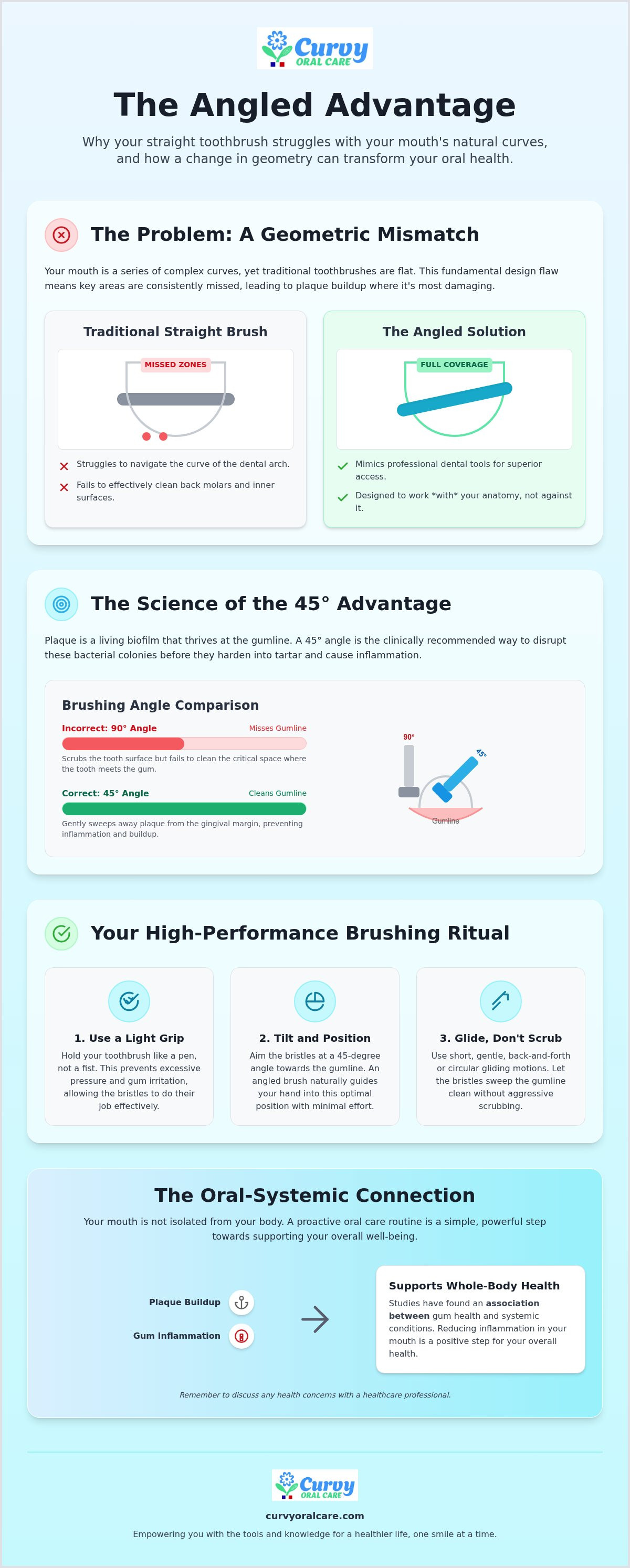
Your mouth is a series of complex, organic arches. It's a landscape of curves and tight spaces. Yet, for decades, the industry has relied on a tool shaped like a flat ruler. This geometric mismatch is the fundamental flaw of the straight toothbrush. While it works well for the flat, visible surfaces of your front teeth, it fails to navigate the tight corners where plaque actually accumulates. To maintain healthy gums, you need a tool that respects your anatomy.
The back molars are the final frontier of home care. Because they sit at the very end of the dental arch, a straight handle forces you to push your cheek outward just to make contact. This creates a shadow effect. Your front teeth and jaw structure physically block the brush from reaching the rear gumline. When access is limited, bacteria thrive, leading to inflammation that can compromise your oral-systemic health. Professional dental tools are angled for a reason; your daily brush should be too.
The Limitation of Traditional Straight Handles
Straight brushes demand awkward wrist maneuvers. You've likely felt the frustration of hitting your back teeth with the hard plastic of the brush head. This physical barrier causes most people to stop brushing exactly where the curve begins. It's not a lack of effort; it's a limitation of the tool. When you miss these zones, plaque hardens into tartar, which can only be removed by a professional. This buildup triggers gum disease, or periodontal disease, an inflammatory condition that affects the tissues supporting your teeth. It's a cycle of inefficiency that only a change in geometry can break.
Reaching the Hidden Zones of the Mouth
An angled brush mimics the precision of professional dental instruments. It functions as a lever, allowing you to reach the lingual surfaces, which are the tongue-side areas of your teeth, without straining your hand. Research on different tooth brushing techniques confirms that the angle of the bristles is just as important as the duration of the brush. A 45-degree tilt toward the gumline is necessary to sweep away the sticky film of bacteria that causes bleeding and inflammation.
Mastering a specific brushing technique for angled toothbrush tools ensures you aren't just cleaning the easy spots. The y-angled sonic toothbrush provides the necessary reach to target the four quadrants of your mouth with ease. This specialized brushing technique for angled toothbrush designs transforms a daily chore into a precision health routine. It's about working with your anatomy to create a cleaner mouth and a healthier life.
The Science of Plaque Mechanics and the 45-Degree Advantage
Plaque isn't just a cosmetic issue; it's a living biofilm. This sticky, colorless film of bacteria never stops forming on your teeth. If left undisturbed, it creates a complex colony at the gingival margin, which is the line where your teeth and gums meet. This is where the 45-degree angle becomes your most powerful defensive tool. By tilting the bristles, you aren't just cleaning the surface; you're physically disrupting the bacterial colonies hiding in the shallow groove between the tooth and the gum. This specific tilt is the secret to preventing the buildup that leads to long-term issues.
What Happens When Plaque Stays Put
When plaque stays put, it undergoes a rapid chemical transformation. Within just a few days, it absorbs minerals from your saliva and hardens into tartar, or calculus. This transition is a turning point for your oral health. Tartar provides a rough surface that attracts even more bacteria, fueling a cycle of chronic inflammation. This leads to gum disease, or periodontal disease, an inflammatory condition that can eventually cause the gums to pull away from the teeth. These resulting "pockets" become breeding grounds for infection. Effective prevention is about stopping this mineralization process before it even starts.
The Physics of the Angled Brush Head
Most people struggle to maintain the correct tilt with a straight handle. They often end up brushing at a 90-degree angle, which cleans the enamel but misses the gumline entirely. The brushing technique for angled toothbrush users is different because the tool does the geometric work for you. The slanted head naturally finds the 45-degree position, allowing the bristles to sweep under the gumline with minimal effort. This design also helps prevent the common "scrubbing" reflex that can damage your mouth.
Soft bristles act like a precision broom, gently clearing the biofilm matrix without irritating your soft tissues. Instead of using aggressive force, you use physics and precision to achieve a deeper clean. Adopting a smarter brushing technique for angled toothbrush designs, especially when paired with a Y-angled sonic toothbrush, ensures your daily routine is both safe and effective. It's a simple shift in movement that protects your enamel while prioritizing the health of your gums every single day.
Mastering the Brushing Technique for Angled Toothbrushes
Success with an angled brush isn't about force; it's about finesse. Most people instinctively grip their toothbrush like a hammer, applying excessive pressure that can actually wear down enamel and irritate gum tissue. Instead, you should hold your brush with a light, "pen-like" grip. This subtle shift in your brushing technique for angled toothbrush use allows for micro-adjustments in the angle, ensuring the bristles stay in constant contact with the varying contours of your teeth.
To ensure total coverage, start with the most difficult areas first. Begin at the very back of your furthest molars while you are most focused. By the time you reach the front teeth, which are easier to see and clean, you've already conquered the "final frontier" of your mouth. This sequence prevents the common habit of rushing through the hidden corners at the end of the two minutes. It turns a reactive habit into a proactive health ritual.
Step-by-Step: The 2-Minute Precision Routine
Divide your mouth into four quadrants: upper right, upper left, lower right, and lower left. Spend exactly 30 seconds on each. Place the angled head at the gumline, allowing the pre-set tilt to nestle the bristles into the gingival groove. Use small, circular motions rather than long, horizontal strokes. This "Tilt and Glide" method disrupts the biofilm without scraping the gums. As you move along the arch, let the handle's natural curve guide you. The design of a y-angled sonic toothbrush ensures that even when you reach the back, your wrist stays in a neutral, comfortable position.
Cleaning the Difficult 'Inside' Curves
The lingual, or tongue-side, surfaces of your teeth are notorious for plaque buildup. For the lower front teeth, where tartar often forms first, use the tip of the angled brush head. Position the brush vertically and use a gentle "flick" motion to clear debris from the interdental spaces. Don't forget the very back surface of your last molar. Reach around the tooth and pull the brush forward slightly to sweep that hidden rear wall. Mastering this specific brushing technique for angled toothbrush tools ensures that every quadrant feels as clean as a professional dental visit. It's about precision care that targets the areas where traditional brushes simply can't reach.
Whole-Body Wellness: The Oral-Systemic Connection
Your mouth is not an isolated system. It functions as the primary gateway to your entire body, including your digestive and respiratory tracts. Research suggests that the health of your gums may be associated with your overall physical well-being. When bacteria accumulate in hard-to-reach areas, they don't just stay on the tooth surface. They can trigger inflammation in the soft tissues of the gums. This inflammation can make the gum tissue more permeable, potentially allowing bacteria to enter the bloodstream. Studies have found an association between this process and systemic inflammation. This inflammation may be linked to heart wellness and other whole-body concerns. Mastering a precise brushing technique for angled toothbrush use is more than a cosmetic choice. It's a fundamental health strategy for long-term vitality.
Understanding the Association, Not Just the Cause
Chronic inflammation is the body’s alarm system. When your gums bleed or swell, it's a sign that your immune response is working overtime. Research is investigating the relationship between oral bacteria and systemic inflammation, which affects the entire body. Gum disease, also known as periodontal disease, is an inflammatory condition affecting the tissues that support the teeth. While scientists are still studying whether one causes the other, the link between gum health and metabolic wellness is a growing area of focus. Translating "systemic" into "whole-body" wellness helps us see that a clean gumline is a vital barrier. By keeping these areas clear of plaque, you are supporting your body's natural defenses and overall immune health.
Small Habits, Big Impact
Two minutes of precision care twice a day supports a healthy lifestyle. In 2026, 91% of adults report that oral health is extremely important to their overall well-being. Using an angled brush head allows you to reach the back molars and the inner gumline where traditional tools often fail. This prevents the "hidden" inflammation that often goes unnoticed until a dental visit. By adopting a proactive brushing technique for angled toothbrush models, you turn a mundane chore into a high-performance longevity ritual. It's about more than a bright smile. It's about the psychological confidence that comes from knowing your preventative care is complete. Prevention is always more effective than reactive treatment. If you're ready to evolve your routine, the y-angled sonic toothbrush offers the structural solution needed for true whole-body prevention.
Elevating Your Routine with EMF-Free Sonic Innovation
The history of oral care has evolved from basic manual sticks to high-frequency sonic precision. While manual tools depend entirely on your hand movement, sonic technology introduces mechanical efficiency that manual brushing cannot match. The next necessary evolution in this journey is the shift toward safe, non-toxic innovation. EMF-free technology addresses a modern concern: reducing unnecessary electromagnetic exposure while maintaining superior performance. By combining an ergonomic angled head with high-frequency vibrations, you achieve a level of clean that is both technologically advanced and deeply practical.
The Curvy approach centers on precision, safety, and access. Traditional sonic brushes often omit the ergonomic needs of a curved mouth, focusing only on power. By integrating a patented angle with sonic vibrations, you ensure that the energy of the brush is directed exactly where it's needed most. This synergy allows you to master a brushing technique for angled toothbrush use that feels effortless yet delivers professional-grade results every morning.
The Power of Gentle Sonic Vibrations
Sonic waves do more than just move bristles. They create micro-bubbles in your saliva that reach deep between the teeth and under the gumline. This fluid dynamics effect helps disrupt plaque in areas where bristles might not physically touch. For those with receding gums, these gentle vibrations are far safer than the aggressive scrubbing often associated with manual tools. Learn more about the Y Angled Sonic Toothbrush EMF-Free and how it integrates these safety features into its patented design.
Your Proactive Prevention Checklist
A high-tech tool is most effective when paired with a disciplined routine. Use this checklist to ensure your preventative care is complete:
- Brush twice daily using a proper brushing technique for angled toothbrush models to target difficult back molars.
- Don't neglect the gumline; it's the foundation of your tooth's support system.
- Clean your tongue and use interdental tools to remove hidden bacteria colonies.
- Maintain regular dental visits for professional evaluation and care.
Healthy gums are the essential foundation of your well-being. They serve as a protective barrier for your entire body, supporting your oral-systemic health. When you master the correct movements and pair them with sonic innovation, you aren't just cleaning your teeth. You're taking a simple, practical step toward a healthier lifestyle and long-term quality of life.
Take Control of Your Oral Health Future
Your oral health journey is a series of small, daily decisions. You've learned that standard tools often fail to navigate the organic curves of your mouth. By mastering a precise brushing technique for angled toothbrush designs, you eliminate the hidden plaque that traditional brushes miss. This isn't just about a cleaner feeling; it's about protecting your whole-body wellness. Research suggests that maintaining healthy gums is a vital foundation for your systemic health.
You now have the knowledge to reach every molar and protect your gumline with confidence. It's time to replace outdated habits with a modern, science-backed solution. Our patented design provides superior access to difficult spots while our EMF-free technology offers peace of mind for your daily routine. This evolution in your care routine ensures that every brush stroke is gentle yet effective for your delicate gum tissue.
Upgrade to the Y Angled Sonic Toothbrush for a deeper, safer clean. Your gums are the foundation of your smile; give them the precision care they deserve today.
Frequently Asked Questions
Is an angled toothbrush better than a straight one for plaque removal?
Yes, an angled toothbrush is superior for plaque removal because it aligns with the organic curves of the human mouth. Straight brushes often miss the back molars due to jaw geometry. The angled design acts like a precision lever, allowing you to reach the lingual surfaces and the deep corners where bacteria hide. This structural advantage ensures that your daily routine is more efficient and results in a professional-clean feeling every morning.
How do I hold an angled toothbrush properly at a 45-degree angle?
You should hold an angled brush with a light, pen-like grip rather than a tight fist. This allows for better finesse and control. The primary brushing technique for angled toothbrush users involves letting the pre-set angle of the head do the work. Simply place the bristles at the gumline and they will naturally sit at the required 45-degree tilt. Use small, circular motions to disrupt plaque without irritating the soft tissues.
Can an angled toothbrush help with receding gums?
An angled toothbrush is a valuable tool for those with receding gums. Because the design allows for better access, you don't need to apply excessive pressure to reach difficult spots. High-frequency sonic vibrations provide a deep clean that is far gentler than the aggressive scrubbing often seen with manual tools. This precision helps you maintain a healthy gumline without causing further damage to delicate tissues or wearing down your enamel.
Why is it so hard to reach my back molars with a regular brush?
Reaching back molars is difficult because straight handles create a "shadow effect" where front teeth block access. Your cheek and jaw structure physically limit the movement of a straight tool at the end of the dental arch. An angled head solves this by bypassing these barriers. It allows the bristles to wrap around the back of the last molar, ensuring that the "final frontier" of your mouth receives the same care as your front teeth.
What is an EMF-free sonic toothbrush and why does it matter?
An EMF-free sonic toothbrush provides high-frequency vibrations to clean teeth without generating electromagnetic fields. This is an important evolution for users who prioritize non-toxic, holistic health. Traditional electric models can create EMF exposure close to the head and brain. By choosing an EMF-free option, you get the plaque-disrupting power of sonic waves while maintaining a proactive, safety-first approach to your long-term physical well-being and daily self-care rituals.
How often should I replace the head on my angled sonic toothbrush?
You should replace your brush head every three to four months to ensure optimal performance. Bristles eventually become frayed and lose their ability to sweep away plaque effectively. If you notice the bristles are splayed or you've recently been ill, it's best to swap the head sooner. Consistent replacement is a simple, practical step that maintains the integrity of your brushing technique for angled toothbrush use and keeps your routine hygienic.
Does brushing at an angle help prevent gum disease?
Brushing at a 45-degree angle is the most effective way to prevent gum disease, also known as periodontal disease. This specific tilt allows bristles to enter the shallow groove between the tooth and the gum, known as the gingival margin. Disrupting the sticky biofilm in this area prevents it from hardening into tartar. Since tartar can only be removed by a dentist, keeping this zone clear through daily precision is your best defense against inflammation.
Should I use an angled brush if I have braces or dental work?
Yes, an angled brush is highly effective for those with braces, crowns, or other dental work. The specialized head provides better access around brackets and wires where food particles and plaque often get trapped. It allows you to clean the gumline more thoroughly without the brush head getting caught on dental hardware. This makes it a smart choice for maintaining both your natural teeth and your investment in professional dental procedures.

Article by
Aline Peixe Nebot
Aline Peixe Nebot is a Veterinarian and passionate advocate for better oral health, committed to raising awareness of oral health as a matter of public health. She actively promotes the importance of simple, effective oral care routines and works to educate the public about the often-overlooked link between oral health and overall systemic health. Her mission is to make better oral care knowledge accessible to everyone and encourage healthier habits for life.
Disclaimer
Disclaimer: The information provided in this article is intended for general educational and informational purposes only. It is not intended to replace professional medical, dental, or healthcare advice, diagnosis, or treatment.
Some content may be AI-assisted and is provided to support health education and awareness. While we strive to share accurate and up-to-date information, health recommendations and scientific evidence can evolve, and the information presented may not apply to every individual.
The connection between oral health and overall systemic health is an important and developing area of research. Associations discussed in this article should not necessarily be interpreted as proof of cause and effect.
Always consult a qualified dentist, physician, or other healthcare professional regarding your individual health, symptoms, medications, or treatment decisions. Do not delay or discontinue professional care based on information presented in this article.
This content is for education and awareness—not diagnosis or treatment.