
Angled Toothbrush for Lingual Surfaces: Buying Guide
Can a different brush angle make the inside surfaces of your teeth easier to reach? If brushing behind your front teeth feels awkward, you’re not alone. An angled toothbrush for lingual teeth surfaces may improve access, but the angle alone doesn’t guarantee a thorough clean. Comfort, control, and technique matter too.
This guide explains what an angled brush can and can’t do, and what to consider when choosing one. Compare how the brush feels in your hand, whether you can guide it comfortably around your mouth, and how its bristles reach the inner tooth surfaces.
You’ll also find practical steps for cleaning the tongue-facing sides of your teeth. For the front teeth, a vertical brush position and gentle up-and-down strokes can help. A complete routine also includes the gumline, the spaces between teeth, and the back molars. The goal is to make daily brushing manageable while giving every tooth surface and your gum health thoughtful attention.
Key Takeaways
- Lingual surfaces face the tongue and can be easy to miss when brushing by feel alone.
- An angled toothbrush for lingual teeth surfaces may help with access, but comfort and control matter more than the angle by itself.
- Compare manual and sonic options by how they fit your routine, and choose a brush you can guide gently without awkward wrist movement.
- Use a steady brushing sequence to cover inner front teeth, back teeth, and the gumline without rushing or pressing hard.
- Curvy angled toothbrushes are designed to help reach difficult areas as part of a daily routine, alongside cleaning between teeth and regular dental care.
Why Lingual Tooth Surfaces Are Easy to Miss
The inner surfaces of your teeth are easy to overlook because they’re harder to see than the fronts that face your lips and cheeks. Dentists call the tongue-facing sides the lingual surfaces. Every tooth has a lingual surface, and each needs attention during daily brushing.
Where lingual surfaces are and why access feels awkward
On the visible front of a tooth, it’s easier to see where the bristles are going. On the inside, your tongue, the shape of your mouth, and the position of each tooth can make brush placement less intuitive. You may need to adjust the brush or your wrist, particularly behind the lower front teeth and around the back teeth.
If reaching an area feels awkward, slow down instead of scrubbing harder. Position the bristles deliberately so they contact the inner tooth surface. The Toothbrush overview describes general toothbrush types and use. Whatever style you choose, careful positioning matters. An angled toothbrush for lingual teeth surfaces may help guide the bristles into areas that feel difficult to reach, but the design alone can’t ensure every surface gets cleaned.
Why the gumline belongs in the conversation
Plaque is a sticky film that builds up on teeth. When it remains around the gumline, it may irritate the gum tissue over time and contribute to inflammation. So brushing the inner surfaces means more than passing over the middle of each tooth. Give the edge where tooth and gum meet gentle, close attention too.
Take particular care behind the lower front teeth and along the inner gumline, where brush placement can feel unfamiliar. Include the back teeth, which can be easy to miss. Use controlled strokes and let the bristles do the work rather than pressing forcefully against your teeth or gums.
A clean-looking smile isn’t the same as a complete brushing routine: the tongue-facing surfaces and gumline need attention too. The visible fronts are only part of the picture. Brush all tooth surfaces, including those you can’t easily see, and clean between your teeth as part of your routine. If a spot remains difficult to reach or brushing causes persistent bleeding or discomfort, ask a dental professional for guidance.
How an Angled Toothbrush Can Help Reach Inner Tooth Surfaces
An angled head changes how the bristles approach a tooth. For areas that feel awkward to reach, such as the tongue-facing sides of the lower front teeth or the inner surfaces of back teeth, the changed position may make it easier to guide the brush. Think of the angle as an access aid, not a shortcut to a complete clean.
What the angle changes during brushing
As you move from the outer to the inner surfaces, turn the handle slightly or adjust your wrist until the bristles sit comfortably against the tooth and near the gumline. An angled head may help you find that position without forcing your hand, though what feels natural depends on your mouth and grip. If a position feels strained, adjust the brush or use a smaller, more controlled movement.
Head design and brushing technique are related, but they aren’t the same. The American Dental Association advises tilting the brush vertically to clean the inside surfaces of the front teeth, using several gentle up-and-down strokes. For other surfaces, its guidance describes placing the brush at a 45-degree angle to the gums and using short, gentle back-and-forth strokes. These technique cues apply whether your toothbrush head is angled or straight.
Keep the bristles in light contact with your teeth. Pressing harder or scrubbing quickly doesn’t improve access and can make it harder to control where the brush is going. Pause at the inner front teeth, then move along the tooth surfaces and gumline in an orderly pattern to help avoid skipping an area.
What an angled toothbrush cannot do on its own
An angled head doesn’t guarantee plaque removal, prevent gum disease, or ensure that every area gets brushed. A brush can only clean the surfaces its bristles reach, and each surface still needs consistent, deliberate attention. Cleaning between teeth and keeping up with routine dental visits remain important parts of oral care.
Brush design can support access, but it can’t replace a consistent technique. Curvy Oral Care offers an angled sonic toothbrush and toothpaste combo as one option for a daily routine. Choose tools you can handle comfortably, then focus on gently covering every surface, including the gumline.
How to Compare Angled Toothbrushes for Lingual Cleaning
A useful brush is one you can position comfortably and use consistently. An angled head may help you approach tongue-facing surfaces, but compare the whole brushing experience: the format, grip, bristles, and how easily you can guide the head along each tooth and the gumline.
Manual or sonic: which format fits your routine?
A manual brush gives you direct control over each stroke and needs no powered operation. A sonic toothbrush provides powered brushing, which some people may prefer as part of their routine. Neither format is automatically the right fit for everyone, and the label alone doesn’t establish better cleaning. See the angled sonic toothbrush to consider how that format might fit your preferences.
With either type, consider whether you can steady the handle and move the head around your mouth without straining your wrist. Think about brushing behind the lower front teeth, along the inner gumline, and around the back teeth. If an angle makes those movements feel more natural, it may be a useful access feature. If you have to twist your hand or press harder to reach, it may not suit your grip.
Comfort, bristles, and head positioning
Soft bristles are a practical comfort consideration, not a treatment for gum problems. Firmer bristles aren’t automatically better. Choose a brush that lets you use gentle pressure and controlled movements. Curvy’s angled adult toothbrush with soft bristles is one option if you prefer a manual brush.
Use this comparison to separate features you can assess yourself from claims that need clinical evidence:
| What to compare | What to look for | What it doesn’t prove |
|---|---|---|
| Head angle | Can you guide bristles to inner surfaces without awkward wrist movement? | That the angle alone removes more plaque or prevents gum disease. |
| Manual or sonic format | Does the brushing style feel manageable and fit your routine? | That one format is universally more effective. |
| Bristle feel and grip | Can you hold the brush comfortably and use light pressure? | That firmer bristles clean better or soft bristles treat gum conditions. |
When comparing an angled toothbrush for lingual teeth surfaces, prioritize comfortable access and reliable technique over dramatic promises. A design can help you position a brush, but careful, consistent brushing is what covers the tooth surfaces and gumline. Claims about clinical outcomes require supporting evidence, not just an angled shape or feature description.
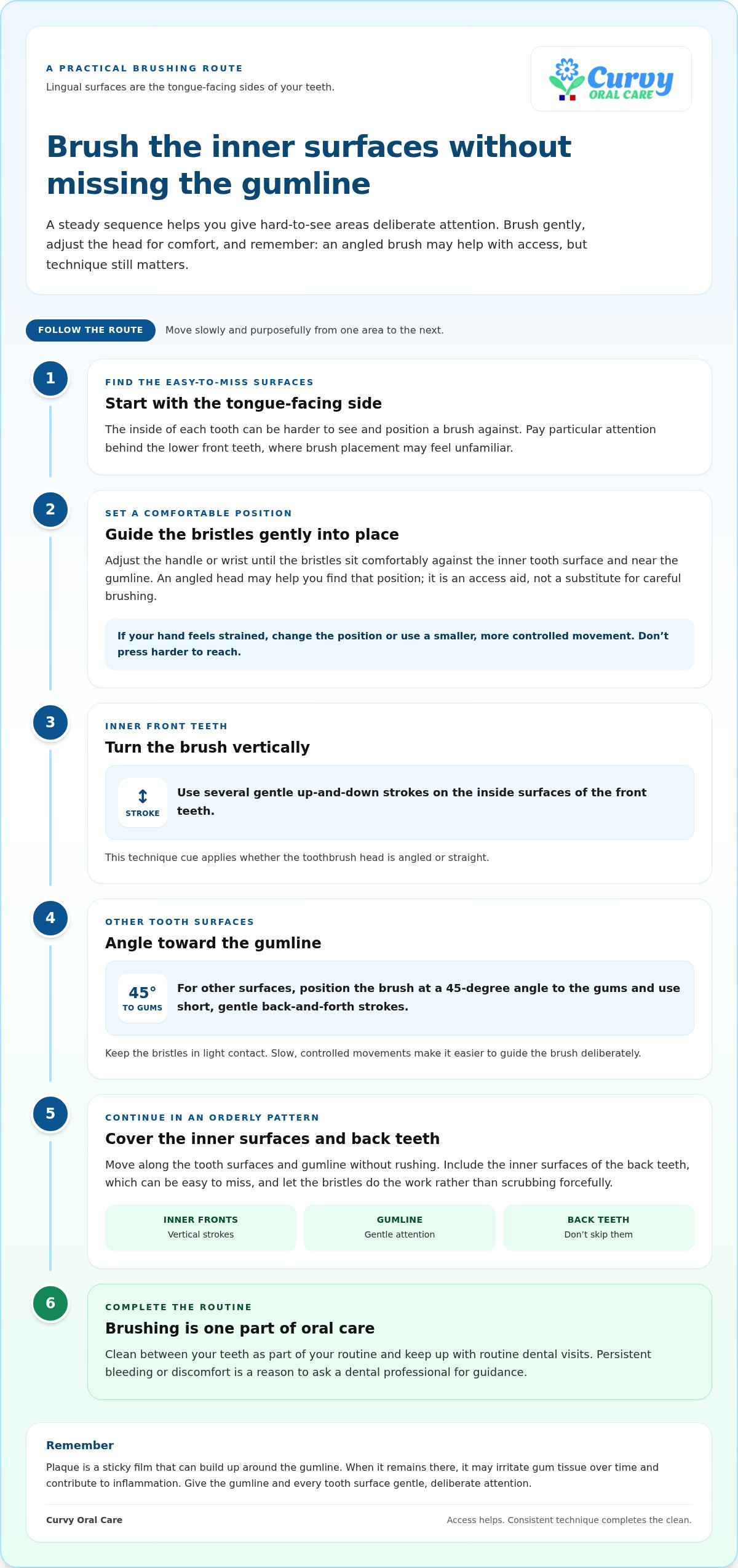
How to Brush Lingual Surfaces Without Missing the Gumline
A simple route through your mouth can make inner surfaces easier to cover. Brush twice a day for two minutes, using gentle pressure. Guide the bristles along each tooth and its gumline rather than scrubbing hard.
A simple sequence for the tongue-facing surfaces
Start with the inside of your lower front teeth, then move across the upper front teeth and continue to the inner surfaces of your back teeth. Following the same route each time can help you avoid skipping a section. At each area, direct the bristles toward the gumline and use small, controlled movements.
- Lower front teeth: Turn the brush vertically if that helps you reach behind the teeth. Use gentle up-and-down strokes, moving gradually across the row.
- Upper front teeth: Keep the handle comfortable and use the same vertical approach if needed. Avoid forcing your wrist into an awkward position.
- Back teeth: Guide the brush head to the inner surfaces one area at a time. Pause long enough to reach the gumline without pressing into the tissue.
For other tooth surfaces, use short, gentle strokes and keep the bristles near the gumline. If an angled toothbrush for lingual teeth surfaces feels easier to position, use that access to brush deliberately rather than rushing. Comfort and control matter more than force.
Complete the routine beyond brushing
Brushing doesn’t fully clean the narrow spaces between teeth. Add interdental cleaning to your daily routine, using a suitable method to reach those areas. Clean your tongue as an additional step, not as a replacement for brushing or caring for your gums. Regular dental visits also support preventive care and give you a chance to get advice suited to your needs.
Pay attention to changes rather than trying to diagnose them yourself. Persistent bleeding, swelling, pain, or other notable changes are reasons to seek professional dental advice.
A consistent routine is built from small, repeatable actions: brush all surfaces gently, include the gumline, clean between teeth, and don’t skip your tongue. If a sonic brush and toothpaste combo suits your routine, explore the sonic toothbrush and toothpaste combo.
Choosing a Curvy Angled Toothbrush for Your Daily Routine
A useful toothbrush should fit your hand, your mouth, and the way you brush every day. Curvy Oral Care shares practical oral-health education and offers angled toothbrushes designed to help users reach areas that can be difficult to access with a conventional straight brush. The angle is an access feature, not a substitute for careful brushing or professional dental advice.
When an angled sonic toothbrush may suit your routine
If the inner surfaces of your front teeth or the backs of your molars feel awkward to reach, an angled head may make it easier to position the bristles. Comfort varies from person to person, so focus on whether you can guide the brush smoothly to each surface and along the gumline without twisting your wrist or pressing harder. An angled sonic toothbrush is one option if you prefer a powered brush; its design doesn’t guarantee a particular plaque-removal or gum-health outcome.
Curvy’s angled sonic toothbrush combines an angled design with sonic brushing. Whichever brush you choose, use gentle pressure and work methodically across the inner, outer, and chewing surfaces. Continue cleaning between teeth and keep regular dental visits as part of your routine.
A practical next step toward consistent oral care
Choose based on four things: access to hard-to-reach surfaces, comfort in your hand and mouth, gentle technique you can maintain, and routine fit that makes daily brushing manageable. An angled toothbrush for lingual teeth surfaces can support positioning, but steady habits help you give each area consistent attention.
If a sonic brush and toothpaste combination fits the routine you’re building, explore the sonic toothbrush and toothpaste combo as an option. Choose a brush that feels comfortable to use, then focus on thorough, gentle brushing and complete daily care.
Make Inner-Surface Brushing a Steady Habit
Inner tooth surfaces can be awkward to reach, but a thoughtful routine can help you clean them with more confidence. An angled toothbrush for lingual teeth surfaces may offer useful access. The right choice still depends on comfort, control, and whether you can guide the bristles gently along every surface and the gumline.
Curvy Oral Care offers angled manual and sonic toothbrushes, with a focus on education, prevention, and access to difficult-to-reach areas. Oral health is part of overall health, and research continues to explore links between conditions in the mouth and the rest of the body. Reported associations don’t necessarily mean one causes the other. An angled design can support brushing technique, but it doesn’t replace consistent brushing, cleaning between teeth, or regular dental care.
Build the habit with gentle, methodical brushing and attention to the gumline, inner surfaces, and back teeth. To make an angled sonic brush and toothpaste part of your routine, explore Curvy’s sonic toothbrush and toothpaste combo.

Article by
Aline Peixe Nebot
Aline Peixe Nebot is a Veterinarian and passionate advocate for better oral health, committed to raising awareness of oral health as a matter of public health. She actively promotes the importance of simple, effective oral care routines and works to educate the public about the often-overlooked link between oral health and overall systemic health. Her mission is to make better oral care knowledge accessible to everyone and encourage healthier habits for life.
Disclaimer
Disclaimer: The information provided in this article is intended for general educational and informational purposes only. It is not intended to replace professional medical, dental, or healthcare advice, diagnosis, or treatment.
Some content may be AI-assisted and is provided to support health education and awareness. While we strive to share accurate and up-to-date information, health recommendations and scientific evidence can evolve, and the information presented may not apply to every individual.
The connection between oral health and overall systemic health is an important and developing area of research. Associations discussed in this article should not necessarily be interpreted as proof of cause and effect.
Always consult a qualified dentist, physician, or other healthcare professional regarding your individual health, symptoms, medications, or treatment decisions. Do not delay or discontinue professional care based on information presented in this article.
This content is for education and awareness—not diagnosis or treatment.